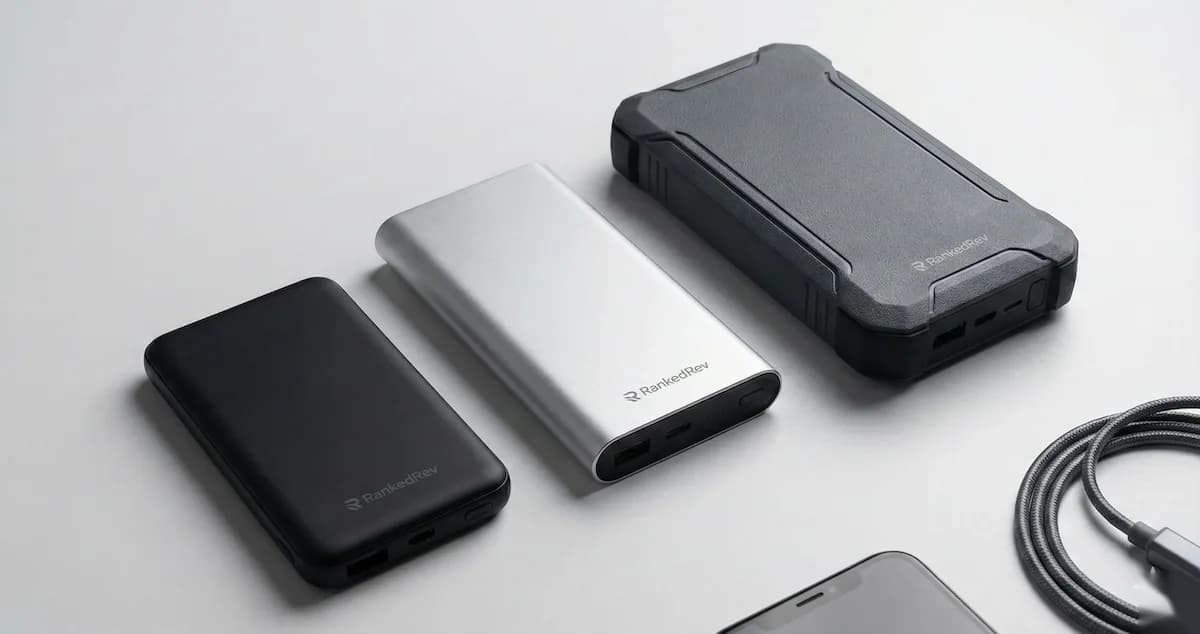
Best Power Banks in 2026
From slim pocket chargers to high-capacity laptop power banks, we tested the best portable chargers for speed, size, and reliability.

Power Banks Are Essential Travel Gear: But Most People Buy the Wrong One
The power bank market in 2026 is massive and confusing. There are thousands of options ranging from $15 lipstick-sized chargers to $150 laptop-charging bricks, and the spec sheets are filled with numbers that are easy to misinterpret. A "20,000mAh" power bank sounds like it should charge a 5,000mAh phone four times, but in practice, you will get roughly 3 to 3.5 full charges due to voltage conversion losses and heat dissipation. A "100W output" power bank sounds like it can fast-charge your laptop, but only if the USB-C cable you are using supports that wattage.
I have been testing power banks across real-world scenarios for months: long-haul flights, multi-day camping trips, conference days where outlets are scarce, and the daily grind of keeping a phone, earbuds, and smartwatch charged on the go. The differences between good and mediocre power banks are significant and show up quickly under real use. For the complete ranked list with detailed scoring, visit our best power banks category page.
What to Look For in a Power Bank
These are the specs and features that actually matter, and they are the same criteria behind our scoring methodology.
Capacity: mAh vs Wh. Milliamp-hours (mAh) is the standard capacity metric, but it is misleading for comparisons. mAh is measured at the battery's internal voltage (typically 3.7V), not at the USB output voltage (5V or higher). A 20,000mAh power bank actually delivers about 13,000-14,000mAh of usable charge at 5V output. Watt-hours (Wh) is a more honest metric: 20,000mAh at 3.7V = 74Wh. If you need to charge a 15Wh phone (like a modern iPhone), a 74Wh power bank gives you roughly 4.5 full charges after efficiency losses. Always calculate with a 15-20% efficiency loss.
Output wattage. This determines how fast the power bank charges your devices. Standard USB-A ports max out at 12-18W. USB-C with Power Delivery (PD) reaches 30W, 45W, 65W, or even 140W+ depending on the power bank. For phones, 20-30W is plenty for fast charging. For laptops, you need at least 45W (and preferably 65-100W) to charge while using the laptop. A power bank that can only deliver 18W will technically charge a laptop, but so slowly that the laptop drains faster than it charges under load.
Charging speed (input). How fast the power bank recharges itself matters more than people realize. A 20,000mAh power bank that takes 10 hours to recharge via a slow 10W input is a power bank you forget to charge. The best models accept 45-65W input and recharge in 90 minutes to two hours. If you only have a few hours between uses, airport layovers, overnight at a hotel, fast input charging is essential.
Port configuration. Count the USB-C and USB-A ports and check the total combined output. Most power banks split their maximum wattage across ports, a "100W" power bank might deliver 100W from one port, but only 65W + 30W when two ports are in use simultaneously. Built-in cables eliminate the need to carry separate charging cables, but check that they support your devices (Lightning/USB-C) and that the cables are rated for fast charging.
Size, weight, and airline compliance. Power banks above 100Wh (roughly 27,000mAh) are restricted on flights, most airlines limit you to two power banks under 100Wh in carry-on luggage, with no power banks allowed in checked bags. A 20,000mAh power bank at 74Wh is well within limits. For frequent travelers, staying under 100Wh simplifies airport security and avoids confiscation.
Passthrough charging. This lets you charge the power bank and your devices simultaneously, plug the power bank into a wall outlet and your phone into the power bank. It is surprisingly useful in hotels and airports where outlets are limited. Not all power banks support passthrough, and some that do reduce output wattage while recharging.
Our Top Picks
Anker Prime 26K 300W: Best Overall
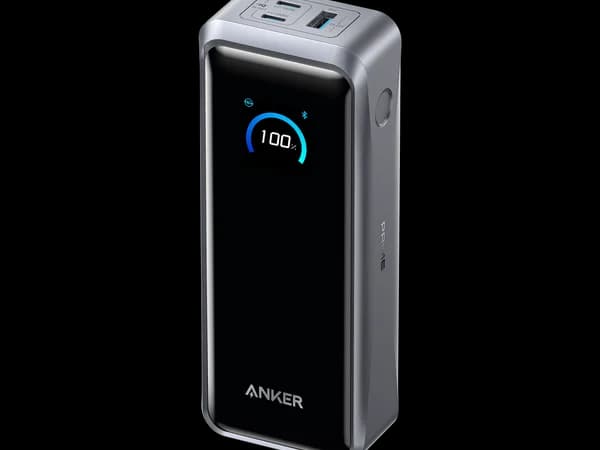
The Anker Prime 26K is the most capable power bank I have tested, and it solves the core problem that plagues most portable chargers: it charges everything fast, including laptops. The 300W total output (140W maximum from a single USB-C port) means it can fast-charge a MacBook Pro 16-inch at near-wall-charger speeds. That is not an incremental improvement, it fundamentally changes what a power bank can do. Instead of trickling power to keep a laptop alive, the Prime actively charges it from dead to usable in under an hour.
The 25,600mAh (approximately 96Wh) capacity sits just under the 100Wh airline limit, which is intentional. You get the maximum capacity allowed on flights without the hassle of declarations or restrictions. In my testing, that capacity delivered about 4.5 full phone charges or kept a MacBook Air running for an additional 6-7 hours of work.
The smart digital display shows remaining capacity in both percentage and estimated hours for connected devices, plus individual port wattage readouts. It is the most informative display I have seen on a power bank and eliminates the guesswork about how much charge you have left and how fast your devices are receiving power.
Recharging the Prime itself is fast: 0-80% in about 30 minutes with a compatible charger, thanks to the 170W input. That speed means you can top off the power bank during a lunch break and have it nearly full for the afternoon.
The trade-off is size and weight. The Prime 26K is not a pocket power bank, it weighs about 1.5 lbs and has the footprint of a thick smartphone. The two USB-C ports and one USB-A port cover most use cases, but there is no built-in cable. For power users who need to charge laptops on the go and want the fastest, most capable portable charger available, the Prime 26K is the clear pick. See our full review for the complete charging benchmarks.
Anker Zolo 20K 45W: Best Built-In Cables
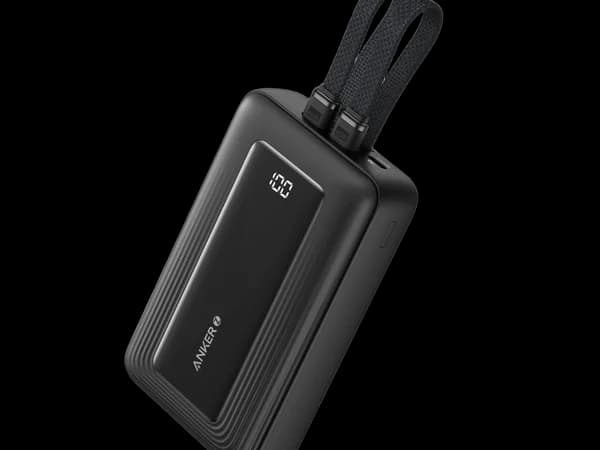
The Zolo 20K solves the most common power bank annoyance: forgetting the cable. It has built-in USB-C and Lightning cables tucked into the body of the unit, which means you grab the power bank and you are ready to charge, no digging through your bag for a cable, no realizing you left it plugged into the hotel wall outlet.
The 20,000mAh capacity delivers about 3.5 full charges for a modern smartphone, which covers a full day of heavy use or two days of moderate use. The 45W maximum output is enough to fast-charge any phone and can slowly charge tablets and lightweight laptops, though it will not keep a power-hungry laptop running under load.
The built-in cables support fast charging on both USB-C and Lightning devices, which means iPhone and Android users are covered without carrying any additional accessories. There is also a USB-C port for devices that need a cable connection, bringing the total simultaneous charging to three devices.
The form factor is slim and pocketable for a 20,000mAh unit. The integrated cables add slight bulk but keep everything self-contained. Passthrough charging works well, and the LED display shows remaining capacity clearly.
The limitation is charging speed for more demanding devices. At 45W maximum, this is firmly a phone and small device charger. If you need to charge a laptop, the Anker Prime is the better choice. But for the majority of people who just need to keep their phone alive through a long day, commuters, travelers, conference attendees, the Zolo 20K's built-in cables and solid capacity make it the most practical daily carry option. Read our full review for the cable durability assessment.
Baseus Blade Laptop 100W 20K: Best for Laptops
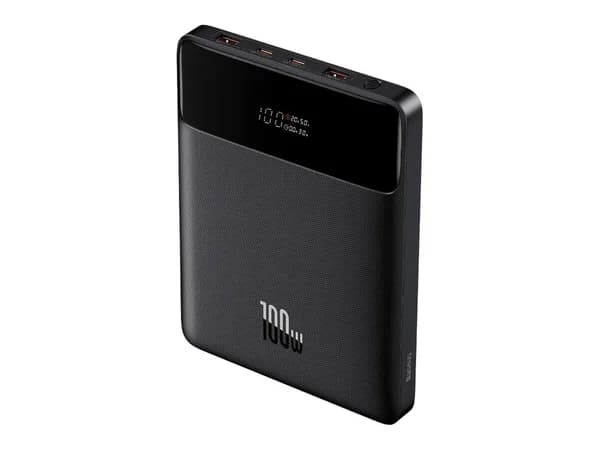
The Baseus Blade takes a different approach to laptop charging portability: make the power bank as thin as possible. At about 0.7 inches thick, the Blade is the slimmest laptop-capable power bank I have tested. It slides into a laptop sleeve alongside your computer without adding noticeable bulk, which makes it the most travel-friendly option for people who carry a laptop bag.
The 100W USB-C output is genuinely useful for laptops. It charges a MacBook Air at full speed and can charge a MacBook Pro 14-inch at a reasonable rate. The 20,000mAh (74Wh) capacity adds roughly 4-5 hours of productivity to a MacBook Air or 3-4 hours to a MacBook Pro, which can be the difference between making it through a cross-country flight or running out mid-work.
The slim form factor means heat management is a consideration. Under sustained 100W output, the Blade gets warm, not hot enough to be concerning, but noticeably warmer than thicker power banks with more surface area for heat dissipation. The output steps down slightly when the unit reaches its thermal threshold, which is a sensible safety measure.
Two USB-C ports and one USB-A port handle multi-device charging, and the digital display shows remaining capacity and output wattage. Input charging accepts up to 65W, which recharges the unit in about 90 minutes.
The trade-off versus the Anker Prime is output wattage (100W vs 300W) and features. The Prime is more powerful and has a smarter display. The Baseus Blade is thinner, lighter, and more travel-friendly. For people who need a slim laptop charger for travel and do not need the Prime's extreme output, the Blade is the practical choice. See our full review for the thermal throttling analysis.
INIU 45W 20000mAh: Best Budget

INIU has carved out a reputation for delivering reliable power banks at prices that undercut the major brands significantly. The 45W 20000mAh model is the current sweet spot in their lineup, it offers USB-C Power Delivery at 45W, 20,000mAh of capacity, and a build quality that punches above its price point.
The 45W USB-C output fast-charges modern iPhones and Samsung Galaxy devices at their maximum speeds, and can provide a slow but steady charge to tablets and lightweight laptops. The 20,000mAh capacity delivers roughly 3.5 full phone charges, consistent with the category. An LED display shows remaining capacity as a percentage, which is more useful than the four-dot LED indicators still found on some budget competitors.
Build quality is solid for the price. The matte finish resists fingerprints, the ports feel sturdy, and the unit has held up well through months of daily carry. INIU includes a USB-C cable in the box, which saves you a separate purchase. Passthrough charging is supported, and the power bank recharges itself in about 2.5 hours with a 45W charger.
Where the INIU falls short compared to the Anker options is polish and smart features. There is no wattage display, no real-time output monitoring, and the single USB-C plus single USB-A port configuration is more limited than the Anker Zolo's built-in cables. The charging circuitry is also less sophisticated, the INIU does not negotiate power delivery as smoothly with all devices, occasionally defaulting to slower charging profiles.
For budget-conscious buyers who need a reliable 20,000mAh power bank with competent fast charging, the INIU delivers the core functionality without the premium price. It is the power bank I recommend to people who lose or forget their chargers regularly, it performs well enough that you will not mind replacing it, and cheap enough that doing so does not sting. Read our full review for the charging protocol compatibility testing.
Head-to-Head: Anker Prime 26K vs Baseus Blade 20K
These are the two laptop-charging options on this list, and the choice depends on what you prioritize.
Charging speed: The Anker Prime wins decisively. 300W total output and 140W from a single port means it charges laptops at near-wall-charger speeds. The Baseus Blade's 100W is good but noticeably slower under heavy loads.
Portability: The Baseus Blade wins. Its slim form factor slides into a laptop sleeve effortlessly and weighs less. The Anker Prime is a substantial brick that requires its own space in your bag.
Capacity: Comparable. The Prime's 25,600mAh (96Wh) edges out the Blade's 20,000mAh (74Wh), giving you roughly 25% more charge. Both are under the 100Wh airline limit.
Display and features: The Prime's smart display showing per-port wattage and estimated time is genuinely useful. The Blade's display is basic by comparison.
Price: The Baseus Blade costs considerably less than the Anker Prime. If 100W output meets your needs, the savings are significant.
For power users and heavy laptop chargers, the Prime is worth the premium. For travelers who need a slim, capable laptop charger without the bulk, the Blade delivers. If you are unsure, start with the Blade, most people find that 100W is more than adequate for their laptop charging needs.
How to Choose the Right Capacity
The right power bank depends on what you are charging and how long you need to be away from an outlet.
Phone-only users: 10,000mAh covers one full day of heavy phone use. 20,000mAh covers a weekend trip or two full days. Unless you are going off-grid for extended periods, 20,000mAh is the practical maximum for phone-only charging.
Phone plus earbuds and watch: 20,000mAh handles all three devices comfortably for two to three days. Earbuds and smartwatches draw minimal power compared to phones.
Phone plus laptop: 20,000mAh adds 3-5 hours of laptop runtime depending on the laptop. For all-day backup, you need the largest capacity you can get while staying under 100Wh for airline compliance.
Multi-day off-grid: Consider a portable power station instead. Power banks top out around 26,000mAh (96Wh), which is not enough for multiple days of laptop use. Our best portable power stations guide and sizing calculator cover larger capacity options.
The Bottom Line
The best power banks in 2026 are more capable than ever. The Anker Prime 26K 300W is the most powerful option, delivering near-wall-charger speeds for laptops and the smartest display in the category. The Anker Zolo 20K 45W is the most practical daily carry with built-in cables that eliminate accessory hunting. The Baseus Blade 100W 20K is the best slim option for laptop users who prioritize portability. And the INIU 45W 20000mAh delivers core fast-charging functionality at a budget-friendly price.
The best power bank is the one you actually carry with you. A compact, charged 10,000mAh unit in your pocket is infinitely more useful than a 26,000mAh brick sitting on your desk at home. Choose the capacity and form factor that matches your actual daily carry habits, not the biggest number on the shelf.
Frequently Asked Questions
Can I take a power bank on an airplane?
Yes, with restrictions. Most airlines allow power banks under 100Wh (roughly 27,000mAh) in carry-on luggage without any declaration. Power banks between 100-160Wh typically require airline approval. Power banks above 160Wh are generally prohibited. All power banks must go in carry-on luggage, never in checked bags. Every power bank on this list is under 100Wh and flight-legal.
How many times can a 20,000mAh power bank charge my phone?
Approximately 3 to 3.5 full charges for a modern smartphone with a 4,500-5,000mAh battery. The advertised 20,000mAh is measured at the internal battery voltage (3.7V), and conversion losses reduce the usable output to roughly 13,000-14,000mAh at 5V. Heat dissipation and charging circuitry inefficiency account for the rest.
Do power banks lose charge when not in use?
Yes, slowly. A quality power bank loses about 1-2% of its charge per month due to self-discharge. After six months of sitting unused, a fully charged power bank will still have roughly 90% capacity. Cheaper models may discharge faster. Store power banks at 50-80% charge for maximum battery longevity if you will not be using them for extended periods.
Should I get a power bank with built-in cables?
If you primarily charge phones and frequently forget cables, yes. Built-in cables eliminate the most common power bank frustration. The trade-off is that built-in cables are thinner than standalone cables and may not support the highest charging speeds. For laptop charging, a standalone USB-C cable rated for your wattage needs is preferable.


