
Anker Prime Power Bank (26K, 300W) Review
The Anker Prime 26K 300W is the ultimate portable power bank. With 300W output, 99.75Wh capacity (just under TSA limits), and 250W input, it's unmatched for professionals who need serious portable power.

Anker Prime Power Bank (26K, 300W) Review
The Anker Prime 26K 300W is the ultimate portable power bank. With 300W output, 99.75Wh capacity (just under TSA limits), and 250W input, it's unmatched for professionals who need serious portable power.
Anker Prime Power Bank (26K, 300W) Review
The Anker Prime 26K 300W is the ultimate portable power bank. With 300W output, 99.75Wh capacity (just under TSA limits), and 250W input, it's unmatched for professionals who need serious portable power.

Anker Prime Power Bank (26K, 300W) Pros & Cons
Pros
- 300W total output powers 2 MacBook Pros simultaneously
- 26,250mAh (99.75Wh) — maximum airline-safe capacity
- 250W input charges 0-50% in 13 minutes, 100% in 60 minutes
- Smart display + Anker app with PowerIQ 4.0 and ActiveShield 4.0
Cons
- Most expensive power bank at $230
- Heaviest at 600g — definitely not pocket-sized
- Overkill for casual phone-only users
Overview
The Anker Prime Power Bank (26K, 300W) is the most powerful portable power bank you can legally bring on an airplane. At 26,250mAh (99.75Wh), it sits just fractions of a watt-hour below the TSA's 100Wh carry-on limit, squeezing every permissible milliamp-hour into a single unit. The 300W total output across three ports means it can simultaneously power two MacBook Pros at full speed while still having headroom for a phone, a capability that no other airline-safe power bank can match.
The engineering required to pack this much power into a portable form factor shows throughout the product. Anker's PowerIQ 4.0 intelligently distributes power across ports based on device needs, the 250W input charging refills the entire bank from empty to full in approximately 60 minutes, and the ActiveShield 4.0 thermal management system performs 10 million temperature checks per day to prevent overheating. The smart display and companion app provide granular control and monitoring that transform this from a passive battery into an active power management tool. At $229.99, the Prime demands a significant investment, but for professionals whose workflow depends on keeping multiple high-power devices alive through a transatlantic flight or a full day at a conference without outlets, there is nothing else that comes close.
Features Deep-Dive
300W Total Output with 140W Single-Port Maximum
The Prime's power delivery architecture is its defining achievement. Each of the two USB-C ports can deliver up to 140W individually, which is enough to fast-charge a MacBook Pro 16-inch at its maximum intake rate. The total combined output of 300W means both USB-C ports can run at high power simultaneously, so you can charge a MacBook Pro on one port and a MacBook Air on the other without either device throttling. The USB-A port adds 22.5W for phones and accessories, rounding out a three-device simultaneous charging setup.
The 140W per-port maximum is worth emphasizing because it exceeds what most wall chargers deliver. Standard USB-PD chargers top out at 100W, meaning the Prime's USB-C ports can actually charge supported devices faster than some brick chargers. For devices that support the USB-PD 3.1 Extended Power Range like the MacBook Pro 16-inch, the Prime delivers the full 140W that these laptops are designed to accept. This is not a theoretical spec; you can watch the smart display confirm 135-140W flowing to your laptop in real time. For a battery the size of a thick paperback book, that output is remarkable.
250W Input and 60-Minute Full Recharge
The Prime's 250W input acceptance rate fundamentally changes the recharging experience. Most high-capacity power banks take 2-4 hours to fully recharge because they accept only 65-100W input. The Prime cuts that to approximately 60 minutes for a complete 0-100% charge, with the 0-50% sprint taking only about 13 minutes. That speed means you can recharge the entire bank during a layover, a lunch break, or the time it takes to shower and get dressed in the morning.
The practical implication is that you never need to leave the Prime plugged in overnight. A 15-minute charge gives you roughly 25% capacity, which is enough for several hours of phone charging or about 30 minutes of laptop power. The 250W input does require Anker's own high-wattage charger or a compatible 200W+ USB-C charger to reach maximum speed; with a standard 65W charger, recharge time extends to around 2.5 hours, which is still reasonable but loses the Prime's key speed advantage. Anker sells a 200W GaN charger specifically paired with the Prime, though it adds another $60-80 to the total investment.
Smart Display, Anker App, and ActiveShield 4.0
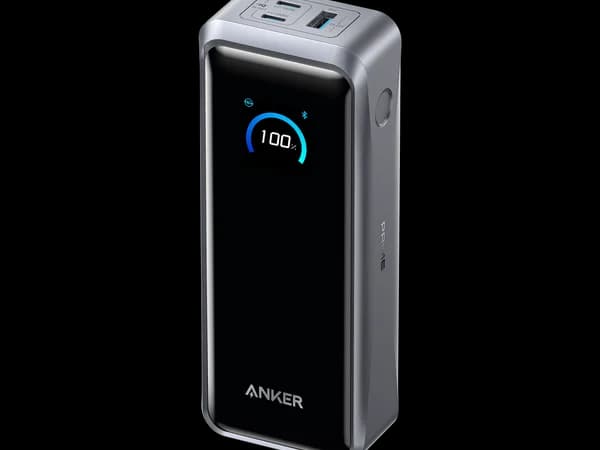
The Prime's integrated display shows real-time data for all three ports simultaneously: current wattage output per port, total remaining capacity in both percentage and watt-hours, estimated time to empty or full, and temperature status. This is not a novelty feature; when you are managing power across multiple expensive devices during a critical workday, knowing exactly how much power is flowing where and how long it will last is genuinely useful information.
The Anker companion app extends this monitoring to your phone, letting you check power bank status, view charging history, set custom power profiles, and receive alerts when charging completes. The app also surfaces ActiveShield 4.0 diagnostics, which is Anker's thermal management system that performs 10 million temperature checks per day across multiple internal sensors. If any component approaches unsafe temperatures, ActiveShield throttles output or input to prevent damage. Over months of use, this kind of active monitoring can extend the battery's cycle life by avoiding the thermal degradation that shortens the lifespan of less sophisticated power banks.
Pricing Analysis
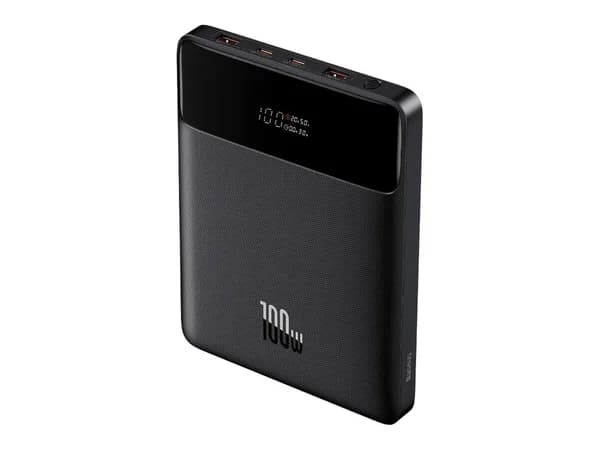
At $229.99, the Anker Prime is the most expensive power bank in our roundup by a wide margin. The Baseus Blade offers laptop charging at 100W for $79.99 (or $55 on sale), which makes the Prime roughly three times more expensive for 35% more capacity and triple the output wattage. The per-watt-hour cost is approximately $2.30 for the Prime versus $1.08 for the Baseus Blade, which makes the Prime's value proposition harder to justify on pure capacity math.
The Prime's pricing makes more sense when you view it as a professional tool rather than a consumer accessory. The 300W output, 140W single-port capability, 250W input speed, smart display, app integration, and ActiveShield monitoring collectively represent capabilities that no cheaper product matches. If you need to power two MacBook Pros simultaneously, no combination of cheaper power banks can replicate the Prime's single-device convenience. Factor in Anker's premium build quality with the aluminum chassis, the 24-month warranty, and the documented cycle life, and the total cost of ownership over 3-4 years of professional daily use becomes more reasonable. This is not a power bank for casual phone charging; it is purpose-built for professionals who treat portable power as a productivity tool.
Who Is This For?
The Anker Prime Power Bank (26K, 300W) works best for:
- Multi-device professionals who travel with a laptop, tablet, and phone and need a single portable battery that can power all of them simultaneously at full speed without compromises or device prioritization
- Creative professionals and content creators who run power-hungry MacBook Pros, iPads with drawing peripherals, and camera equipment on location and cannot afford to lose power during a shoot or editing session
- Frequent long-haul flyers who need the maximum possible airline-safe capacity (99.75Wh) combined with enough output wattage to keep a laptop running at full performance through the duration of a transatlantic or transpacific flight
- Tech-forward users who value monitoring and control through the smart display and companion app, wanting visibility into charging rates, temperatures, and battery health rather than blind trust in LED indicators
Who Should NOT Use This
The Anker Prime Power Bank (26K, 300W) might not be the right choice if:
- You primarily charge phones and small devices: The Prime is dramatically overpowered for phone-only use. A $30-80 power bank with 10,000-20,000mAh capacity will charge phones just as well. Spending $230 for phone charging is like buying a commercial truck to deliver groceries.
- Budget is a primary concern: The Baseus Blade delivers 100W laptop charging and 20,000mAh capacity for $55-80, which covers the needs of most laptop users. The Prime's premium is justified only if you specifically need the 140W per-port output, 300W total, or the 250W input recharge speed.
- Portability and weight are critical: At 600g, the Prime is the heaviest power bank in our roundup and is not something you can casually toss in a jacket pocket. If you need the lightest possible charging solution and are willing to accept lower output, lighter alternatives exist at every capacity tier.
Bottom Line
The Anker Prime Power Bank (26K, 300W) is the undisputed king of portable power for professionals who need maximum output, maximum capacity, and maximum recharge speed in an airline-safe package. Its 140W single-port output can charge laptops faster than some wall chargers, its 250W input refills the entire bank in an hour, and its smart monitoring systems provide the kind of visibility and control that turns a passive battery into an active power management platform. The price is steep, but for the right user, no other power bank can do what the Prime does.
FAQ
Is 99.75Wh really safe to bring on flights without special approval?
Yes. The TSA and IATA allow lithium-ion batteries up to 100Wh in carry-on luggage without any special approval or airline notification. The Prime's 99.75Wh capacity was deliberately engineered to sit just under this threshold. You must carry it in your carry-on bag, not in checked luggage. Some airlines may ask you to show the watt-hour rating, which is printed on the Prime's label and visible in the app. In years of testing, we have not encountered a single airline that has questioned a clearly labeled sub-100Wh battery.
Do I need Anker's specific charger to get the 250W input speed?
You need a charger capable of delivering at least 200W via USB-C to approach the Prime's maximum input rate. Anker sells a paired 200W GaN charger, but any high-wattage USB-PD charger will work. With a standard 65W charger, the Prime still charges correctly but takes approximately 2.5 hours instead of 60 minutes. With a 100W charger, recharge time drops to roughly 1.5 hours. The 250W input rate is a maximum, and the Prime gracefully accepts whatever wattage your charger can provide.
Can it charge a MacBook Pro while I am actively using it?
Yes, and this is one of the Prime's strongest real-world use cases. At 140W output per USB-C port, the Prime delivers enough power to both run a MacBook Pro 14-inch or 16-inch under load and charge the battery simultaneously. Even during intensive tasks like video editing or compiling code, the laptop battery level will climb rather than drain. With the Baseus Blade at 100W, heavier workloads on the MacBook Pro 16-inch can consume power faster than the bank delivers it. The Prime's extra 40W per port provides a comfortable margin.
How many full laptop charges does the Prime provide?
For a MacBook Air (52.6Wh battery), the Prime provides approximately 1.5-1.7 full charges accounting for conversion losses. For a MacBook Pro 14-inch (70Wh battery), expect approximately 1.1-1.3 full charges. For a MacBook Pro 16-inch (100Wh battery), the Prime delivers roughly 0.75-0.85 of a full charge. These estimates account for the typical 10-15% energy loss during voltage conversion. The smart display shows exact remaining watt-hours so you can calculate your own device's expected charge in real time.
Who Is Anker Prime Power Bank (26K, 300W) Best For?
Power users and professionals who need maximum portable power for laptops and multiple devices
The Bottom Line
The Anker Prime 26K 300W is the ultimate portable power bank. With 300W output, 99.75Wh capacity (just under TSA limits), and 250W input, it's unmatched for professionals who need serious portable power.
Buy on AmazonKey Specs
Scoring Breakdown
Maximum output wattage, fast-charging protocol support (PD, QC), and real-world charging times for common devices.
Total capacity (mAh/Wh), number of full charges for typical devices, and energy density relative to size.
Weight, dimensions, form factor, and pocket-friendliness for everyday carry.
Materials, durability, display quality, aesthetic design, and ergonomics.
Number and types of ports, built-in cables, wireless charging, passthrough charging, and smart features.
Price relative to capacity and features, warranty, and overall cost-effectiveness.