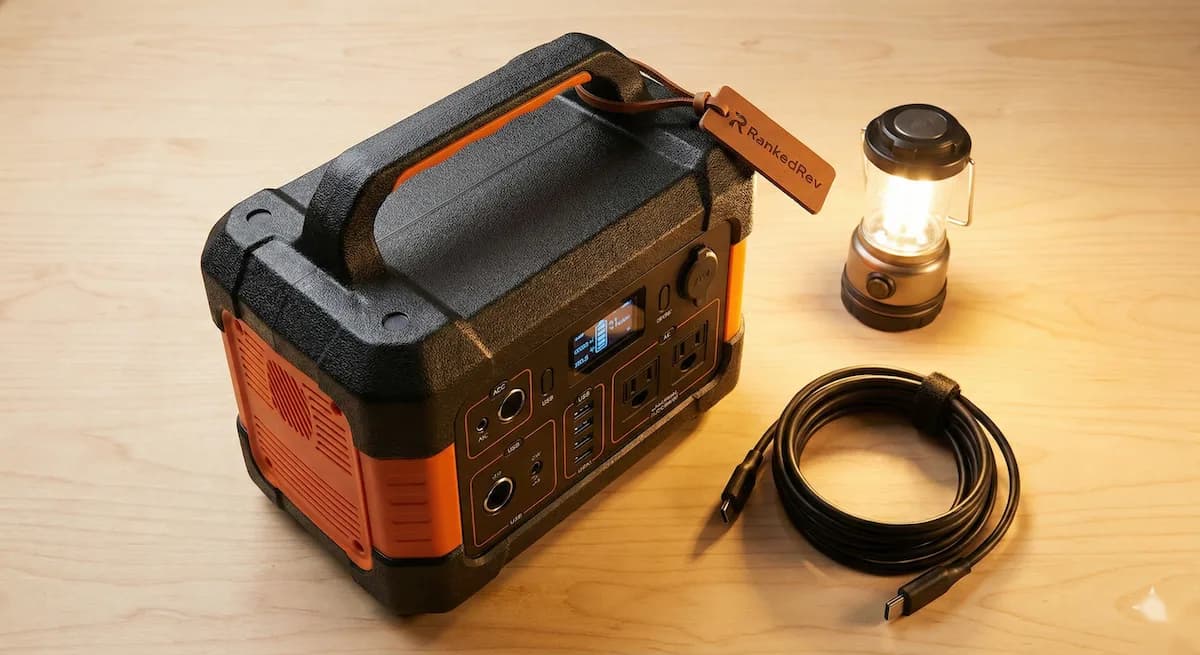
Best Portable Power Stations in 2026
From tailgating to emergency backup, we tested the top portable power stations for capacity, charging speed, and portability.

Portable Power Has Gone Mainstream
Portable power stations used to be a niche product for off-grid enthusiasts and emergency preppers. In 2026, they are mainstream, powering camping trips, tailgate parties, home backup during outages, remote work setups, and even construction sites. The technology has matured dramatically: LiFePO4 batteries last 3,000-4,000+ charge cycles, charging speeds have dropped from overnight to under an hour, and output wattage has climbed high enough to run full-size appliances.
The challenge is that the market is flooded with options from EcoFlow, Jackery, Anker, Bluetti, and a dozen others, all throwing around capacity numbers and wattage specs that are hard to compare without context. This guide focuses on real-world performance, how these stations actually behave when you need them, and helps you pick the right one for your situation. For the complete ranked list, visit our best portable power stations category page.
What to Look For
These criteria separate the good power stations from the marketing hype. They align with our scoring methodology.
Battery chemistry: LiFePO4 is the standard. Lithium iron phosphate (LiFePO4) batteries offer 3,000-4,000+ charge cycles (vs ~500-800 for older lithium-ion), are safer (no thermal runaway), and maintain capacity longer. Every recommendation in this guide uses LiFePO4. If a power station still uses lithium-ion NMC in 2026, skip it.
Usable capacity vs rated capacity. The stated watt-hour rating is theoretical. Real-world output is typically 85-90% of rated capacity due to inverter efficiency losses. A "1,000Wh" station delivers about 850-900Wh of usable power.
Output wattage. This determines what you can actually run. A 500W output handles phones, laptops, and LED lights. 1,500W adds small kitchen appliances. 2,000W+ handles space heaters, power tools, and larger appliances. Always check surge capacity for devices with motors (compressors, drills) that briefly draw 2-3x their rated wattage on startup.
Charge speed. The best stations in 2026 charge from 0-80% in under an hour via AC wall outlet. This matters for both home backup (rapid recharge between outages) and camping (charge during a lunch stop). Solar charging speed varies by panel wattage and conditions.
Weight and portability. A 1,000Wh station weighs 25-30 lbs. A 2,000Wh station hits 55-65 lbs, you need two hands or a dolly. Consider how you will transport it and whether wheels or handles matter for your use case.
Our Top Picks
EcoFlow DELTA Pro 3: Best for Home Backup

The DELTA Pro 3 is the most capable portable power station available. At 4,096Wh with 4,000W continuous output (6,000W with X-Boost), it can run a refrigerator, lights, router, and multiple devices simultaneously during a multi-day outage. The LiFePO4 battery is rated for 4,000+ cycles, meaning daily use for over a decade before significant degradation.
The headline feature is charging speed: 0-100% in about two hours from a wall outlet, which is remarkable for a 4kWh battery. EcoFlow's app integration lets you monitor power consumption, schedule charging during off-peak electricity rates, and manage the station remotely.
The trade-offs are size and price. At 114 lbs, this is not something you carry, it needs a dolly or cart. And at $2,999, it is a serious investment. But for homeowners who want genuine whole-house backup or anyone building an off-grid setup, the DELTA Pro 3 justifies the cost. See our full review for the complete capacity test results.
EcoFlow DELTA 3 Plus: Best for Camping and Outdoors
The DELTA 3 Plus hits the sweet spot for outdoor use: 1,024Wh of LiFePO4 capacity in a weather-resistant package that charges to 80% in 40 minutes. That charge speed is the fastest in the 1kWh class, and it means a quick stop at a campground outlet gives you nearly a full battery.
The 1,800W output (2,700W with X-Boost) handles everything a campsite needs, electric coolers, blenders, CPAP machines, and even small space heaters for cold nights. The IP54-rated weather resistance gives peace of mind in rain or dusty conditions that would concern me with non-rated units.
At about 29 lbs, it is carryable by one person for short distances, manageable for car camping, less practical for hiking. The $200 premium over the standard DELTA 3 buys you faster charging and weather resistance, both of which are worth it for regular outdoor use. Read our full review for solar charging benchmarks.
Anker SOLIX C1000 Gen 2: Best Value

Anker brought its consumer electronics expertise to the power station market, and the C1000 Gen 2 shows it. The headline: 49-minute full charge from a wall outlet, the fastest in the 1kWh class. The 1,024Wh LiFePO4 battery delivers 2,000W continuous (3,000W surge), which comfortably powers most household appliances.
What makes the C1000 Gen 2 the value pick is not just the price (frequently discounted below competitors) but the Anker ecosystem. It integrates with Anker's solar panels, expansion batteries, and smart home features. The build quality is solid, Anker has years of battery manufacturing expertise behind it, and the 3,000+ cycle LiFePO4 battery will last years.
The 28.6 lbs weight requires two-handed carrying, and there are no integrated wheels. The app is functional but not as polished as EcoFlow's. For the price-to-performance ratio, though, it is hard to beat. Check out our full review for the full efficiency breakdown.
Bluetti AC200L: Best for Expandable Setups

If you think you might need more capacity down the road, the AC200L is the pick. It starts at 2,048Wh, already substantial, and can expand to a massive 8,192Wh by connecting additional B300 expansion batteries. That is enough to power a small cabin for days.
The 2,400W output (3,600W with Power Lifting mode) handles nearly any household appliance. The LiFePO4 battery is rated for 3,500+ cycles. And the modular expansion means you can start with the base unit and add capacity as your needs grow, rather than committing to a massive station upfront.
At 62 lbs, the base unit requires two people to move. It is built for stationary use, home backup, workshop power, or base camp, not portability. But for anyone building a scalable power system, the AC200L's expansion ecosystem is unmatched. See our full review for expansion battery testing.
Head-to-Head: EcoFlow DELTA 3 Plus vs Anker C1000 Gen 2
Both are 1,024Wh LiFePO4 stations in the same price range. The DELTA 3 Plus wins on weather resistance (IP54 rated) and brand ecosystem (EcoFlow's app is best-in-class). The Anker C1000 Gen 2 wins on charge speed (49 min vs 40 min to 80%) and value (frequently discounted).
For outdoor use, the DELTA 3 Plus is safer thanks to weather resistance. For home backup and general use, the Anker C1000 Gen 2 offers better value. Both are excellent choices. Not sure what capacity you need? Our power station sizing guide walks you through the calculation.
The Bottom Line
The EcoFlow DELTA Pro 3 is the best home backup solution, expensive but unmatched in capacity and output. The DELTA 3 Plus is the best camping companion with weather resistance and fast charging. The Anker C1000 Gen 2 delivers the most value per watt-hour. And the Bluetti AC200L is the smartest choice if you want to expand your setup over time.
Portable power stations are one of those products where buying the right capacity upfront saves you money long-term. Figure out your power needs (our sizing guide can help), and invest accordingly.
Frequently Asked Questions
How long will a portable power station run my refrigerator?
A typical refrigerator draws 100-200W when running and 400-600W on startup. A 1,000Wh station runs a fridge for roughly 5-8 hours of continuous operation; a 2,000Wh station doubles that. During an outage, a fridge cycles on and off, so real-world runtime is usually 12-24 hours for a 1kWh station.
Can I charge a power station with solar panels?
Yes, all stations on this list support solar charging. Charge times depend on panel wattage and sunlight conditions. A 200W panel in full sun charges a 1,000Wh station in roughly 5-7 hours. For faster solar charging, see our upcoming guide on the best solar panels for power stations.
Are portable power stations safe to use indoors?
Yes, unlike gas generators, portable power stations produce zero emissions, no carbon monoxide, and minimal noise. They are designed for indoor use. LiFePO4 batteries are the safest lithium chemistry available, with no risk of thermal runaway under normal conditions.
You Might Also Like
How to Size a Portable Power Station for Your Needs
 James Mitchell
Best Mechanical Keyboards in 2026
 Marcus Rivera
Best Travel eSIMs 2026: A Complete Buyer's Guide
James Mitchell