
Baseus Blade Laptop Power Bank (100W, 20K) Review
The Baseus Blade is the best power bank for laptop charging. Its 100W output, ultra-slim design, and 4-port layout make it the ideal travel companion for MacBook and laptop users.

Baseus Blade Laptop Power Bank (100W, 20K) Review
The Baseus Blade is the best power bank for laptop charging. Its 100W output, ultra-slim design, and 4-port layout make it the ideal travel companion for MacBook and laptop users.
Baseus Blade Laptop Power Bank (100W, 20K) Review
The Baseus Blade is the best power bank for laptop charging. Its 100W output, ultra-slim design, and 4-port layout make it the ideal travel companion for MacBook and laptop users.

Baseus Blade Laptop Power Bank (100W, 20K) Pros & Cons
Pros
- 100W USB-C output charges MacBook Pro 14" to 50% in 30 minutes
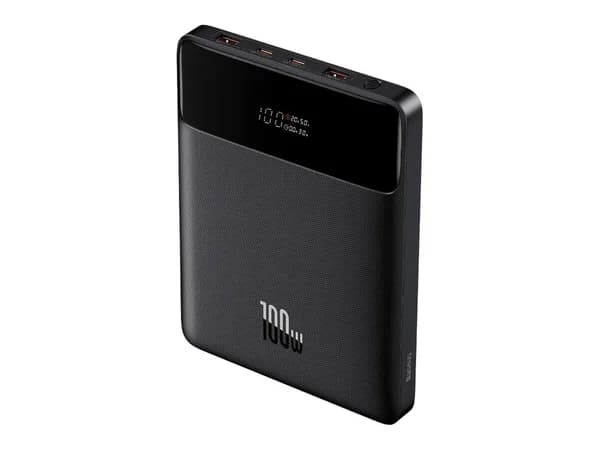
- Ultra-thin 0.7" laptop-style form factor slips into laptop sleeves
- 4-port charging (2x USB-C 100W + 2x USB-A 30W) for entire desk setup
- Digital display shows real-time wattage for each port
Cons
- Heavier at 490g — not pocket-friendly
- Large form factor designed for bags, not pockets
- Plastic build feels less premium than metal competitors
Overview
The Baseus Blade Laptop Power Bank (100W, 20K) solves a problem that most power banks ignore: charging a laptop on the go. With 100W USB-C output from each of its two USB-C ports, it can charge a MacBook Pro 14-inch to 50% in approximately 30 minutes, performance that was previously reserved for wall chargers. The ultra-thin 0.7-inch form factor means it slides into a laptop sleeve alongside your computer rather than competing for bag space, a design philosophy that makes it feel like it was designed by someone who actually travels with a laptop.
At 20,000mAh (74Wh), the Blade carries roughly double the capacity of phone-oriented power banks while remaining well within the 100Wh airline limit. The four-port layout with two USB-C ports at 100W each and two USB-A ports at 30W each means you can simultaneously charge a laptop, tablet, phone, and earbuds from a single device. At a retail price of $79.99 that frequently drops to around $55 on sale, the Blade offers a cost-per-watt ratio that no competitor comes close to matching. For remote workers, digital nomads, and anyone whose productivity depends on keeping a laptop alive, this is the most practical power bank on the market.
Features Deep-Dive
100W USB-C Output for True Laptop Charging
The Blade's headline spec is its 100W USB-C output, which crosses the critical threshold for meaningful laptop charging. Most power banks cap out at 30W or 65W, which can slow-charge a laptop but cannot keep up with active use. At 100W, the Blade delivers enough power to charge a MacBook Pro 14-inch, Dell XPS 15, or ThinkPad X1 at full speed, even while you are using the laptop. This is a fundamental capability difference, not an incremental improvement.
In practical terms, 100W output means the Blade can take a MacBook Pro 14-inch from empty to 50% in roughly 30 minutes, which is comparable to Apple's own 96W wall charger. For a power bank, that performance is remarkable. The 74Wh total capacity provides approximately 60-70% of a full MacBook Pro charge or a full charge for smaller laptops like the MacBook Air or Dell XPS 13. Both USB-C ports support the full 100W output independently, though total combined output across all four ports has limits when all ports are in simultaneous use.
Ultra-Thin 0.7-Inch Laptop-Style Form Factor
At 0.7 inches thick, the Blade is thinner than most smartphones and roughly the dimensions of a small tablet. This form factor is not accidental; Baseus designed the Blade to fit alongside a laptop in a standard laptop sleeve or padded compartment. Traditional high-capacity power banks tend to be chunky rectangular bricks that need their own dedicated bag pocket, but the Blade's flat profile lets it share space with your laptop without adding uncomfortable bulk.
The flat design also distributes the 490-gram weight more evenly across the surface area, making it feel lighter in hand than brick-shaped competitors of the same weight. In a backpack or messenger bag, the weight sits flat against your back rather than creating a pressure point. The matte surface resists scratches when sliding against a laptop, and the slim profile means it works well as a desk pad or coaster-sized charging station. For a 20,000mAh power bank, this form factor is genuinely innovative and addresses a real packaging problem that larger power banks typically ignore.
Four-Port Simultaneous Charging with Digital Display
The Blade provides four ports: two USB-C ports rated at 100W each and two USB-A ports rated at 30W each. This means you can charge a laptop on one USB-C port, an iPad on the other USB-C port, a phone on one USB-A port, and earbuds or a smartwatch on the remaining USB-A port. Four-device simultaneous charging from a single portable battery eliminates the need to carry multiple power banks or prioritize which device gets charged first.
The digital display on the Blade shows real-time wattage for the active ports, remaining battery percentage, and estimated time to depletion. The wattage display is particularly useful for verifying that your laptop is receiving the full 100W output rather than negotiating down to a lower power level. If you see 65W instead of 100W, you know to check your cable, as not all USB-C cables support 100W power delivery. The display is bright enough to read in daylight but dim enough not to be distracting on a bedside table, and it auto-dims after a few seconds to conserve the bank's own battery.
Pricing Analysis
The Baseus Blade retails at $79.99, but it frequently drops to around $55 during sales events, which makes it one of the most compelling values in the entire power bank market. At $55, you are getting 20,000mAh of capacity, 100W laptop-grade output, and four ports for roughly the same price as a basic 10,000mAh phone charger. Even at full retail, the cost per watt-hour of capacity is excellent: approximately $1.08 per Wh compared to $2.05 per Wh for the Anker MagGo 10K Slim and $2.30 per Wh for the Anker Prime 26K.
The competitive landscape at 20,000mAh with 100W output is thin. The Anker Prime 20K costs $129.99 for similar capacity with higher build quality. Laptop power banks from Zendure and Shargeek command $100-150. The Blade undercuts all of them while matching or exceeding their output specs. The tradeoff is build material: the Blade uses polycarbonate rather than aluminum, which feels less premium but also makes it lighter per unit capacity. At the sale price, the Blade is an impulse-buy level of value for anyone who owns a USB-C laptop.
Who Is This For?
The Baseus Blade Laptop Power Bank (100W, 20K) works best for:
- Remote workers and digital nomads who need reliable laptop charging in cafes, airports, and coworking spaces where outlets are scarce or inconveniently located, and who cannot afford to have their MacBook or ThinkPad die mid-task
- Frequent business travelers who want a single power bank that handles everything from a laptop to a phone and fits in the same laptop sleeve compartment, reducing the number of chargers and cables packed for each trip
- Students and conference attendees who spend long days away from outlets and need their laptop, tablet, and phone to last through back-to-back classes, sessions, or meetings without scrambling for wall power
- Budget-conscious buyers who want laptop-grade portable charging without paying the $130-230 premium charged by brands like Anker Prime or Zendure for comparable output specs
Who Should NOT Use This
The Baseus Blade Laptop Power Bank (100W, 20K) might not be the right choice if:
- You want the most compact pocket-friendly power bank: At 490g and tablet-sized dimensions, the Blade is designed for bags, not pockets. If you want something you can slip into a jeans pocket for phone charging, a 5,000-10,000mAh magnetic bank is the right category entirely.
- You need maximum capacity for extended off-grid use: The 74Wh provides roughly one full laptop charge, which may not be enough for multi-day trips without any outlet access. The Anker Prime 26K at 99.75Wh provides 35% more capacity for extended off-grid scenarios, though at three times the price.
- You prioritize premium build quality and materials: The Blade uses polycarbonate construction that feels functional but not luxurious. If the feel of your accessories matters and you are willing to pay for it, the Anker Prime's aluminum body and higher build quality may be worth the premium.
Bottom Line
The Baseus Blade is the power bank that makes laptop portable charging accessible to everyone. Its 100W output handles real laptops at real speeds, the flat form factor slides into any laptop bag without complaint, and the four-port layout charges an entire desk of devices simultaneously. At its frequent sale price of $55, it delivers more power per dollar than anything else on the market. It is not the most premium or the most powerful, but it is the best value in laptop-class portable power by a significant margin.
FAQ
Can the Blade fully charge a MacBook Pro 16-inch?
The Blade's 74Wh capacity will deliver approximately 50-60% charge to a MacBook Pro 16-inch, which has a 100Wh battery. While it cannot provide a complete charge, it can extend your working time by 3-5 hours depending on workload. The 100W output rate means even that partial charge is delivered quickly. For MacBook Pro 14-inch models with their smaller 70Wh battery, the Blade comes close to a full charge.
Does it support USB Power Delivery and work with all USB-C laptops?
Yes, the Blade supports USB-PD 3.0 with power profiles at 5V/3A, 9V/3A, 12V/3A, 15V/3A, and 20V/5A. This covers virtually all USB-C laptops including MacBook Air, MacBook Pro, Dell XPS, Lenovo ThinkPad, HP Spectre, and others. Some gaming laptops require proprietary chargers above 100W and cannot be powered by any USB-C power bank. If your laptop charges via USB-C at 100W or below, the Blade will work.
What happens when I charge four devices simultaneously?
When all four ports are active, the power bank distributes its output across devices using dynamic power allocation. The two USB-C ports can each deliver up to 100W individually, but the combined total across all ports is limited. In practice, if you are charging a laptop at 60W on one USB-C port, the other USB-C port may be limited to 30-45W rather than the full 100W. The USB-A ports maintain their 30W maximum regardless of USB-C activity. The digital display shows real-time wattage per port so you can see exactly how power is being distributed.
Is 74Wh safe to bring on an airplane?
Yes. The TSA and IATA limit lithium-ion batteries in carry-on luggage to 100Wh, and the Blade's 74Wh capacity is well within this limit. You do not need airline approval for batteries under 100Wh. The Blade must be carried in your carry-on luggage, not checked baggage, as is required for all lithium-ion batteries. This regulation is consistent across all major airlines worldwide.
Who Is Baseus Blade Laptop Power Bank (100W, 20K) Best For?
Remote workers and travelers who need laptop-class 100W charging in a slim form factor
The Bottom Line
The Baseus Blade is the best power bank for laptop charging. Its 100W output, ultra-slim design, and 4-port layout make it the ideal travel companion for MacBook and laptop users.
Buy on AmazonKey Specs
Scoring Breakdown
Maximum output wattage, fast-charging protocol support (PD, QC), and real-world charging times for common devices.
Total capacity (mAh/Wh), number of full charges for typical devices, and energy density relative to size.
Weight, dimensions, form factor, and pocket-friendliness for everyday carry.
Materials, durability, display quality, aesthetic design, and ergonomics.
Number and types of ports, built-in cables, wireless charging, passthrough charging, and smart features.
Price relative to capacity and features, warranty, and overall cost-effectiveness.