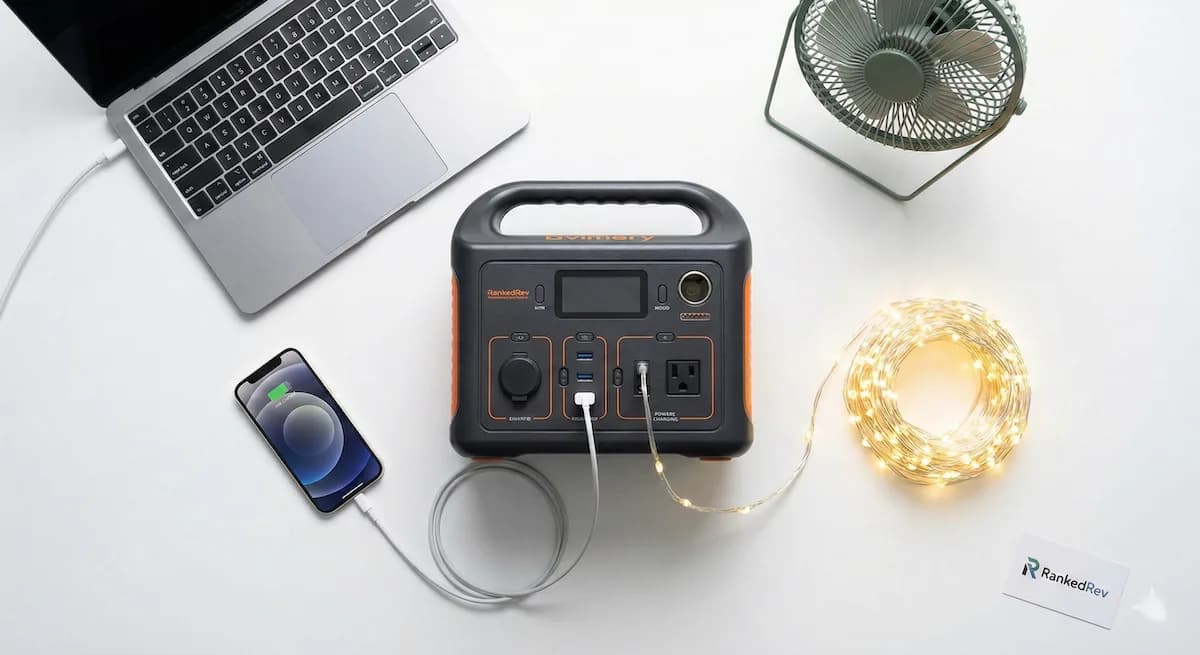
How to Size a Portable Power Station for Your Needs
Watt-hours, surge watts, and inverter capacity — we explain exactly how to calculate what size power station you need for camping, backup, or van life.

The Number One Mistake People Make
The most common regret I hear from power station buyers is choosing the wrong capacity, either too small (runs out halfway through a camping trip or outage) or too large (spent hundreds extra on watts they never use, and now they are lugging around a 60-pound brick). Both problems come from the same root cause: not calculating your actual power needs before buying.
The math is straightforward once you understand the key terms. This guide walks you through the exact process I use when recommending a power station for any scenario, camping, home backup, van life, or remote work. For specific product recommendations, see our best portable power stations buying guide.
The Three Numbers That Matter
1. Capacity (Watt-Hours / Wh)
Capacity tells you how much total energy the station stores. A 1,000Wh station can theoretically deliver 1,000 watts for one hour, or 100 watts for 10 hours, or 50 watts for 20 hours. It is the "fuel tank" size.
Important: Real-world usable capacity is about 85-90% of the rated number due to inverter efficiency losses. A "1,000Wh" station delivers roughly 850-900Wh of usable power. Always calculate with 85% efficiency to be safe.
2. Output Wattage (Watts / W)
Output wattage tells you how much power the station can deliver at any given moment. A 1,500W output means the station can run devices that draw up to 1,500W simultaneously. Exceed this and the station shuts off to protect itself.
Continuous vs surge: The continuous rating is what matters for sustained use. The surge rating (typically 1.5-2x higher) handles brief spikes when devices with motors start up, a refrigerator compressor, a power drill, a window AC unit.
3. Weight
Weight directly correlates with capacity. Rough rules of thumb:
- 500Wh: 12-15 lbs (one-handed carry)
- 1,000Wh: 25-30 lbs (two-handed carry)
- 2,000Wh: 50-65 lbs (needs two people or a cart)
- 4,000Wh+: 100+ lbs (needs a dolly)
Step-by-Step: Calculate Your Needs
Step 1: List Your Devices and Their Wattage
Check the label on each device or search "[device name] wattage" for averages. Here are common devices:
| Device | Typical Wattage | Notes |
|---|---|---|
| Smartphone charging | 15-20W | 5-10 charges per 1,000Wh |
| Laptop | 50-100W | Depends on workload |
| LED camping light | 5-15W | Very efficient |
| Portable fan | 30-60W | |
| Mini fridge / cooler | 40-60W | Runs intermittently |
| CPAP machine | 30-60W | Critical for medical users |
| Full-size refrigerator | 100-200W | 400-600W surge on startup |
| Microwave | 800-1,200W | High draw, short duration |
| Space heater | 750-1,500W | Very high draw |
| Electric kettle | 1,000-1,500W | High draw, short duration |
| Power drill | 500-800W | Intermittent use |
| TV (32-55") | 50-120W |
Step 2: Estimate Daily Usage Hours
For each device, estimate how many hours per day you will use it. A refrigerator runs about 8-10 hours per day (cycling on and off), a laptop might run 6 hours, and a phone charges for 1-2 hours.
Formula: Wattage x Hours = Watt-hours consumed
Example camping setup:
| Device | Watts | Hours/Day | Wh/Day |
|---|---|---|---|
| LED lights (x3) | 30W | 5h | 150 Wh |
| Phone charging (x2) | 30W | 2h | 60 Wh |
| Laptop | 65W | 3h | 195 Wh |
| Portable fan | 45W | 6h | 270 Wh |
| Mini fridge | 50W | 8h | 400 Wh |
| Total | 1,075 Wh/day |
Step 3: Account for Efficiency Losses
Divide your daily total by 0.85 to account for inverter efficiency:
1,075 Wh / 0.85 = 1,265 Wh needed per day
Step 4: Multiply by Number of Days
If you need two days of power without recharging:
1,265 Wh x 2 days = 2,530 Wh total
Step 5: Check Your Output Requirements
Add up the maximum wattage of devices you will run simultaneously. In the camping example, if the fridge, fan, lights, and laptop are all on at once: 50 + 45 + 30 + 65 = 190W. A 500W station handles this easily. But if you add a microwave (1,000W), you need a station with at least 1,200W continuous output.
Sizing by Use Case
Camping (Weekend Trip)
- Needs: Lights, phone charging, laptop, small fan, cooler
- Daily consumption: 500-800 Wh
- Recommended capacity: 1,000-1,500 Wh
- Minimum output: 500W
- Best pick: EcoFlow DELTA 3 Plus (1,024Wh)
Home Backup (Power Outage)
- Needs: Refrigerator, lights, phone/laptop, router, CPAP
- Daily consumption: 800-1,500 Wh
- Recommended capacity: 2,000-4,000 Wh
- Minimum output: 1,500W (2,000W+ with refrigerator)
- Best pick: EcoFlow DELTA Pro 3 (4,096Wh)
Remote Work / Van Life
- Needs: Laptop, monitor, phone, router, small appliances
- Daily consumption: 300-600 Wh
- Recommended capacity: 500-1,000 Wh
- Minimum output: 300W
- Best pick: Anker SOLIX C1000 Gen 2 (1,024Wh)
Tailgating / Events
- Needs: TV, blender, speakers, phone charging, cooler
- Daily consumption: 300-500 Wh (shorter duration)
- Recommended capacity: 500-1,000 Wh
- Minimum output: 1,000W (for blender/TV)
- Best pick: Anker SOLIX C1000 Gen 2 (1,024Wh)
Common Sizing Mistakes
Forgetting surge wattage. A refrigerator draws 150W running but 500W+ on startup. If your station's continuous output is 300W, the fridge will trip the overload protection. Always check surge specs for motor-driven devices.
Ignoring weather effects. Cold temperatures reduce battery capacity by 10-20%. If you plan to use a power station in winter, size up by 20% over your calculated needs.
Planning for 100% discharge. Draining a battery to 0% regularly shortens its lifespan. Aim to stay above 20% charge for longevity. Size your station so your typical usage drains it to 20-30%, not zero.
The Bottom Line
Calculate your wattage, multiply by hours, add 15% for efficiency losses, and multiply by the number of days between charges. That gives you the minimum capacity you need. Then round up to the next available station size for a comfortable margin.
When in doubt, bigger is better, you will find uses for extra capacity that you did not anticipate. The cost difference between a 1,000Wh and 1,500Wh station is far less than the frustration of running out of power. Head to our best portable power stations page for the full rankings.
You Might Also Like
Best Portable Power Stations in 2026
 James Mitchell
Mechanical Keyboard Switch Guide: Cherry MX, Gateron and Beyond
 Marcus Rivera
Standing Desk vs Desktop Converter: Which Is Right for You?
 Emily Thornton