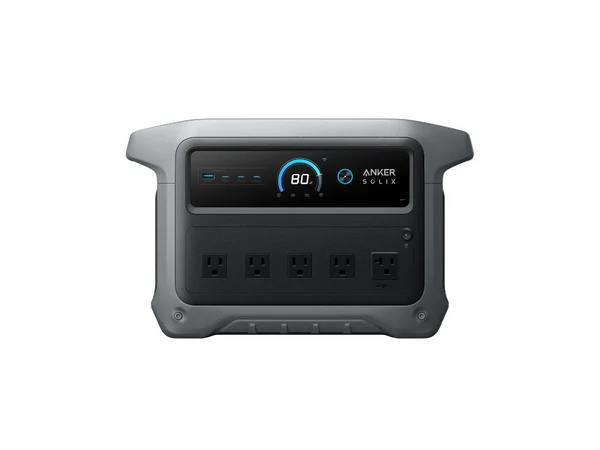

Anker SOLIX C1000 Gen 2 Review
The Anker SOLIX C1000 Gen 2 charges faster than any competitor - 49 minutes from empty to full. Its 2,000W output can run most household appliances, making it ideal for home backup and serious camping.

Anker SOLIX C1000 Gen 2 Review
The Anker SOLIX C1000 Gen 2 charges faster than any competitor - 49 minutes from empty to full. Its 2,000W output can run most household appliances, making it ideal for home backup and serious camping.
Anker SOLIX C1000 Gen 2 Review
The Anker SOLIX C1000 Gen 2 charges faster than any competitor - 49 minutes from empty to full. Its 2,000W output can run most household appliances, making it ideal for home backup and serious camping.

Anker SOLIX C1000 Gen 2 Pros & Cons
Pros
- 1,024Wh LiFePO4 battery with 3,000+ cycles
- 2,000W output (3,000W surge)
- Industry-leading 49-minute full charge
- Anker app with smart scheduling
- UPS function with 10ms switchover
- Expandable up to 3,072Wh
Cons
- 28.6 lbs requires two-handed carrying
- No integrated wheels
- Premium price vs competitors
- Expansion batteries sold separately
Overview
The Anker SOLIX C1000 Gen 2 has one party trick that defines its appeal: a complete recharge in 49 minutes. No other 1kWh power station comes close to this speed, and it transforms how you use portable power. Forgot to charge overnight? Top off during breakfast. Found an outlet at a rest stop? Meaningful capacity in the time it takes to get coffee.
Beyond the headline charging speed, Anker delivers a thoroughly modern 1kWh station with 2,000W output, LiFePO4 chemistry, and a polished app experience. The company's reputation for quality consumer electronics translates well to this category.
Features Deep-Dive
HyperFlash Charging Technology
The 49-minute full charge isn't marketing exaggeration—it's genuine engineering achievement. Anker's proprietary charging system manages heat precisely enough to accept massive power input without degrading the battery. For context, most competitors take 1.5-2 hours for the same capacity.
This speed difference matters most when power access is unpredictable. During outages with intermittent generator use, between camping locations, or at fast-paced worksites, the C1000 Gen 2 maximizes every charging opportunity.
2,000W Output with SurgePad
The continuous 2,000W output (3,000W surge) comfortably runs most household appliances. SurgePad technology handles initial startup surges from refrigerators, power tools, and air conditioners that would trip protection on lesser units.
Six AC outlets, three USB-A ports, two USB-C ports (one at 100W), and a car outlet provide versatile connectivity. The port count matches or exceeds competitors.
LiFePO4 Longevity
Anker rates the C1000 Gen 2 for 3,000 cycles to 80% capacity—not quite as aggressive as some competitors claiming 4,000 cycles, but still representing a decade of daily use. The conservative rating may reflect Anker's cautious approach to specifications.
Smart App Control
The Anker app provides scheduling, monitoring, and firmware updates comparable to EcoFlow's offering. You can track charge state remotely, schedule charging for off-peak electricity rates, and receive low-battery alerts. It's polished without being overwhelming.
Expansion Capability
The C1000 Gen 2 accepts expansion batteries (sold separately) to double capacity. This modular approach lets you buy what you need now and expand later without replacing the entire unit.
Pricing Analysis
At $799, the C1000 Gen 2 sits squarely in the mid-range for 1kWh stations. You're paying a premium over budget options, but getting Anker's build quality, the fastest charging available, and legitimate expansion options.
The value proposition strengthens when you consider that the 49-minute charging enables use patterns impossible with slower competitors. If your lifestyle involves frequent short charging windows, no competitor offers equivalent capability at any price.
Who Is This For?
The Anker SOLIX C1000 Gen 2 makes sense for:
- Road trippers and nomads who grab charging opportunities whenever available
- Event vendors and mobile businesses needing quick turnaround between locations
- Home backup users who might only have brief generator runtime during outages
- Photographers on location who need rapid recharges between shoots
- Anyone who routinely forgets to charge overnight and needs a last-minute solution
Who Should NOT Use This
The C1000 Gen 2 isn't the right choice if:
- You have reliable overnight charging: Slower, cheaper options deliver the same capacity
- Portability is paramount: At 28.6 lbs without wheels, it requires two-handed carrying
- Maximum lifespan matters most: Competitors with 4,000-cycle ratings offer longer theoretical life
- Budget is extremely tight: Capable 1kWh alternatives exist for $200-300 less
Bottom Line
The Anker SOLIX C1000 Gen 2 delivers on its core promise: the fastest charging in its class. Combined with Anker's track record, solid build quality, and expandability, it's a compelling choice for users whose lives don't accommodate predictable charging schedules.
FAQ
Is the 49-minute charge safe for the battery?
Yes. Anker's thermal management specifically enables this speed without accelerated degradation. The 3,000-cycle rating assumes regular use of fast charging.
How does it compare to EcoFlow DELTA 3?
The C1000 Gen 2 charges faster (49 min vs 56 min) and outputs more power (2,000W vs 1,800W). The DELTA 3 has a higher cycle rating (4,000 vs 3,000) and arguably a more feature-rich app. Both are excellent choices at similar prices.
Can I use it while charging?
Yes, pass-through charging works seamlessly. Input power supplies connected devices first, with excess going to the battery. This makes it useful as a UPS for home office equipment.
Does the fast charging require special outlets?
No. Standard 15A or 20A household outlets support the maximum charging speed. No special wiring or circuits needed.
Who Is Anker SOLIX C1000 Gen 2 Best For?
Power users wanting the fastest charging 1kWh station with expansion options
The Bottom Line
The Anker SOLIX C1000 Gen 2 charges faster than any competitor - 49 minutes from empty to full. Its 2,000W output can run most household appliances, making it ideal for home backup and serious camping.
Buy on AmazonKey Specs
Scoring Breakdown
Watt-hours per pound and overall energy density. Evaluates how much usable power the station provides relative to its size and weight.
Continuous watts, surge capacity, and number/variety of outlets. Determines what devices and appliances you can actually run.
Time to full charge via AC wall outlet and maximum solar input wattage. Faster charging means less downtime between uses.
Weight, dimensions, handles, and wheels for transport. Considers ease of carrying to campsites, loading in vehicles, and storage.
LiFePO4 cycle count, warranty length, and expected battery lifespan. All products in this category use LiFePO4 chemistry for maximum durability.
Smartphone app control, UPS function, display quality, expandability, and smart home integration options.
Price per watt-hour considering capacity, features, and warranty. Evaluates overall cost-effectiveness.


