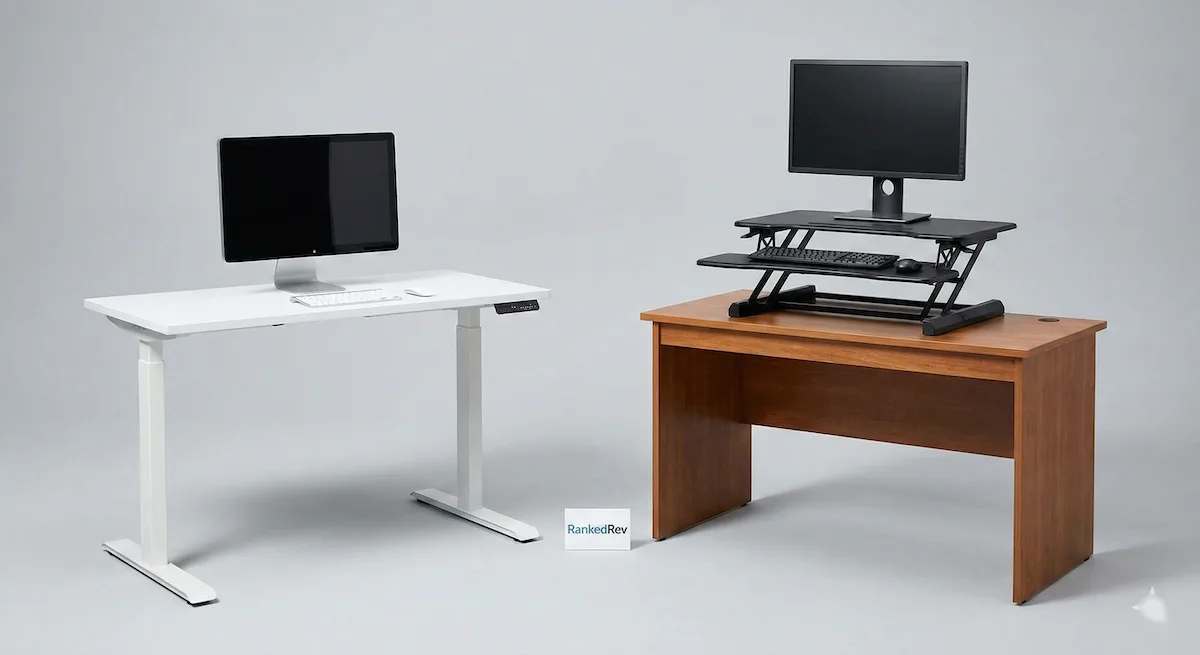
Standing Desk vs Desktop Converter: Which Is Right for You?
Full standing desks offer more range, but converters cost less and fit your existing setup. We compare both options for space, budget, and ergonomics.

Two Ways to Stand: Very Different Trade-Offs
You have decided you want to stand more during the workday. Good call. The next question is whether you need a full electric standing desk or whether a desktop converter, the platform that sits on top of your existing desk and raises your monitor and keyboard, does the job.
This is not a simple question, and the answer depends on your space, budget, and how seriously you plan to use standing position. I have used both extensively, and the differences go well beyond price. Here is an honest comparison to help you make the right choice. For product-specific recommendations, see our best standing desks buying guide.
What Is a Desktop Converter?
A desktop converter (sometimes called a sit-stand riser) is a platform that sits on your existing desk. You place your monitor, keyboard, and mouse on the converter, and it raises and lowers, usually with a gas spring or pneumatic mechanism, to switch between sitting and standing height. Your existing desk stays put underneath.
Popular options include the VariDesk Pro Plus, FlexiSpot M7, and Ergotron WorkFit. Prices typically range from $150-400 depending on size and lifting mechanism.
Full Desk vs Converter: The Real Comparison
Stability
Full desk wins. This is the biggest practical difference and the one that matters most day-to-day. An electric standing desk has its legs planted directly on the floor, with the entire frame engineered for stability at standing height. A converter, by contrast, sits on top of another desk, you are stacking two structures, and the combined setup is inherently less rigid.
I notice the wobble difference most when typing at standing height. On a full desk like the UPLIFT V3, my monitor stays still while I type aggressively. On a converter, the monitor visibly shakes with each keystroke. It is not dangerous, but it is distracting, and over months of use it became the primary reason I switched to a full desk.
Usable Desk Space
Full desk wins. A converter takes up a significant portion of your existing desk surface. When raised, the converter platform occupies the center of your desk, leaving only the edges for anything else, your coffee, notes, phone, or desk accessories get pushed to the margins. When lowered, the converter sits on your desk like a large, bulky platform that you work around.
A full standing desk gives you the entire surface at any height. Your desk space is your desk space, period.
Cost
Converter wins. A decent converter costs $200-350. A quality electric standing desk costs $400-900+. If budget is tight and you already own a desk you like, the converter saves $200-500.
However, the math changes if your existing desk is cheap or worn out. Selling or discarding a $100 desk and buying a $400 standing desk (like the FlexiSpot E7 on sale) gets you a better setup for only $100 more than a good converter.
Ergonomic Range
Full desk wins. Electric standing desks typically adjust from 22-50 inches, covering both seated and standing positions for users of all heights. You set the exact height for your body and save it as a preset.
Converters have a more limited range, they raise from your desk height to roughly 15-20 inches above it. If your existing desk is too high or too low to begin with, the converter inherits that problem. You also cannot adjust the keyboard and monitor heights independently on most converters, which means your ergonomic position is a compromise.
Assembly and Setup
Converter wins. A converter is out of the box and on your desk in five minutes. No tools, no assembly, no moving your existing desk out. An electric standing desk takes 30-90 minutes to assemble and requires clearing your old desk, which is a real deterrent for people who do not enjoy furniture projects.
Noise
Converter wins. Gas spring converters are nearly silent, you lift and lower the platform manually with a squeeze handle. Electric desks produce motor noise during adjustment, though modern dual-motor desks are much quieter than older models (most are comparable to a quiet conversation).
When to Choose a Converter
- You rent and cannot make permanent changes. A converter sits on your existing desk and leaves with you when you move.
- Your budget is genuinely tight. If $400+ is not feasible right now, a $200 converter gets you standing today.
- You love your current desk. If you have a vintage desk or a custom surface you do not want to replace, a converter preserves it.
- You just want to try standing. If you are not sure standing will work for you, a converter is a low-risk way to test it before committing to a full desk.
When to Choose a Full Standing Desk
- You work from home daily. If standing is part of your everyday routine, the stability, desk space, and ergonomic precision of a full desk make a meaningful difference over months and years.
- You use dual monitors. Converters struggle with the weight and width of dual monitor setups. A full desk handles them without issue.
- You are buying your first desk. If you do not already own a desk, buying a converter plus a desk to put it on costs nearly as much as buying a standing desk outright.
- Wobble bothers you. If you are the type of person who notices a shaking monitor while typing, you will not be happy with a converter long-term.
My Honest Take
I started with a converter and used it for eight months before switching to a full electric desk. The converter got me standing, and for that I am grateful, it proved to me that alternating between sitting and standing genuinely helped my back. But the wobble, the lost desk space, and the ergonomic compromises accumulated into daily friction that a full desk eliminated overnight.
If you can afford it, buy the full desk. The UPLIFT V3 is my top pick, or the FlexiSpot E7 if you want to spend less. If budget is the constraint, start with a converter, any standing is better than none, and plan to upgrade when it makes sense. Either way, you are making a good decision for your body.
For full product recommendations, see our best standing desks in 2026 buying guide.
You Might Also Like
How to Size a Portable Power Station for Your Needs
 James Mitchell
Mechanical Keyboard Switch Guide: Cherry MX, Gateron and Beyond
 Marcus Rivera
Best Standing Desks in 2026
 Emily Thornton