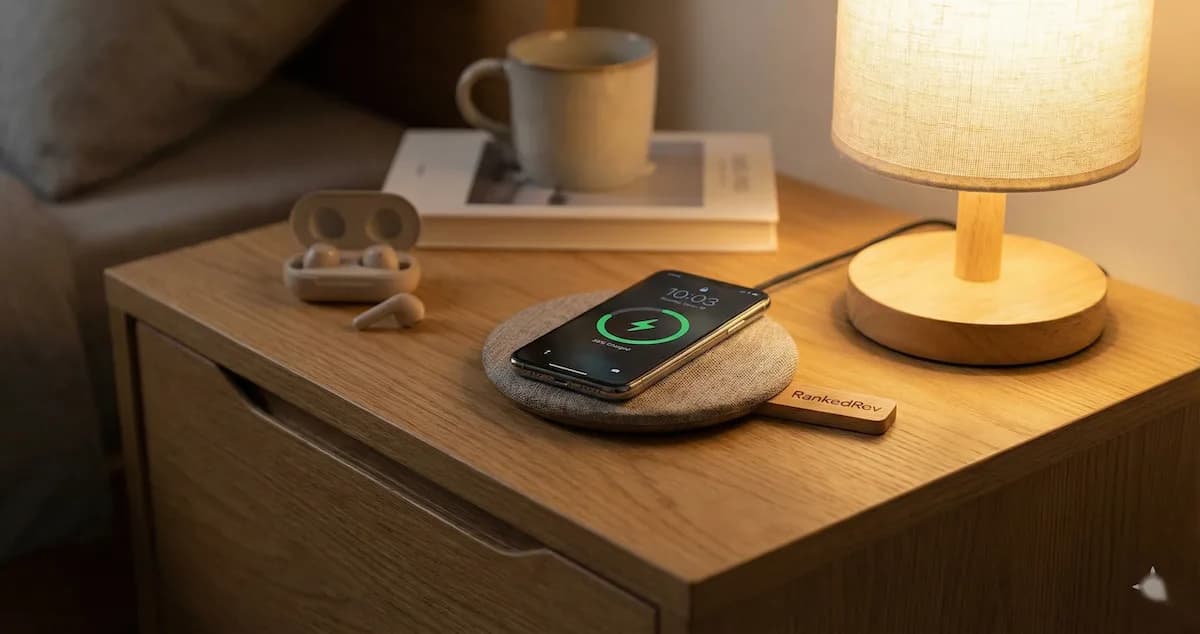
Best Wireless Charging Pads in 2026
Qi2, MagSafe, and multi-device — we tested the top wireless chargers for speed, alignment, and compatibility with the latest phones.

Qi2 Finally Makes Wireless Charging Worth It
Wireless charging spent years as a convenience compromise. You set your phone on a pad, it charged slowly, and if you bumped it a centimeter off-center, it stopped charging entirely. The Qi standard topped out at 15W, enough for overnight charging but painfully slow if you needed a quick top-up before heading out.
Qi2 changes the equation. The new standard, which incorporates magnetic alignment from Apple's MagSafe technology, solves the two biggest pain points at once. The magnets snap your phone into the correct position every time, eliminating misalignment. And Qi2 supports up to 25W of wireless charging, which cuts charge times roughly in half compared to the original Qi standard. A phone that took over two hours to charge wirelessly at 15W now reaches full in about 75 minutes at 25W.
The 3-in-1 charger category has matured alongside Qi2. The best stations now charge your phone, Apple Watch (or smartwatch), and earbuds simultaneously from a single unit, replacing the tangle of cables on your nightstand. I have been testing these chargers across months of daily use, checking alignment reliability, measuring actual charging speeds, evaluating heat management, and seeing how they hold up over time. For the complete ranked list with detailed scoring, visit our wireless charging pads category page.
What to Look For in a Wireless Charger
These are the criteria that separate genuinely good wireless chargers from mediocre ones. They align with our scoring methodology.
Qi2 vs Qi (first generation). Qi2 is the clear winner in 2026. Magnetic alignment ensures your phone charges every time you set it down, and the 25W maximum speed is a meaningful upgrade from Qi's 15W. If you are buying a new wireless charger, buy Qi2. First-generation Qi chargers are obsolete for any phone released in the last two years.
Charging speed (actual vs advertised). A "25W wireless charger" does not deliver 25W continuously. Wireless charging generates heat, and every charger throttles its output as the phone and pad warm up. In practice, a 25W Qi2 charger averages around 18-22W over the course of a full charge, with the higher wattage sustained during the first 30-40% of the charge cycle. This is normal and expected, what matters is the total time to full charge, not the peak wattage.
3-in-1 vs standalone. A 3-in-1 charger (phone, watch, earbuds) replaces three separate chargers and cables. If you own an iPhone and Apple Watch, a 3-in-1 station is the most practical nightstand setup. If you only need to charge a phone, a standalone pad or stand is simpler and cheaper. The watch charging module matters, look for Apple Watch fast charging support if you own a Series 7 or later.
MagSafe and magnetic alignment. Qi2's magnetic alignment is based on Apple's MagSafe technology. For iPhones, this means every Qi2 charger works like MagSafe at the hardware level. Android phones with Qi2 support (Samsung Galaxy S24 and later, Google Pixel 9 and later) also snap into place magnetically. If your Android phone does not have built-in Qi2 magnets, you can add a magnetic case or ring for alignment.
Cooling and thermal management. Heat is the enemy of wireless charging speed and battery longevity. Premium chargers include active cooling, small fans that dissipate heat from the charging coil, which allows them to sustain higher wattage for longer periods. In my testing, chargers with active cooling maintain peak speeds roughly 40% longer than passively cooled models. The trade-off is a slight fan noise, which some people notice on a quiet nightstand.
Build quality and stability. A wireless charger sits on your desk or nightstand every day. Premium materials (metal bases, quality plastics) and weighted construction prevent the charger from sliding around or tipping when you grab your phone. Foldable designs add travel versatility but sometimes sacrifice stability. The charging cable quality matters too, a cheap barrel connector or proprietary cable will be the first failure point.
Our Top Picks
Anker Prime 3-in-1 Foldable: Best Overall
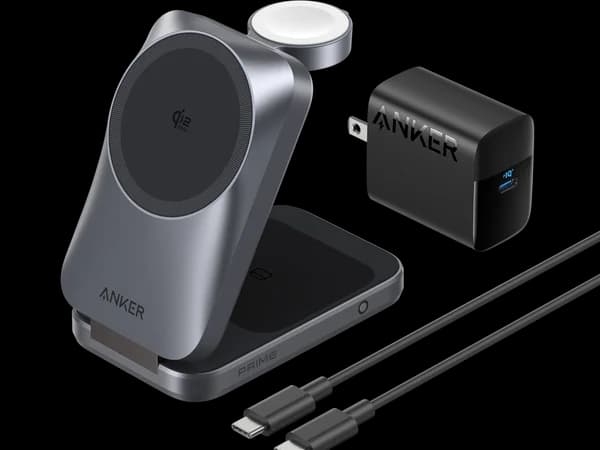
The Anker Prime 3-in-1 Foldable hits the rare sweet spot of doing everything well without a significant weakness. The phone pad delivers the full 25W Qi2 charging speed with magnetic alignment that snaps iPhones and Qi2 Android phones into position instantly. The Apple Watch module supports fast charging. The AirPods pad handles earbuds. And the whole unit folds flat for travel.
What sets the Prime apart is charging consistency. In my testing over several months, it maintained 25W output more reliably than competitors, thanks to active cooling that keeps the charging coil at optimal temperature. The fan is barely audible from a few feet away, I cannot hear it from my pillow at night, which is the test that matters for a nightstand charger.
The foldable design is genuinely useful. Folded flat, the unit is about the size of a thick smartphone and slides into a travel pouch easily. Unfolded, it creates a stable charging station with the phone pad angled for visibility, you can see incoming notifications while your phone charges, which makes it work as a de facto bedside clock. The hinge mechanism feels durable and holds its position firmly at multiple angles.
Build quality is premium. The soft-touch finish and metal accents give it a weight and feel that justify the price. The USB-C input cable is high quality, and the unit works with any USB-C charger that delivers at least 30W, meaning you can pair it with one of the best USB-C wall chargers you already own.
The main limitation is price. This is the most expensive charger on this list, and if you do not need the foldable travel design, you can get comparable charging performance for less. But for people who want one charger for both nightstand duty and travel, the Prime 3-in-1 is the most refined option available. See our full review for the thermal performance data.
Belkin UltraCharge Pro 3-in-1: Best Nightstand Charger
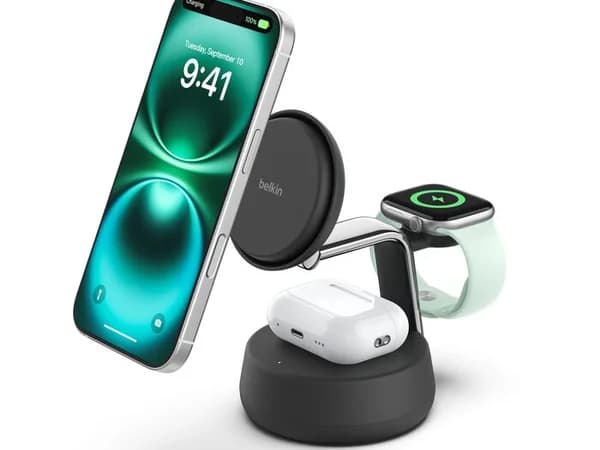
Belkin has been making Apple ecosystem accessories for decades, and the UltraCharge Pro 3-in-1 reflects that experience. This is a purpose-built nightstand charger that prioritizes stability, aesthetics, and the Apple charging experience over portability or flexibility.
The phone charging stand holds your iPhone in landscape orientation with strong magnetic alignment, which automatically triggers StandBy mode on iOS 17 and later, turning your phone into a bedside smart display showing the clock, widgets, and notifications. This integration alone makes it the best nightstand experience for iPhone users. Qi2 charging at 25W keeps the phone topped off quickly.
The Apple Watch charging puck is integrated into the base and supports fast charging for Series 7 and later. The AirPods pad sits flush with the base and charges through most cases without issue. The three charging areas are spaced well, so there is no interference between devices.
Build quality is excellent, Belkin's charcoal finish and weighted base create a premium look that sits confidently on a nightstand without sliding. The unit has a substantial feel without being bulky. Cable management is clean, with the power cable routing neatly out the back.
The trade-off is that this is a dedicated desk/nightstand charger. It does not fold, it is not particularly portable, and the fixed stand angle does not adjust. For travel, you will need a separate solution. The premium pricing also reflects Belkin's brand positioning more than its raw feature set, the Anker Prime offers similar charging performance with foldable travel capability.
For iPhone users who want the most polished nightstand charging station and use StandBy mode, the Belkin UltraCharge Pro is the premium pick. Read our full review for the StandBy mode integration details.
ESR CryoBoost 3-in-1 25W Stand: Best Active Cooling

ESR built its reputation on one feature, CryoBoost active cooling, and the 3-in-1 25W Stand is the fullest expression of that technology. The built-in fan pulls heat away from the charging coil and your phone, allowing the charger to sustain higher wattage for longer periods than passively cooled alternatives. In my testing, the ESR maintained 25W output for approximately 15-20 minutes longer than chargers without active cooling before thermal throttling reduced the speed.
The practical impact: your phone charges noticeably faster with CryoBoost enabled. A full charge from 0-100% completes about 10-15 minutes sooner than on a comparably rated charger without active cooling. That gap is most noticeable during the first 50% of the charge, where the higher sustained wattage makes the biggest difference.
The 3-in-1 functionality covers phone, Apple Watch, and earbuds. Qi2 magnetic alignment snaps the phone into position, and the stand angle works well for both portrait and landscape viewing. The Apple Watch module and AirPods pad perform as expected.
The fan noise is the consideration. CryoBoost is not silent, there is a subtle whirring that is audible in a quiet room. ESR includes the option to disable CryoBoost and charge passively at standard Qi2 speeds, which I recommend for nightstand use. Run CryoBoost when you need a quick charge during the day and passive mode when you are sleeping.
For people who prioritize charging speed above all else and want the absolute fastest wireless charging experience, the ESR CryoBoost delivers. The active cooling technology provides a measurable speed advantage that no passively cooled charger can match. See our full review for the cooling performance benchmarks.
Baseus PicoGo AF21 3-in-1: Best Budget
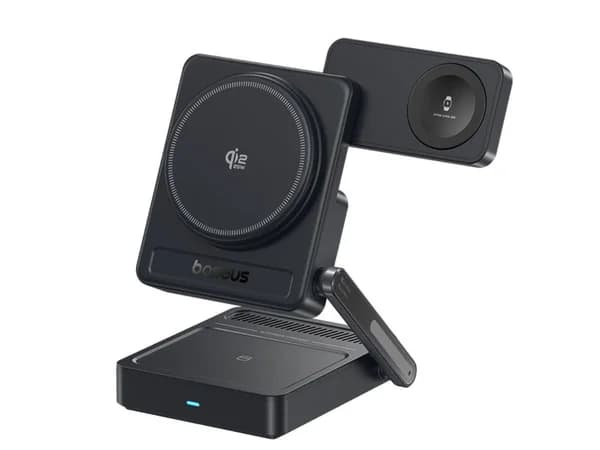
The Baseus PicoGo AF21 delivers the core 3-in-1 wireless charging experience at a price that significantly undercuts the premium options. Qi2 at 25W for the phone, Apple Watch charging, and an AirPods pad, all in a foldable design that travels well. If you want a no-frills 3-in-1 charger without paying flagship prices, this is the one.
The foldable form factor is compact when closed and opens to reveal three distinct charging areas. Magnetic phone alignment works reliably with Qi2 phones, and the stand angle is comfortable for nightstand viewing. The Apple Watch module and earbuds pad work without issues.
Build quality is solid for the price. The plastic construction does not feel as premium as the Anker Prime or Belkin, but it is well-assembled and the hinge mechanism holds up to daily folding and unfolding. The included USB-C cable is serviceable, and the unit works with standard USB-C chargers.
Where the PicoGo falls short compared to the premium picks is thermal management and sustained charging speed. Without active cooling, the 25W output throttles faster than the ESR CryoBoost, and the overall charge time is a few minutes longer. The magnetic alignment is slightly weaker than the Anker and Belkin, meaning phones that are nudged can occasionally shift enough to slow charging.
For budget-conscious buyers who want the convenience of 3-in-1 Qi2 charging and a travel-friendly foldable design, the PicoGo AF21 delivers. It charges all three devices reliably, folds flat for travel, and costs less than the competition. The premium you pay for the Anker Prime buys you better materials, stronger magnets, and active cooling, but the PicoGo handles the fundamentals well. Read our full review for the long-term durability assessment.
Head-to-Head: Anker Prime vs Belkin UltraCharge Pro
These two represent the premium tier, and the choice depends on how you use your charger.
Charging speed: Effectively tied. Both deliver 25W Qi2 charging, and both maintain speed well. The Anker's active cooling gives it a slight edge in sustained output, but the difference in total charge time is minimal, under 5 minutes for a full phone charge.
Portability: The Anker wins. Its foldable design packs flat for travel, making it genuinely portable. The Belkin is a permanent desk fixture.
Nightstand experience: The Belkin wins. The fixed stand angle and weighted base create a more stable, premium-feeling nightstand station. The StandBy mode integration with iPhones is seamless, and the overall aesthetic is more polished for a bedroom setting.
Versatility: The Anker wins. Adjustable stand angles and the ability to fold flat for travel give it more use cases. The Belkin does one thing, sit on your nightstand, and does it beautifully.
Price: Both are premium. The Belkin typically costs slightly more, but pricing fluctuates.
If you travel frequently and want one charger that works everywhere, choose the Anker Prime. If your wireless charger lives permanently on your nightstand and you want the most refined bedside experience, choose the Belkin UltraCharge Pro.
Travel Considerations
A wireless charger for travel has different requirements than one for your nightstand. Pair your travel charger with a compact USB-C wall charger for the most streamlined travel kit.
Foldable is non-negotiable for travel. Both the Anker Prime and Baseus PicoGo fold flat, making them viable travel companions. The Belkin and ESR are desk chargers that stay home.
Weight and size matter. A 3-in-1 charger replaces three cables (Lightning/USB-C for phone, Apple Watch cable, earbuds cable) but adds its own bulk. The trade-off is worth it for most travelers, one charger is easier to manage than three cables.
Power source compatibility. All chargers on this list work with any USB-C power source that delivers sufficient wattage. You do not need a proprietary power brick. A single 65W+ GaN charger powers both your wireless charging station and has a spare port for your laptop.
Hotel and airport outlets. Wireless chargers eliminate the need to unpack cables at every stop. Drop the charger on the nightstand, set your phone on it, done. The magnetic alignment means you do not need to carefully position your phone in the dark.
The Bottom Line
The best wireless charging pads in 2026 have crossed the threshold from convenience luxury to practical necessity, thanks to Qi2's magnetic alignment and 25W speeds. The Anker Prime 3-in-1 Foldable is the best overall choice, it charges fast, travels well, and offers active cooling that maintains peak speeds. The Belkin UltraCharge Pro 3-in-1 is the premium nightstand pick with the most polished StandBy mode experience. The ESR CryoBoost 3-in-1 delivers the fastest sustained charging through its active cooling technology. And the Baseus PicoGo AF21 brings 3-in-1 Qi2 charging and a foldable design at a budget-friendly price.
If you are still using a first-generation Qi charger, upgrading to Qi2 is one of the most noticeable improvements you can make to your daily charging routine. The magnetic snap alone is worth it.
Frequently Asked Questions
Does Qi2 work with my phone?
All iPhones from the iPhone 12 onwards support Qi2 charging natively via MagSafe-compatible magnets. Samsung Galaxy S24 and later models support Qi2. Google Pixel 9 and later models support Qi2. Older phones without built-in magnets can use Qi2 chargers if you attach a magnetic case or ring adapter, though alignment is less precise.
Is 25W wireless charging safe for my battery?
Yes. Both Apple and Android manufacturers implement thermal management at the device level. Your phone regulates its own charging speed based on battery temperature, battery health, and current charge level, regardless of how much power the charger offers. A 25W charger will not push 25W continuously; the phone throttles intake as it approaches full charge to protect battery longevity.
Can I use a wireless charger with a phone case?
Yes, with most cases. Qi2's magnetic alignment works through cases up to about 3mm thick. Magnetic cases work best, as they strengthen the alignment. Very thick cases, cases with metal plates, or wallet cases with cards may interfere with charging. If your phone gets warm or charges slowly through a case, try removing it.
Do I need a specific wall charger for Qi2?
You need a USB-C charger that delivers at least 25-30W to power a Qi2 charger at full speed. Most modern USB-C chargers meet this requirement. The wireless chargers on this list do not include a wall charger in the box (the ESR is the exception), so you will need to supply your own. Any charger from our USB-C wall charger guide will work.

