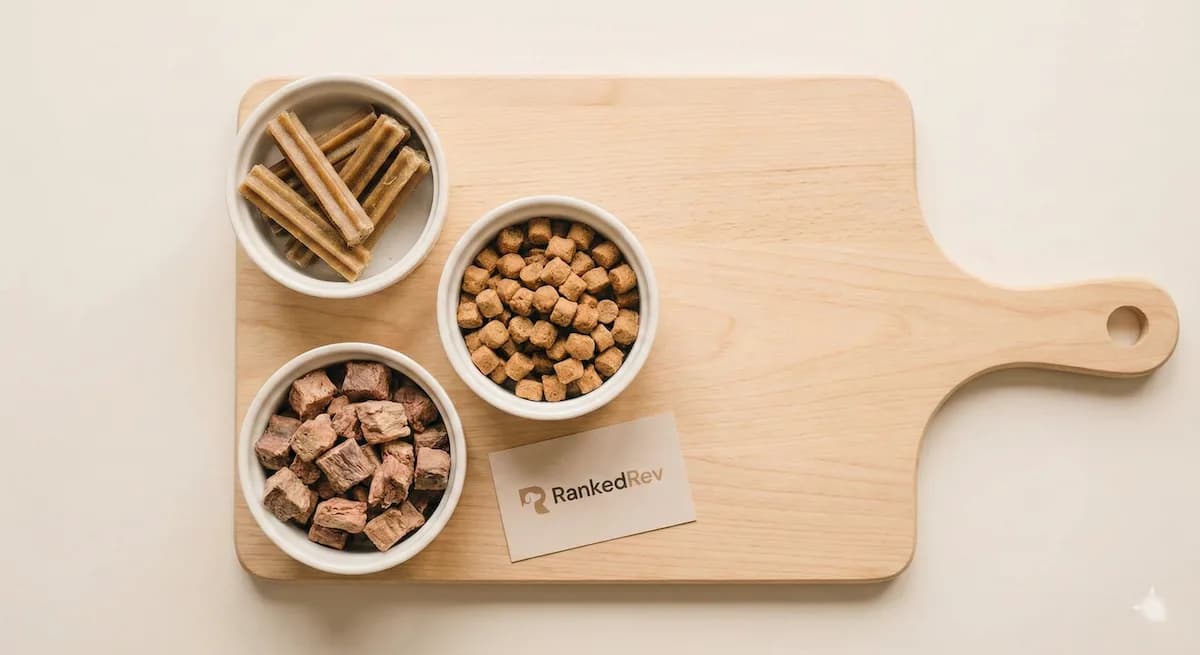
Best Dog Treats in 2026: Training Rewards, Dental Chews, and Healthy Snacks
The best dog treats for training, dental health, and everyday snacking in 2026, with picks at every price point.

Finding the Right Treat for Your Dog
I have spent an embarrassing amount of time reading ingredient labels on dog treats. Not because I am a veterinary nutritionist, I am not, but because after watching my own dog develop digestive issues from a bag of "all-natural" treats that turned out to be mostly corn syrup and artificial flavoring, I decided to actually learn what goes into this stuff. The difference between a good treat and a bad one is not marketing. It is the ingredient list, and most pet owners never flip the bag over.
This guide covers the best dog treats across three categories that matter most: training treats (small, low-calorie, high-value), dental chews (functional treats that clean teeth), and premium snacks for everyday rewarding. I have researched ingredients, compared prices per ounce, and cross-referenced veterinary recommendations to find the products that genuinely deliver. Whether you are teaching a puppy to sit or trying to keep your senior dog's teeth clean without a wrestling match, there is a pick here for you.
What to Look For in Dog Treats
Before getting into specific products, here are the criteria I use to separate the good from the garbage:
- Short ingredient lists. The best treats have five ingredients or fewer. If you cannot pronounce half the label, your dog probably should not be eating it. Single-ingredient treats, like freeze-dried liver or dehydrated chicken, are the gold standard for transparency.
- Calorie count per treat. This is the number most people ignore, and it matters enormously. Training sessions can involve 30-50 treats in a sitting. If each treat is 25 calories, you have just fed your dog a second meal. Look for treats under 5 calories each for training use.
- Protein source quality. "Chicken flavor" and "chicken" are not the same thing. Look for named whole proteins (chicken, beef, salmon) as the first ingredient, not by-products, meals, or vague "meat" designations.
- Functional purpose. Not all treats need to do double duty, but the best ones do. Dental chews should have mechanical texture that actually scrapes plaque. Training treats should break apart cleanly without crumbling. Everyday snacks should contribute to overall nutrition rather than working against it.
- Artificial additives. Avoid treats with artificial colors, flavors, or preservatives. Your dog does not care what color the treat is. BHA, BHT, and ethoxyquin are preservatives you will find in lower-quality treats, they are worth avoiding when better options exist at similar price points.
With those principles in mind, let us get into the picks. You can also browse the full rankings on our best dog treats category page, scored using our scoring methodology.
Best Training Treats
Training treats need to hit a very specific sweet spot: small enough to eat in one second, flavorful enough to hold a dog's attention over a coworker's shoe, and low enough in calories that you can use dozens per session without guilt. These two deliver.
Zuke's Mini Naturals Chicken: Best for Training Sessions
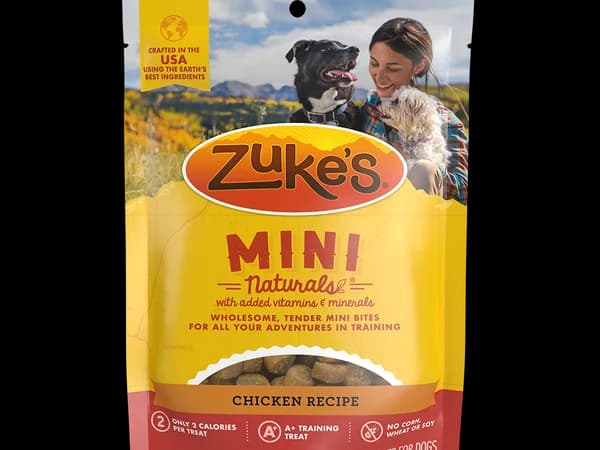
Zuke's Mini Naturals have been the go-to training treat for professional dog trainers for years, and the reason is simple math: 3 calories per treat. That means you can run through 40 treats in a training session and add only 120 calories to your dog's daily intake, roughly the equivalent of a tablespoon of kibble. For a 30-pound dog on a 900-calorie daily budget, that is manageable without adjusting meal portions.
The treats are genuinely small, about the size of a blueberry, and they are soft enough to eat instantly without breaking focus during a training sequence. The chicken recipe uses real chicken as the first ingredient, supplemented with cherries, turmeric, and rosemary. No corn, wheat, soy, or artificial anything. The texture holds up well in a treat pouch without turning into a crumbly mess after an hour, which is a problem I have had with cheaper alternatives.
At $15.79 for a 16-ounce bag, Zuke's sit in the mid-range price-wise, but the per-treat cost is exceptionally low given the small size. Read our full review for the complete breakdown.
Full Moon Chicken Jerky: Best Human-Grade Option
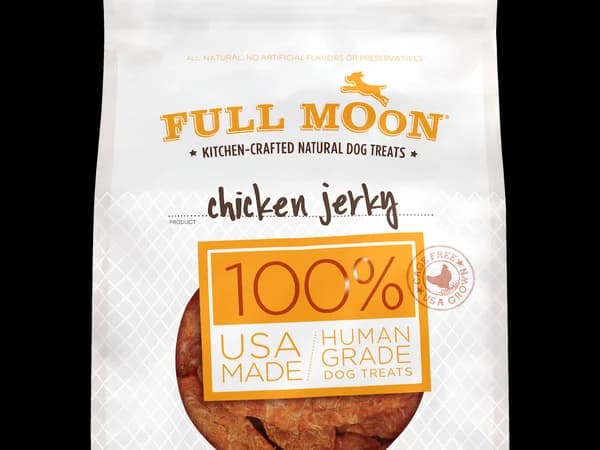
Full Moon takes an approach that sounds like marketing but is actually meaningful: every ingredient is USDA-certified human-grade. That designation is not cosmetic. It means the chicken is sourced, handled, and processed in facilities that meet human food safety standards, a bar that most pet food manufacturers do not clear. You could technically eat these yourself, and they would taste like slightly bland chicken jerky.
The jerky strips are larger than Zuke's, so they work better as an everyday reward or a high-value treat you can tear into smaller pieces. The ingredient list is refreshingly short: chicken breast, dried cane molasses, vinegar, and rosemary extract. That is it. No fillers, no glycerin, no artificial preservatives.
At $17.99 for 24 ounces, Full Moon is one of the better values in the premium treat space. The strips are thick and meaty, so a single bag lasts longer than you might expect. The downsides are real: they can dry out if you leave the bag open, and the larger size makes them less ideal for rapid-fire training repetitions. But for everyday treating and as a tear-apart high-value reward, they are excellent. See our full review.
Best Dental Chews
Dental health is one of the most overlooked aspects of dog care. By age three, over 80% of dogs show signs of periodontal disease, and the resulting vet bills can run into thousands. Dental chews are not a replacement for professional cleanings, but the right ones can meaningfully slow plaque and tartar buildup between visits.
GREENIES Original Dental Chews: Most Widely Recommended
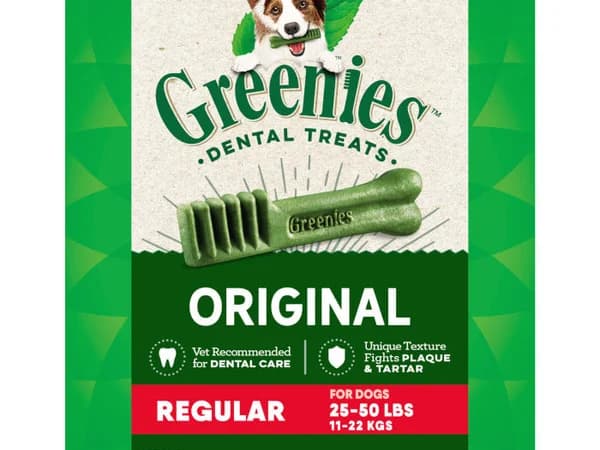
GREENIES carry the VOHC (Veterinary Oral Health Council) seal of acceptance, which means their plaque and tartar reduction claims have been independently verified through clinical trials. That seal matters more than any marketing copy on the packaging. The textured shape is designed to reach the back teeth where tartar accumulates most, and the chew time is long enough, about 5-10 minutes for most dogs, to provide meaningful mechanical cleaning.
The ingredient list is where GREENIES get more complicated. The first few ingredients are wheat flour, wheat gluten, and glycerin, not exactly the clean label you see on premium treats. They also contain added vitamins and chlorophyll extract for breath freshening. For a treat whose primary job is dental cleaning rather than nutrition, this is an acceptable trade-off, but it is worth knowing.
At $39.99 for a 27-count pack of Regular size, GREENIES are not cheap. That works out to roughly $1.48 per chew for daily use. But compare that to a $400-$800 professional dental cleaning under anesthesia, and the math starts to favor prevention. Read our full review for a deeper look at efficacy.
WHIMZEES Brushzees: Best Natural Dental Chew
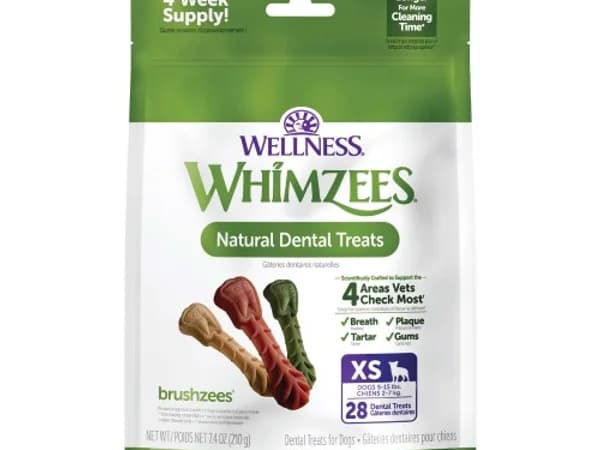
WHIMZEES Brushzees take a different approach from GREENIES by using an all-natural, vegetable-based formula that is grain-free and free from artificial additives. The main ingredients are potato starch, glycerin, powdered cellulose, and lecithin, simpler and cleaner than most dental chews on the market. For dogs with grain sensitivities or owners who want a more natural option, this is the dental chew I recommend.
The toothbrush-shaped design with raised bristle textures gives dogs multiple angles of cleaning as they chew. In my research, dogs typically spend 10-15 minutes on a Brushzee, which is longer than most dental chews and means more contact time for plaque removal. They are also lower in calories than GREENIES, about 16 calories for a small versus 27 for a comparable GREENIES, which matters for smaller breeds where every calorie counts.
At $15.82, they are a solid value compared to GREENIES' premium pricing. The trade-off is that WHIMZEES do not carry the VOHC seal, so the dental claims lack independent clinical validation. That said, the mechanical cleaning action is real, and the ingredient quality is notably higher. See our full review.
Best Premium & Freeze-Dried Treats
For owners who want the cleanest possible ingredient list and the highest nutritional value, freeze-dried raw treats are in a category of their own. They are minimally processed, nutrient-dense, and dogs go absolutely wild for them.
Stewart Freeze Dried Raw Beef Liver: Best Single-Ingredient Treat
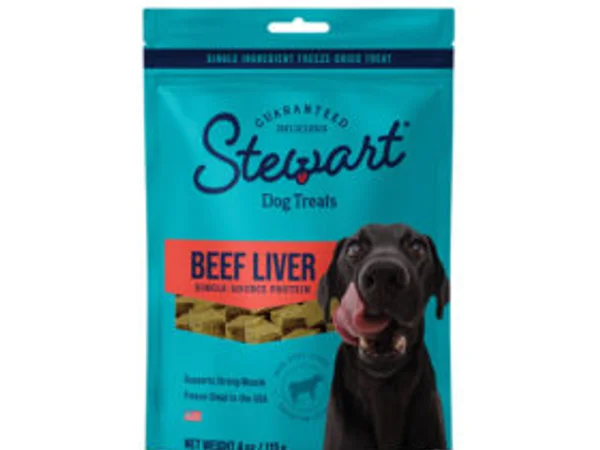
Stewart Freeze Dried Raw Beef Liver is the treat I give when I want a guaranteed response. The ingredient list is one item long: beef liver. That is it. No fillers, no preservatives, no added flavors. Just liver that has been freeze-dried to preserve nutrients while creating a lightweight, shelf-stable treat that snaps apart easily.
The nutritional profile is genuinely impressive. Beef liver is one of the most nutrient-dense foods on the planet, packed with iron, B vitamins, vitamin A, and high-quality protein. Unlike many commercial treats that are essentially empty calories, these contribute real nutritional value. The freeze-drying process retains significantly more nutrients than baking or dehydrating, which is why raw-feeding advocates consider freeze-dried treats the next best thing to actual raw food.
At $36 for a 14-ounce tub, Stewart is the most expensive option in this guide on a per-ounce basis. But the treats are incredibly light, a single tub contains hundreds of pieces, so the per-treat cost is actually reasonable. They break apart easily into smaller pieces for training, and the intense liver flavor makes them a high-value reward that works even with dogs who are picky or easily distracted.
The downsides are real: they smell like liver (which is to say, not great for humans), they can crumble in a treat pouch, and the light texture means they blow away outdoors if you are not careful. But in terms of ingredient quality and dog enthusiasm, nothing else in this guide comes close. Read our full review for the complete assessment.
Head-to-Head: Zuke's Mini Naturals vs Full Moon Chicken Jerky
These are two of the best-selling training and reward treats on the market, but they serve different purposes. Here is where each one wins.
Calorie control: Zuke's takes this decisively. At 3 calories per treat, you can use them freely during training without blowing your dog's calorie budget. Full Moon's jerky strips are larger and higher in calories per piece, though you can tear them into smaller portions.
Ingredient quality: Full Moon edges ahead. USDA human-grade certification is a higher standard than "natural" labeling, and Full Moon's ingredient list is shorter and cleaner. Zuke's are good, no artificial additives, real chicken first, but they include more supplementary ingredients like turmeric and rosemary.
Training practicality: Zuke's, without question. The uniform small size, soft texture, and quick-eat format are purpose-built for rapid reinforcement during training. Full Moon strips need to be torn apart and are chewier, which slows the training loop.
Everyday rewarding: Full Moon wins here. The larger strips feel more substantial as a reward, the meaty texture satisfies dogs for longer, and the jerky format is satisfying to hand over in a way that a pea-sized treat is not.
Value: Full Moon offers better cost per ounce ($0.75/oz vs $0.99/oz for Zuke's), but Zuke's offers better cost per treat given the tiny size. It depends on how you measure value.
The verdict: Buy both. Seriously. Zuke's for training sessions where you need speed and calorie control, and Full Moon for everyday rewards and high-value situations. They are complementary, not competitive.
Budget vs Premium: Is It Worth the Upgrade?
This is the question I hear most from dog owners, and my answer depends on the category.
Training treats: mid-range is the sweet spot. You do not need to spend $36 on freeze-dried liver for daily training, Zuke's at $15.79 for 16 ounces hits the right balance of ingredient quality and per-treat cost. Budget training treats (under $8 per bag) tend to be loaded with fillers and artificial flavors that can cause digestive upset with heavy use. Spend a little more here.
Dental chews: the premium is justified. Cheap dental chews are essentially flavored starch with no clinical evidence of dental benefit. GREENIES and WHIMZEES cost more because they are engineered for actual plaque removal. When you compare $40 per month on dental chews versus $400-$800 for a veterinary dental cleaning, the premium option is the budget option long-term.
Freeze-dried treats: worth it for specific use cases. Stewart's freeze-dried liver at $36 per tub is expensive, but it is the best option for dogs with food sensitivities, picky eaters, or high-stakes training situations where you need maximum motivation. For everyday casual treating, you do not need to spend at this level, Full Moon at $17.99 for 24 ounces delivers excellent quality at a more accessible price.
The one area I would not recommend going budget is treats with vague sourcing. "Made with real chicken" on a $5 bag from an unknown brand is a gamble with your dog's digestive system. Stick with brands that list specific ingredient sources and manufacturing locations.
The Bottom Line
The best dog treats in 2026 are better than they have ever been, with more transparency, cleaner ingredients, and genuine functional benefits. My top pick overall is the Stewart Freeze Dried Raw Beef Liver for its unmatched ingredient purity and dog appeal. For training, Zuke's Mini Naturals remain the benchmark at 3 calories per treat. And for dental health, WHIMZEES Brushzees offer the best combination of natural ingredients and mechanical cleaning action.
The common thread across all my recommendations: read the ingredient list, calculate the per-treat calorie cost, and match the treat to its intended purpose. A great training treat is not the same as a great dental chew, and neither is a substitute for a balanced diet. If you are also evaluating your dog's primary nutrition, check out our guides to the best dry dog food and best wet dog food for complete recommendations.
Your dog does not care about branding. They care about taste, and their body cares about what is actually in the bag. Choose accordingly.
Frequently Asked Questions
How many treats per day is too many?
The general veterinary guideline is that treats should make up no more than 10% of your dog's daily caloric intake. For a 30-pound dog eating roughly 900 calories per day, that is 90 calories from treats. With Zuke's Mini Naturals at 3 calories each, that allows 30 treats per day, more than enough for training. With larger treats like Full Moon jerky strips, you will hit that ceiling faster. The key is to track treat calories and adjust meal portions accordingly, especially during periods of heavy training.
Are grain-free treats better for dogs?
Not necessarily. The grain-free trend in pet food has been largely driven by marketing rather than veterinary science. Most dogs digest grains perfectly well, and the FDA has investigated a potential link between grain-free diets and dilated cardiomyopathy (DCM) in dogs. Unless your dog has a diagnosed grain allergy or sensitivity, confirmed by a veterinarian, not a pet store employee, there is no reason to specifically seek out grain-free treats. Focus on ingredient quality and protein sources rather than the presence or absence of grains.
Can I use human food as dog treats instead?
Yes, with important caveats. Small pieces of cooked chicken, blueberries, carrots, and apple slices are all safe and nutritious dog treats. Many professional trainers actually prefer using plain boiled chicken for high-value training. However, avoid grapes, raisins, onions, garlic, chocolate, xylitol (often found in sugar-free foods), and macadamia nuts, all of which are toxic to dogs. The advantage of commercial treats is consistency and convenience. The advantage of human food is cost and ingredient transparency. Both approaches work; just know what is safe and what is not.
Do dental chews actually replace brushing my dog's teeth?
No. Dental chews reduce plaque and tartar buildup, but they do not replace mechanical brushing or professional veterinary cleanings. Think of dental chews as one tool in a broader oral health strategy. The VOHC-accepted products like GREENIES have clinical evidence of plaque reduction, but even those are designed to supplement, not replace, regular dental care. If your dog tolerates tooth brushing, that remains the single most effective thing you can do for their dental health at home. Dental chews are the next best option for dogs who will not tolerate a toothbrush, which, honestly, is most dogs.