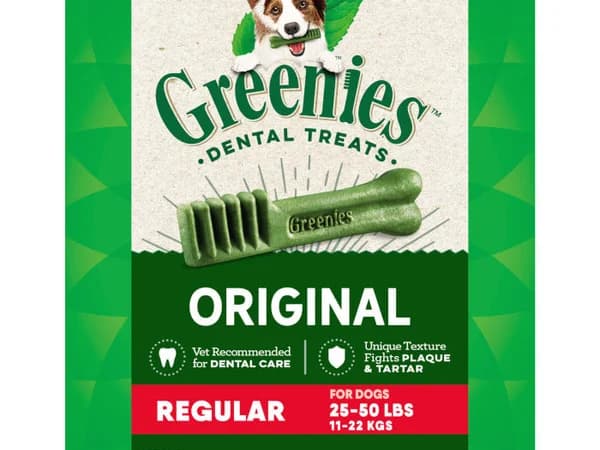

GREENIES Original Regular Dental Chews Review
Greenies are the most recognized dental treat for good reason — VOHC-accepted for plaque and tartar control with a shape dogs actually enjoy chewing. The calorie count and grain content are trade-offs, but no other treat in this comparison delivers the same level of dental benefit.

GREENIES Original Regular Dental Chews Review
Greenies are the most recognized dental treat for good reason — VOHC-accepted for plaque and tartar control with a shape dogs actually enjoy chewing. The calorie count and grain content are trade-offs, but no other treat in this comparison delivers the same level of dental benefit.
GREENIES Original Regular Dental Chews Review
Greenies are the most recognized dental treat for good reason — VOHC-accepted for plaque and tartar control with a shape dogs actually enjoy chewing. The calorie count and grain content are trade-offs, but no other treat in this comparison delivers the same level of dental benefit.

GREENIES Original Regular Dental Chews Pros & Cons
Pros
- VOHC-accepted for plaque and tartar control — clinically proven dental benefit
- Unique toothbrush shape reaches back teeth for thorough cleaning
- Highly palatable — most dogs treat these as a reward, not a chore
Cons
- Higher calorie count per chew (139 kcal for regular size) — not low-cal
- Contains wheat flour and wheat gluten — not grain-free
- Premium price per treat compared to standard biscuit options
Overview
GREENIES are what happens when a treat company takes dental health seriously enough to submit their product for clinical validation. The Veterinary Oral Health Council (VOHC) seal on the packaging is not a marketing badge you can buy; it requires independent testing proving the product actually reduces plaque and tartar buildup. Most dental treats claim to clean teeth. Greenies proved it.
The distinctive toothbrush shape is more than visual branding. The flexible ridges and grooved texture are engineered to wrap around teeth as your dog chews, reaching surfaces that standard treats never contact. Dogs tend to genuinely enjoy these rather than treating them as medicine, which matters when you are trying to build a daily dental routine. The catch is that each Regular-sized chew packs 139 calories, so this is not a casual snack. It is a deliberate daily dental intervention that needs to be accounted for in your dog's overall diet. The wheat-based formula also rules out dogs with grain sensitivities. But if your dog tolerates grains and you want the single most effective dental treat available, GREENIES have earned that reputation through clinical evidence rather than marketing claims.
Features Deep-Dive
VOHC Acceptance and What It Actually Means
The VOHC seal is the closest thing to FDA approval in the pet dental world. To earn it, a product must demonstrate measurable plaque or tartar reduction in controlled trials compared to a control group. GREENIES carry acceptance for both plaque and tartar, which is relatively uncommon. Many dental treats earn one designation or the other, but not both. In practical terms, this means daily use of a GREENIES chew provides a clinically meaningful supplement to brushing, and for owners who cannot or will not brush their dog's teeth, it provides the next best mechanical cleaning action. This does not replace veterinary dental cleanings for dogs with existing periodontal disease, but it genuinely slows the accumulation of new buildup between professional cleanings.
The Toothbrush Shape and Chew Mechanics
The shape is not arbitrary. The elongated form with raised nubs encourages dogs to chew along the length of the treat rather than biting down and swallowing chunks. This lateral chewing action is what scrubs tooth surfaces. The flexible but firm texture means the treat bends around individual teeth, contacting the gum line where plaque concentrates. Most dogs take 5 to 10 minutes to finish a Regular-sized GREENIES, which is the sweet spot for meaningful dental contact time. Dogs that inhale treats in under a minute get minimal dental benefit from any product. If your dog is a speed-eater, you may want to consider a size up from what the weight chart recommends, not for calorie reasons but to extend chew time.
Palatability as a Dental Compliance Strategy
The biggest obstacle to pet dental care is not product effectiveness; it is owner compliance. Brushing a dog's teeth daily is the gold standard, but surveys consistently show that fewer than 5% of owners actually do it. GREENIES solve this by making the dental routine something your dog actively looks forward to. Most dogs will come running when they hear the bag crinkle. This high palatability transforms dental care from a chore into a treat ritual, which dramatically increases the likelihood you will actually maintain a daily schedule. The chicken flavor drives most of this appeal, though the chewy texture itself seems to be intrinsically rewarding for dogs who enjoy sustained chewing.
Pricing Analysis
At $39.99 for a 27-count box of Regular-sized chews, you are paying about $1.48 per daily dental treatment. Annualized, that is roughly $540 per year. That sounds steep until you compare it to the alternative: a professional veterinary dental cleaning runs $300 to $800 per session, and most vets recommend annual cleanings at minimum. If GREENIES extend the interval between professional cleanings by even six months, they pay for themselves. The per-treat price also compares favorably to other VOHC-accepted dental products, many of which cost $2 or more per unit. For a multi-dog household, the cost multiplies quickly, but so do the vet bills for dental disease. Buying in bulk through subscription services can shave 10 to 15 percent off the sticker price, bringing the daily cost closer to $1.25.
Who Is This For?
-
Owners who cannot or will not brush their dog's teeth and need the most effective passive dental care available. GREENIES are the single best substitute for daily brushing based on clinical evidence.
-
Dogs prone to dental disease, including small breeds like Yorkshire Terriers, Dachshunds, and Cavalier King Charles Spaniels, where periodontal problems are disproportionately common and professional cleanings require anesthesia.
-
Routine-oriented owners who want a simple daily ritual. One GREENIES chew after dinner is easy to remember and easy to maintain, which is the entire point of a compliance-driven dental product.
-
Owners looking to reduce long-term vet costs by slowing plaque and tartar accumulation between professional dental cleanings.
Who Should NOT Use This
-
Dogs with grain allergies or sensitivities need to look elsewhere. Wheat flour and wheat gluten are primary ingredients, making GREENIES incompatible with grain-free dietary requirements. Consider a grain-free dental chew alternative or raw bones under veterinary supervision.
-
Calorie-conscious owners managing overweight dogs should think carefully. At 139 calories per Regular chew, a daily GREENIES habit adds nearly 1,000 calories per week. For a 30-pound dog eating 900 calories daily, that is a 15% caloric increase. You would need to reduce meal portions accordingly, and some owners find that trade-off impractical.
-
Dogs that swallow treats whole without chewing gain almost no dental benefit and face a choking or obstruction risk. If your dog consistently finishes a GREENIES in under two minutes, the product is not functioning as designed.
Bottom Line
GREENIES are the most clinically validated dental treat on the market, backed by VOHC acceptance for both plaque and tartar reduction. The calorie load and wheat-based formula are real trade-offs, but no other treat delivers this level of proven dental benefit in a format dogs actually enjoy.
FAQ
How long should it take my dog to finish one GREENIES chew?
A properly sized GREENIES should take your dog 5 to 10 minutes to finish. This chew time is critical because the dental benefit comes from sustained contact between the treat's textured surface and your dog's teeth. If your dog finishes in under 2 minutes, try the next size up. If they take more than 15 minutes, they may be struggling with the texture and a smaller size could be more appropriate.
Can I give GREENIES to a puppy?
GREENIES makes a separate Puppy formula for dogs 6 months and older with a softer texture suited to developing teeth and jaws. The Original Regular formula is designed for adult dogs 25 to 50 pounds. Do not give adult GREENIES to puppies under 6 months, as the firmer texture is not appropriate for immature dentition.
Do GREENIES replace brushing my dog's teeth?
Nothing fully replaces brushing, but GREENIES are the closest substitute backed by clinical evidence. Ideally, you would brush your dog's teeth daily and give a GREENIES chew for supplemental cleaning. Realistically, most owners do neither, and a daily GREENIES habit provides meaningfully better dental outcomes than doing nothing. Your vet can assess whether GREENIES alone are sufficient for your dog's specific dental health status.
Are GREENIES safe after the old choking concerns?
GREENIES reformulated in 2006 to improve digestibility after early reports of gastrointestinal issues. The current formula is designed to break down more easily when swallowed. However, the fundamental safety rule still applies: always match the treat size to your dog's weight range, and supervise during chewing. Dogs that try to swallow large chunks of any treat face obstruction risk, and GREENIES are no exception.
Who Is GREENIES Original Regular Dental Chews Best For?
Owners who want a treat that doubles as proven dental care
The Bottom Line
Greenies are the most recognized dental treat for good reason — VOHC-accepted for plaque and tartar control with a shape dogs actually enjoy chewing. The calorie count and grain content are trade-offs, but no other treat in this comparison delivers the same level of dental benefit.
Try GREENIES Original Regular Dental Chews TodayKey Specs
Scoring Breakdown
Named protein sources, whole ingredients, absence of fillers (corn/wheat/soy), artificial colors/flavors/preservatives. Penalizes byproducts, unnamed meats, BHA/BHT/ethoxyquin.
Calorie density appropriate for treat use, nutritional value per calorie, protein-to-filler ratio. Training treats evaluated on low-cal suitability (<5 kcal/treat ideal).
Named vs unnamed protein sources, sourcing clarity (country of origin, farm certifications), traceability, absence of vague terms like "animal digest" or "meat meal."
Brand recall history over 5+ years, manufacturing standards, third-party contamination testing, FDA compliance track record.
Dog taste acceptance rate across breeds and sizes, texture quality, aroma appeal, ease of use for training or dental purposes.
Cost per treat, cost per calorie, quality-adjusted value. Best quality per dollar spent, not cheapest overall.