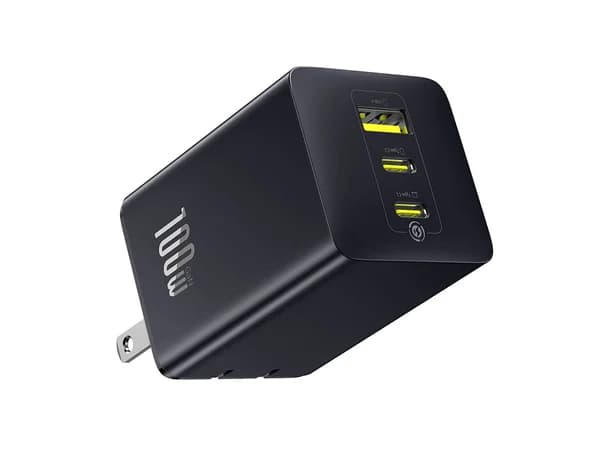
Anker wins for users who want per-port power monitoring, PD 3.1 future-proofing, and premium build quality. Baseus wins for buyers who want 100W charging at the lowest possible price with the broadest protocol support.
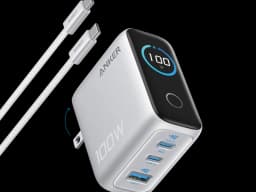
Anker 100W 3-Port Smart Display
Tech enthusiasts who want per-port power monitoring on a high-power multi-port charger
Baseus EnerFill FE11 100W
Power users wanting maximum wattage at the lowest price for laptop and multi-device charging

Score Comparison
Quick Verdict
The Anker 100W 3-Port Smart Display ($69.99) and Baseus EnerFill FE11 100W ($49.99) deliver identical total wattage across the same port configuration (2 USB-C + 1 USB-A), but they target fundamentally different buyers. The Anker adds a per-port wattage display, PD 3.1 support, and ActiveShield 2.0 for a $20 premium. The Baseus counters with the best watt-per-dollar ratio in the entire roundup and UFCS protocol support. If $20 matters more than the display, buy the Baseus. If you want the full-featured experience, buy the Anker.
Head-to-Head Comparison
Charging Power
Winner: Tie
Both chargers deliver 100W total output. The primary USB-C port on each pushes the full 100W when used alone, enough to charge a 14-inch MacBook Pro at its maximum USB-C speed. Under multi-port load, both redistribute power dynamically. A typical three-port scenario on either charger delivers roughly 65W to the primary USB-C, 20-25W to the secondary USB-C, and 10-15W to the USB-A port.
The Anker's PD 3.1 support means it negotiates power delivery through the newer protocol, while the Baseus uses PD 3.0 at the same 100W ceiling. At exactly 100W, both protocols deliver power identically -- PD 3.1's 48V Extended Power Range only matters above 100W. The difference is future-proofing: as devices increasingly expect PD 3.1 negotiation, the Anker will handle those handshakes natively while the Baseus falls back to PD 3.0.
In practice today, charging speeds are indistinguishable between the two. Your MacBook Pro, iPhone, and Galaxy phone charge at the same rate on either charger.
Protocol Support
Winner: Baseus EnerFill FE11 100W
The Baseus supports PD 3.0, PPS, QC, and UFCS. The Anker supports PD 3.1, PPS, and QC but adds UFCS as well. Where the Baseus edges ahead is in the sheer breadth of compatibility at its price point -- four protocols for $49.99 versus three-plus-UFCS for $69.99.
The Anker's PD 3.1 advantage is largely theoretical at 100W, where PD 3.0 is fully sufficient. UFCS support on the Baseus future-proofs it for Chinese-market devices from Xiaomi, Oppo, and OnePlus. PPS handles Samsung Galaxy fast charging on both chargers. QC covers legacy Android accessories on both.
The real-world protocol difference between these two chargers is negligible for most users. Both fast-charge iPhones, Galaxy phones, Pixels, and MacBooks identically. The Baseus's advantage is doing it at a $20 lower price point, not doing it measurably better.
Smart Features and Monitoring
Winner: Anker 100W 3-Port Smart Display
This is the defining differentiator. The Anker's smart display shows real-time wattage per port, turning charging from a trust-based activity into a transparent one. When you plug in a laptop and see "67W" on the display, you know the cable is good, the protocol negotiated correctly, and power is flowing as expected. When you see "5W" on what should be a 25W phone charge, you know something is wrong -- likely a bad cable or a port that did not negotiate properly.
The Baseus has an LED indicator that confirms power is flowing but provides no detail. You know the charger is on. You do not know what each device is getting. For most users most of the time, this is fine. Chargers work as designed. But the first time your laptop charges slowly because of a degraded cable and you cannot figure out why, the Anker's display would have told you in seconds.
Beyond diagnostics, the display provides ambient information that power users find genuinely satisfying: total wattage across all ports, individual device charging rates, and visual confirmation that the charger is not idling when it should be working. It is the difference between a thermostat with a temperature reading and one with just an on/off light.
Build Quality
Winner: Anker 100W 3-Port Smart Display
The Anker's housing is denser, with a matte finish that resists fingerprints. ActiveShield 2.0 provides continuous thermal monitoring with gradual power reduction rather than abrupt cutoffs. Foldable prongs have a solid, precise mechanism. The overall impression is of a well-engineered product designed to sit on a desk for years.
The Baseus uses lighter-weight polycarbonate that is functional but unremarkable. Thermal management relies on standard protections (over-voltage, over-current, over-temperature) without the granular monitoring of ActiveShield. The foldable prongs work fine but lack the Anker's tactile precision. It is a perfectly adequate charger that does not pretend to be premium.
The $20 gap between these two chargers is largely explained by the display and build quality. The Anker costs more because it costs more to make. The Baseus costs less because Baseus prioritizes specifications over fit-and-finish. Neither approach is wrong.
Value
Winner: Baseus EnerFill FE11 100W
At $49.99, the Baseus delivers 100W across three ports at $0.50 per watt -- the best ratio in the entire roundup. The Anker at $69.99 works out to $0.70 per watt. On pure charging capability per dollar, the Baseus wins decisively. The $20 delta buys the Anker's display, ActiveShield, and premium build.
The value question is straightforward: is the display worth $20? If you will actively use it to monitor charging, troubleshoot issues, and verify power delivery, yes. If you plug in your devices overnight and check them in the morning, the display provides zero functional benefit and the $20 is better saved.
Another way to frame it: the $20 saved on the Baseus buys a high-quality USB-C cable, which arguably has more impact on charging performance than any feature difference between these two chargers. A premium cable with proper e-marker chip ensures your devices negotiate maximum wattage with either charger. A cheap cable limits both equally.
When to Choose Anker 100W 3-Port Smart Display
The Anker is the right choice when:
- You want to see what your charger is doing: The per-port display is genuinely useful for troubleshooting and satisfying for anyone who likes data visibility
- PD 3.1 future-proofing matters: As more devices adopt PD 3.1, native support avoids potential protocol negotiation edge cases
- You value premium build quality: Denser construction, ActiveShield 2.0, and Anker's customer support infrastructure add long-term confidence
- This charger will be a desk fixture for years: The build quality and safety features are designed for sustained, high-wattage daily use
When to Choose Baseus EnerFill FE11 100W
The Baseus is the right choice when:
- Price is the priority: $49.99 for 100W is the single best value in the charger market, full stop
- You do not need a display: If "plug in and trust" is your charging workflow, the display provides no benefit and you are paying $20 for a feature you will not use
- You want the broadest protocol support at the lowest price: UFCS future-proofing at $49.99 is remarkable value
- You would rather spend the $20 on accessories: A quality USB-C cable or a separate compact travel charger may serve you better than a display you rarely look at
Final Recommendation
Choose the Anker 100W 3-Port Smart Display if charging transparency and premium build quality are worth $20 to you. The display is not a gimmick -- it is a genuinely useful feature that makes charging visible and diagnosable. Combined with ActiveShield 2.0 and PD 3.1, it is the more complete 100W charger.
Choose the Baseus EnerFill FE11 100W if you want 100W charging for the absolute lowest price. The charging performance is identical, the protocol support is arguably broader, and the $20 you save can be redirected to other parts of your setup. The build quality is adequate, not exceptional, and the lack of a display means trusting that the charger is doing its job without verification.
The Anker is the better product. The Baseus is the better deal. Your priorities determine which definition of "better" matters more.
Pricing & Features
Making Your Decision

When to Choose Anker 100W 3-Port Smart Display
Tech enthusiasts who want per-port power monitoring on a high-power multi-port charger
The Anker 100W 3-Port Smart Display is the premium choice for power users who want full visibility into their charging. Its PD 3.1 support and smart display make it future-proof and feature-rich.
Strengths
- Smart display shows real-time wattage for each port
- PD 3.1 and UFCS support for next-gen fast charging
- Premium Anker build with ActiveShield 2.0 safety
- 3 ports (2 USB-C + 1 USB-A) with intelligent power allocation
Limitations
- Premium price at $69.99 for 100W
- Larger than competitors without displays
- Display adds to power draw when idle

When to Choose Baseus EnerFill FE11 100W
Power users wanting maximum wattage at the lowest price for laptop and multi-device charging
The Baseus EnerFill FE11 delivers 100W of charging power for just $49.99, making it the best value high-power charger. Broad protocol support and 3 ports make it a versatile desktop or travel companion.
Strengths
- 100W output for $49.99 — best watt-per-dollar in its class
- 3 ports (2 USB-C + 1 USB-A) with smart power distribution
- PD 3.0, PPS, QC, and UFCS protocol support
- LED indicator shows charging status
Limitations
- Larger form factor than lower-wattage chargers
- No smart display like Anker competitors
- Plastic construction feels less premium