Anker 100W 3-Port Smart Display Review
The Anker 100W 3-Port Smart Display is the premium choice for power users who want full visibility into their charging. Its PD 3.1 support and smart display make it future-proof and feature-rich.

Anker 100W 3-Port Smart Display Review
The Anker 100W 3-Port Smart Display is the premium choice for power users who want full visibility into their charging. Its PD 3.1 support and smart display make it future-proof and feature-rich.
Anker 100W 3-Port Smart Display Review
The Anker 100W 3-Port Smart Display is the premium choice for power users who want full visibility into their charging. Its PD 3.1 support and smart display make it future-proof and feature-rich.

Anker 100W 3-Port Smart Display Pros & Cons
Pros
- Smart display shows real-time wattage for each port
- PD 3.1 and UFCS support for next-gen fast charging
- Premium Anker build with ActiveShield 2.0 safety
- 3 ports (2 USB-C + 1 USB-A) with intelligent power allocation
Cons
- Premium price at $69.99 for 100W
- Larger than competitors without displays
- Display adds to power draw when idle
Overview
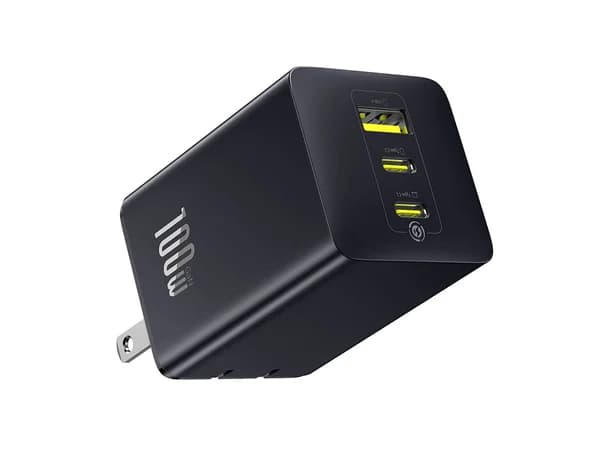
The Anker 100W 3-Port Smart Display is the charger for people who actually want to know what their charger is doing. While most multi-port chargers leave you guessing about power allocation, Anker built a small LED display directly into the front panel that shows real-time wattage flowing through each port. Plug in your laptop and watch it negotiate 65W. Add your phone and see the split adjust to 65W/30W. It turns an invisible process into something tangible, and once you have used it, going back to a blind charger feels like driving without a speedometer.
Beyond the display gimmick that is actually not a gimmick, this is a genuinely capable 100W charger with three ports (two USB-C, one USB-A) and support for both PD 3.1 and UFCS. That protocol breadth matters because it means this charger is not just ready for today's devices but also for next-generation phones and laptops that will negotiate higher voltages. ActiveShield 2.0 temperature monitoring runs continuously, adjusting power output to prevent overheating. This is Anker at its most Anker: taking a commodity product and adding just enough intelligence to justify the premium, while backing it with build quality that makes the price feel reasonable.
Features Deep-Dive
Smart Display and Real-Time Monitoring
The LED display on the front of the charger is small but sharp, and it updates in real time as devices connect and disconnect. You see each port's current wattage output, which means you can instantly verify whether your laptop is actually fast-charging or if a faulty cable has dropped it to 5W trickle mode. This is not a feature most people think they need until they have it. Diagnosing slow charging on other chargers usually means swapping cables, checking adapters, and guessing. Here, you just look at the number. The display brightness is modest enough not to be distracting on a nightstand, though it cannot be fully disabled. It draws a small amount of power even when no devices are connected, but the draw is negligible at under 0.5W.
PD 3.1 and UFCS Protocol Support
This is one of the few 100W chargers that supports both PD 3.1 and UFCS, which positions it as genuinely future-proof. PD 3.1 enables higher voltage charging (up to 48V) that newer laptops and devices are beginning to support, while UFCS (Universal Fast Charging Specification) is the emerging standard backed by Chinese manufacturers including Huawei, Oppo, and Xiaomi. If you use devices from multiple ecosystems or plan to for the next few years, having both protocols means this charger will negotiate the fastest possible speed with whatever you plug in. Most competing 100W chargers still top out at PD 3.0, which works fine today but may leave performance on the table as devices evolve.
Build Quality and ActiveShield 2.0
Anker's build quality has been a consistent strength for years, and the 100W Smart Display continues that reputation. The housing is a dense, matte-finish plastic that resists scratches and feels substantial in hand. Internally, ActiveShield 2.0 monitors temperature through multiple sensors and dynamically adjusts power delivery to prevent overheating. This is not just marketing: GaN chargers can run warm under sustained load, and active thermal management means the charger throttles gracefully rather than shutting down unexpectedly when you are in the middle of a critical charge. The foldable prongs are solid with no wobble, and the overall fit and finish feels a tier above most competitors at this wattage.
Pricing Analysis
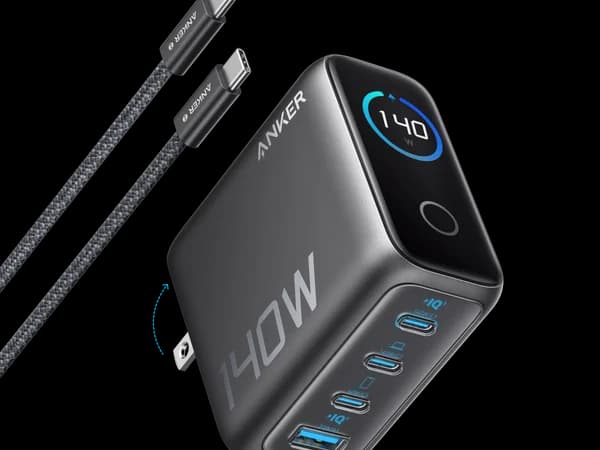
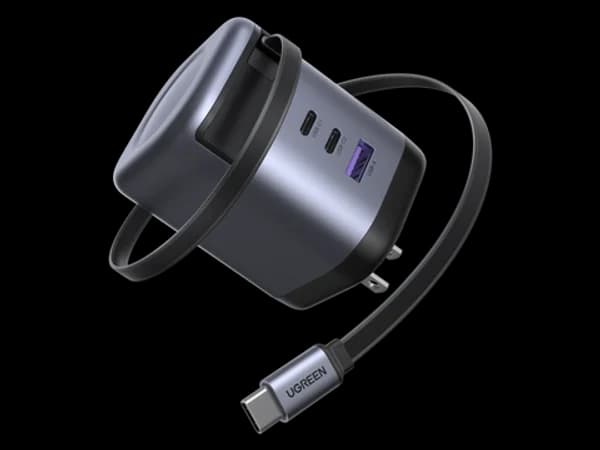
At $69.99, the Anker 100W Smart Display commands a significant premium over basic 100W chargers, which can be found for $35-45 from reputable brands. That roughly $25-35 premium buys you the smart display, PD 3.1 future-proofing, a third port, and Anker's ActiveShield 2.0 safety system. Whether that is worth it depends on how much you value visibility and protocol breadth. Compared to the Ugreen Nexode 100W Retractable at $59.99, you trade the built-in cable for a display and an extra port. Against the Baseus PicoGo AH11 140W at $79.99, you spend $10 less but get 40W less total output and one fewer port. The sweet spot for this charger is the user who wants more than a basic brick but does not need 140W desktop-class power.
Who Is This For?
- Tech enthusiasts and tinkerers who want to see exactly what is happening with their charging. If you have ever wondered whether your cable is actually delivering fast-charge speeds or if your laptop is getting the power it negotiated, the smart display answers that question at a glance.
- Multi-device households where three devices regularly need charging at once. Two USB-C ports and one USB-A port cover the typical modern setup of a laptop, phone, and a legacy accessory like a Kindle or older Bluetooth headphones.
- Early adopters who buy devices from multiple ecosystems. PD 3.1 and UFCS support together mean this charger speaks the widest range of fast-charging dialects in the 100W class, so whatever phone or laptop you buy next, it will likely charge at maximum speed.
Who Should NOT Use This
- Budget-conscious buyers who just need reliable power. If you do not care about seeing per-port wattage and your devices all use standard PD 3.0, there are perfectly capable 100W chargers from Ugreen, Baseus, and others for $20-30 less that will charge your devices at identical speeds today.
- Frequent travelers prioritizing size. The display and three-port design make this charger noticeably larger than minimalist two-port 100W alternatives. If every cubic centimeter in your bag matters and you only charge one or two devices, a slimmer option like the Ugreen Retractable or a compact single-port charger will serve you better on the road.
Bottom Line
The Anker 100W 3-Port Smart Display takes a commodity product and makes it genuinely smarter. The real-time wattage display is one of those features that sounds unnecessary until you use it, then becomes indispensable for diagnosing charging issues and confirming your devices are getting the power they need. PD 3.1 and UFCS support add real future-proofing, and Anker's build quality remains a cut above. The premium price is justified if you value information and longevity, though buyers who just want watts delivered quietly should look at less expensive alternatives.
FAQ
Does the display stay on all the time, even when nothing is plugged in?
The display dims significantly when no devices are connected but does not turn off completely. It shows a low-power standby indicator. The idle power draw is minimal, under 0.5W, so it will not meaningfully affect your electricity bill. If the ambient glow bothers you at night, positioning the charger behind a nightstand or using a different outlet solves the issue.
Can this charger handle a MacBook Pro and an iPhone simultaneously?
Yes. When charging two devices, the typical split is 65W on the primary USB-C port and 30W on the secondary USB-C port. That is enough to fast-charge a 14-inch MacBook Pro and an iPhone simultaneously. If you add a third device on the USB-A port, power redistributes further, but the laptop still receives enough to charge, just at a somewhat slower rate.
What is the difference between PD 3.1 and regular PD 3.0?
PD 3.1 extends the USB Power Delivery standard to support higher voltages, up to 48V compared to PD 3.0's 20V maximum. In practice, this means PD 3.1 chargers can deliver more power more efficiently to devices that support it, and the standard opens the door for USB-C to eventually replace barrel-jack chargers on even larger laptops. Most current devices still negotiate PD 3.0 speeds, but PD 3.1 ensures this charger will not be outgrown as devices adopt the newer standard.
How does ActiveShield 2.0 actually work?
ActiveShield 2.0 uses multiple internal temperature sensors to monitor heat levels in real time. When the charger detects temperatures approaching its safety threshold, it dynamically reduces power output to cool down before resuming full speed. This is more sophisticated than a simple thermal cutoff, which would just shut down the charger entirely. The result is uninterrupted charging at safe temperatures rather than sudden power loss during critical moments.
Who Is Anker 100W 3-Port Smart Display Best For?
Tech enthusiasts who want per-port power monitoring on a high-power multi-port charger
The Bottom Line
The Anker 100W 3-Port Smart Display is the premium choice for power users who want full visibility into their charging. Its PD 3.1 support and smart display make it future-proof and feature-rich.
Buy on AmazonKey Specs
Scoring Breakdown
Maximum wattage output, power per port, and multi-device power distribution efficiency.
Physical size, weight, foldable prongs, and overall travel-friendliness.
Number of ports, port types (USB-C/USB-A), and multi-device charging flexibility.
Fast charging protocol support including PD 3.0/3.1, PPS, QC, UFCS, and SCP.
Materials, safety certifications (TUV, UL), thermal management, and overall construction.
Price-to-performance ratio, wattage-per-dollar, and included accessories like cables.
Display/monitoring, touch controls, smart power allocation, and device identification.