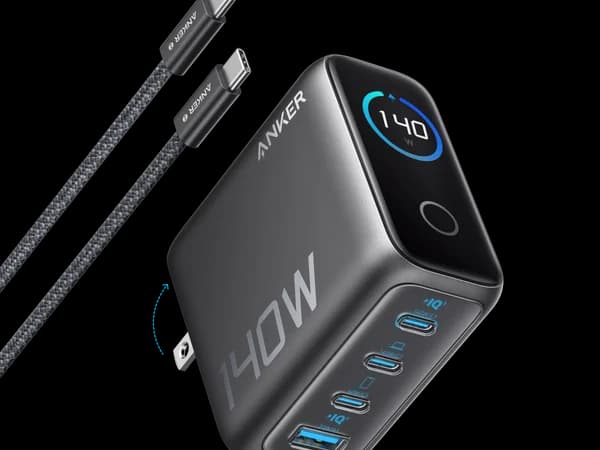
Anker wins for users who want per-port monitoring, premium build quality, and ActiveShield 2.0 safety. Baseus wins for buyers who want the same 140W power with broader protocol support at $10 less.
Anker Charger 140W 4-Port PD 3.1
Power users and professionals who need the most powerful and feature-rich desktop charger

Baseus PicoGo AH11 140W
Desk warriors who need to charge a laptop, tablet, phone, and earbuds simultaneously

Score Comparison
Quick Verdict
The Anker 140W 4-Port PD 3.1 ($89.99) and Baseus PicoGo AH11 140W ($79.99) are the two most powerful chargers in this roundup, both delivering 140W across four ports with PD 3.1 support. The Anker justifies its $10 premium with an LCD display showing real-time per-port wattage and ActiveShield 2.0 thermal monitoring. The Baseus counters with the broadest protocol support of any charger here (adding UFCS and SCP) and a lower price. Most users should buy the Baseus. Users who value build quality and charging diagnostics should pay the Anker premium.
Head-to-Head Comparison
Charging Power
Winner: Tie
Both chargers deliver 140W total output with PD 3.1 support on the primary USB-C port. When charging a single device, either will push 140W to a 16-inch MacBook Pro at its maximum USB-C charging speed. Under multi-port load, both use intelligent power distribution that dynamically reallocates wattage as devices connect and disconnect.
The practical difference is minimal. A typical four-device scenario on either charger distributes roughly 65W to the primary port, 30W to the secondary, and splits the remainder between the third USB-C and USB-A ports. Both chargers handle the same workload -- laptop, tablet, phone, and earbuds -- at effectively identical speeds. If you are choosing between these two based purely on how fast they charge your devices, you will not notice a difference.
Protocol Support
Winner: Baseus PicoGo AH11 140W
The Baseus offers the broadest protocol support of any charger in this entire roundup: PD 3.1, PPS, QC (Quick Charge), UFCS, and SCP (Super Charge Protocol). The Anker supports PD 3.1, PPS, and QC but lacks UFCS and SCP.
For most North American and European users charging Apple, Samsung, and Google devices, PD 3.1 and PPS handle everything. The Baseus's advantage surfaces for users with Huawei devices (SCP) or Chinese-market phones from Xiaomi, Oppo, and OnePlus that use UFCS as their primary fast-charging protocol. Even if you do not currently own those devices, UFCS is gaining adoption globally, making the Baseus marginally more future-proof.
The practical impact today is narrow. Both chargers fast-charge iPhones, Galaxy phones, and Pixels identically. But the Baseus covers more edge cases out of the box, which matters in multi-brand households or for users who switch phone ecosystems periodically.
Build Quality and Safety
Winner: Anker 140W 4-Port PD 3.1
This is where the $10 premium earns its keep. The Anker's housing uses denser, higher-quality plastic with a matte finish that resists fingerprints and scratches. Foldable prongs lock firmly with zero wobble. Internal component quality, based on independent teardowns of Anker's premium charger line, shows clean PCB layouts, quality capacitors, and proper electromagnetic shielding.
ActiveShield 2.0 is the signature differentiator. Rather than using a binary thermal cutoff that kills power when the charger overheats, ActiveShield continuously monitors internal temperatures and gradually reduces wattage to maintain safe operating conditions while keeping devices charging. At 140W, where thermal load is significant, this is meaningful safety engineering rather than a marketing bullet point.
The Baseus PicoGo AH11 is not poorly built -- it uses standard safety protections and adequate materials -- but the plastic feels lighter and less refined. The thermal management is functional without the sophistication of ActiveShield. For a charger that sits on a desk 24/7 handling high wattage, the Anker inspires more confidence over the long term.
Smart Features and Monitoring
Winner: Anker 140W 4-Port PD 3.1
The Anker's LCD display is not a novelty feature. It shows real-time wattage per port, making it trivially easy to diagnose charging issues. A laptop showing 5W instead of 65W points to a bad cable. A phone pulling 2.5W when it should pull 20W suggests a protocol mismatch. Total power draw across all ports tells you whether the charger is near its 140W ceiling.
The Baseus has no display, no indicator lights beyond a basic power LED, and no way to know what each port is actually delivering. You plug in your devices and trust that the charger is distributing power correctly. For most people, that trust is warranted -- the charger works as designed. But for anyone who has ever wondered "why is my phone charging so slowly?" the Anker provides an immediate, visible answer.
Value
Winner: Baseus PicoGo AH11 140W
At $79.99, the Baseus delivers 140W with four ports and the broadest protocol support at $0.57 per watt. The Anker's $89.99 works out to $0.64 per watt. The $10 difference is not enormous, but it represents a clear value advantage for the Baseus when judged on pure charging specifications.
The Anker's $10 premium buys the LCD display, ActiveShield 2.0, and better build materials. Whether those features are worth $10 depends entirely on what you prioritize. For users who treat their charger as infrastructure (plug it in, forget it exists), the Baseus charges identically for less money. For users who want visibility and premium build, the Anker's extras justify the cost.
On a per-port basis, the Baseus costs $20 per port compared to the Anker's $22.50. Both are reasonable for 140W GaN chargers, but the Baseus wins every value metric.
When to Choose Anker 140W 4-Port PD 3.1
The Anker is the right choice when:
- You want charging visibility: The LCD display eliminates guesswork about power distribution and helps diagnose cable and protocol issues instantly
- Build quality is a priority: Denser construction, better materials, and ActiveShield 2.0 thermal management provide peace of mind for a charger running high wattage 24/7
- You plan to keep this charger for years: Anker's track record on durability and customer support is among the strongest in the accessory industry
- You charge Apple and Samsung devices exclusively: PD 3.1 and PPS cover everything you need, so the Baseus's extra protocols add no practical benefit
When to Choose Baseus PicoGo AH11 140W
The Baseus is the right choice when:
- Value is the primary criterion: Same 140W, same four ports, same PD 3.1, broader protocol support, $10 less
- You use devices from multiple ecosystems: UFCS and SCP support means Huawei, Xiaomi, Oppo, and OnePlus devices charge at their optimal speeds alongside Apple and Samsung
- You do not need a display: If you plug in your devices and expect them to charge without monitoring, the display is an expense with no benefit for your workflow
- You prefer to allocate budget elsewhere: The $10 saved could go toward a better USB-C cable, which arguably has more impact on charging speed than any charger feature
Final Recommendation
Choose the Anker 140W 4-Port PD 3.1 if you view your charger as a permanent piece of desk infrastructure where build quality, safety engineering, and diagnostics matter. The LCD display and ActiveShield 2.0 make it the more refined product, and the $10 premium is modest relative to the total cost.
Choose the Baseus PicoGo AH11 140W if you evaluate chargers by specifications per dollar and want the most charging capability for the least money. The broader protocol support is a genuine advantage for mixed-device households, and the charging performance is functionally identical to the Anker.
Both are excellent 140W chargers. The Anker is the better product. The Baseus is the better value. Neither choice is wrong.
Pricing & Features
Making Your Decision

When to Choose Anker Charger 140W 4-Port PD 3.1
Power users and professionals who need the most powerful and feature-rich desktop charger
The Anker 140W 4-Port PD 3.1 is the flagship desktop charger for power users. Its LCD display, PD 3.1 support, and premium build make it the ultimate charging hub — at a premium price.
Strengths
- 140W with PD 3.1 for fastest possible USB-C charging
- LCD display shows per-port power output in real-time
- 4 ports (3 USB-C + 1 USB-A) with ActiveShield 2.0
- Premium Anker engineering and safety certifications
Limitations
- Most expensive charger in this roundup at $89.99
- Large desktop form factor — not travel-friendly
- Premium price for features most users won't fully utilize

When to Choose Baseus PicoGo AH11 140W
Desk warriors who need to charge a laptop, tablet, phone, and earbuds simultaneously
The Baseus PicoGo AH11 140W is the best value high-power charger for desk setups. With 4 ports and the broadest protocol support in this roundup, it charges everything from a MacBook Pro to earbuds.
Strengths
- 140W total output with PD 3.1 support
- 4 ports (3 USB-C + 1 USB-A) charge an entire desk of devices
- Broadest protocol support: PD 3.1, PPS, QC, UFCS, and SCP
- Better value than Anker 140W at $79.99 vs $89.99
Limitations
- Large form factor — not ideal for travel
- No display or smart monitoring
- Power drops significantly when all 4 ports are in use