
Anker Charger 140W 4-Port PD 3.1 Review
The Anker 140W 4-Port PD 3.1 is the flagship desktop charger for power users. Its LCD display, PD 3.1 support, and premium build make it the ultimate charging hub — at a premium price.

Anker Charger 140W 4-Port PD 3.1 Review
The Anker 140W 4-Port PD 3.1 is the flagship desktop charger for power users. Its LCD display, PD 3.1 support, and premium build make it the ultimate charging hub — at a premium price.
Anker Charger 140W 4-Port PD 3.1 Review
The Anker 140W 4-Port PD 3.1 is the flagship desktop charger for power users. Its LCD display, PD 3.1 support, and premium build make it the ultimate charging hub — at a premium price.

Anker Charger 140W 4-Port PD 3.1 Pros & Cons
Pros
- 140W with PD 3.1 for fastest possible USB-C charging
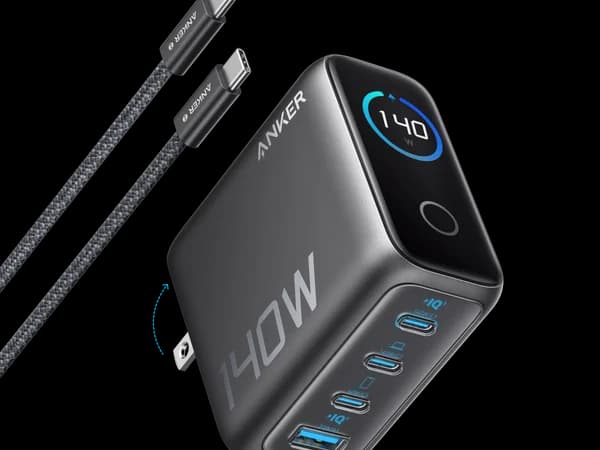
- LCD display shows per-port power output in real-time
- 4 ports (3 USB-C + 1 USB-A) with ActiveShield 2.0
- Premium Anker engineering and safety certifications
Cons
- Most expensive charger in this roundup at $89.99
- Large desktop form factor — not travel-friendly
- Premium price for features most users won't fully utilize
Overview
The Anker 140W 4-Port PD 3.1 is the most expensive charger in this roundup, and it earns that position by being the most complete. This is not just a high-wattage brick with extra ports. It is a fully instrumented charging station with an LCD display that shows real-time power delivery per port, PD 3.1 support for the fastest possible USB-C charging, ActiveShield 2.0 thermal management, and the kind of build quality that makes you confident leaving it plugged in 24/7 behind a desk.
At $89.99, it sits $10 above the Baseus PicoGo AH11 140W and $20 above the Anker 100W Smart Display. What that premium buys is the combination of 140W total output, four ports, per-port monitoring, and Anker's full safety suite in a single package. No other charger in this category offers all of those together. The question is whether you actually need all of it. For a professional whose desk charges a MacBook Pro, an iPad, an iPhone, and a pair of AirPods every day, and who wants to know at a glance that every device is getting its expected power, this is the definitive answer. For everyone else, it might be more charger than the situation demands, and that is perfectly fine. Not every tool needs to be the most expensive one in the drawer.
Features Deep-Dive
140W PD 3.1 and Intelligent Power Distribution
The primary USB-C port pushes up to 140W via PD 3.1 when used alone, matching the fastest USB-C charging rate currently available for consumer laptops. This means a 16-inch MacBook Pro charges at its absolute maximum USB-C speed, which translates to 0-50% in about 30 minutes. When you connect additional devices, the charger's power distribution system reallocates wattage intelligently. A two-device configuration typically delivers 100W to the primary port and 30W to the secondary, while a full four-device load distributes power in tiers: roughly 65W, 30W, 22.5W, and 22.5W. The allocation is dynamic and adjusts as devices approach full charge, freeing up wattage for ports that still need it. This is more sophisticated than fixed-split chargers that assign static power per port regardless of actual demand.
LCD Display and Per-Port Monitoring
The LCD display on the Anker 140W is a step up from the LED display on the smaller 100W model. It shows per-port wattage in real time with higher resolution and better readability. At a glance, you can see exactly how much power each port is delivering, which makes it trivially easy to spot problems: a laptop showing 5W instead of 65W usually means a bad cable, a phone pulling 2.5W when it should pull 20W might indicate a protocol mismatch. For professionals managing multiple devices, this eliminates guesswork entirely. The display also shows total power draw across all ports, which is useful for understanding whether the charger is approaching its 140W ceiling. Unlike the 100W model's display, this one dims more aggressively in standby, drawing even less attention on a nightstand or in a dim office.
ActiveShield 2.0 and Premium Build
Anker's ActiveShield 2.0 thermal protection uses multiple internal sensors to monitor temperature continuously and adjust power delivery in real time. Rather than a blunt thermal cutoff that kills power when the charger gets too hot, ActiveShield gradually reduces wattage to maintain safe temperatures while keeping your devices charging. This is particularly important at 140W, where the thermal load is significantly higher than lower-wattage chargers and the consequences of poor thermal management are more severe. The build itself uses a high-density GaN design with a matte-finish housing that resists fingerprints and scratches. Foldable prongs lock firmly in both positions with no play. Internal component quality matches what independent teardowns have found in other high-end Anker chargers: clean PCB layouts, quality capacitors, and proper shielding.
Pricing Analysis
At $89.99, this is the most expensive charger in the roundup, and justifying that price requires looking at the full feature set rather than raw watts per dollar. On a per-watt basis, the Anker 140W costs $0.64 per watt compared to $0.57 for the Baseus AH11 and $0.70 for the Anker 100W Smart Display. The Baseus matches it on power and port count for $10 less, but the Anker adds the LCD display, ActiveShield 2.0, and noticeably better build quality. Compared to buying an Anker 100W Smart Display ($69.99) plus a separate small charger for overflow devices, the 140W consolidates everything into one cleaner setup for roughly the same total spend. The value calculation ultimately comes down to whether you see this as a charger or as a charging station. As a charger, it is expensive. As a permanent desk fixture that replaces multiple bricks and provides diagnostic capability, the price is more reasonable.
Who Is This For?
- Professionals with device-heavy desks who charge a laptop, tablet, phone, and one more accessory daily and want a single, reliable charging station that handles everything. If you are done with the tangle of multiple chargers and power strips under your desk, this is the consolidation play.
- Power users who want diagnostic visibility and care about confirming that each device receives optimal charging speed. The LCD display transforms charging from a trust-based activity into a verifiable one, which matters when you need your laptop at 80% before a meeting.
- Quality-first buyers who will keep this charger for three or more years and want the build quality and safety engineering to match that timeline. Anker's track record on durability is strong, and ActiveShield 2.0 provides peace of mind during sustained high-wattage use that cheaper alternatives do not match.
Who Should NOT Use This
- Budget-conscious buyers who can get 90% of this charger's capability for $10-50 less. The Baseus PicoGo AH11 matches the 140W output and port count at $79.99 with even broader protocol support. If you do not need the display or Anker's build premium, the savings are straightforward and the charging performance is functionally identical.
- Travelers and mobile workers. At this size and weight, the Anker 140W is a desk fixture. It will fit in a backpack, but it will take up space and weight that a 65W or 100W travel charger would not. If you charge on the go more than at a desk, look at the compact options in the lower tiers of this roundup.
- Minimalists who charge one or two devices. If your daily charging routine is a laptop and a phone, 140W across four ports is massive overkill. The Anker 100W Smart Display or even a 65W two-port charger would serve you identically at a lower price and smaller footprint.
Bottom Line
The Anker 140W 4-Port PD 3.1 is the flagship desktop charger for people who take charging infrastructure seriously. It is the most powerful, most feature-rich, and best-built option in this roundup, and it charges a price that reflects all three. The LCD display, PD 3.1 support, and ActiveShield 2.0 combine to create a charger that is genuinely pleasant to use rather than just functional. But "best" does not mean "best for everyone." Most users will be perfectly served by a less expensive option. This charger is for the subset who want the absolute top tier and are willing to pay the premium to get it.
FAQ
Is the $10 difference over the Baseus AH11 worth it?
It depends on what you value. The extra $10 buys you Anker's LCD display for per-port monitoring, ActiveShield 2.0 thermal management, and a meaningfully better build quality. The Baseus actually offers broader protocol support with UFCS and SCP included. If you want visibility into your charging and premium build, pay the Anker premium. If you want maximum protocol compatibility and do not care about a display, save the $10 with the Baseus.
Can this replace my laptop's original charger entirely?
For most laptops, yes. The 140W PD 3.1 output matches or exceeds the included charger for virtually every USB-C laptop on the market, including the 16-inch MacBook Pro. The only scenario where you might still want the original charger is if your laptop uses a proprietary connector like MagSafe for charging, where the barrel-jack adapter may support higher wattage than what USB-C PD can deliver.
Does the LCD display affect the charger's lifespan?
The LCD panel itself is rated for tens of thousands of hours of operation and draws negligible power. It is not a meaningful point of failure compared to the power components inside. If anything, the display provides an early warning system: if you notice unusual wattage readings, it could indicate a developing issue with a cable or port before it becomes a bigger problem.
How loud is this charger under full load?
The Anker 140W is passively cooled with no internal fan, so it produces zero noise under any load. You may notice the housing gets warm to the touch during sustained high-wattage charging, which is normal for GaN chargers and is managed by ActiveShield 2.0. There is no coil whine or any audible noise during operation.
Who Is Anker Charger 140W 4-Port PD 3.1 Best For?
Power users and professionals who need the most powerful and feature-rich desktop charger
The Bottom Line
The Anker 140W 4-Port PD 3.1 is the flagship desktop charger for power users. Its LCD display, PD 3.1 support, and premium build make it the ultimate charging hub — at a premium price.
Buy on AmazonKey Specs
Scoring Breakdown
Maximum wattage output, power per port, and multi-device power distribution efficiency.
Physical size, weight, foldable prongs, and overall travel-friendliness.
Number of ports, port types (USB-C/USB-A), and multi-device charging flexibility.
Fast charging protocol support including PD 3.0/3.1, PPS, QC, UFCS, and SCP.
Materials, safety certifications (TUV, UL), thermal management, and overall construction.
Price-to-performance ratio, wattage-per-dollar, and included accessories like cables.
Display/monitoring, touch controls, smart power allocation, and device identification.