Baseus PicoGo AH11 140W Review
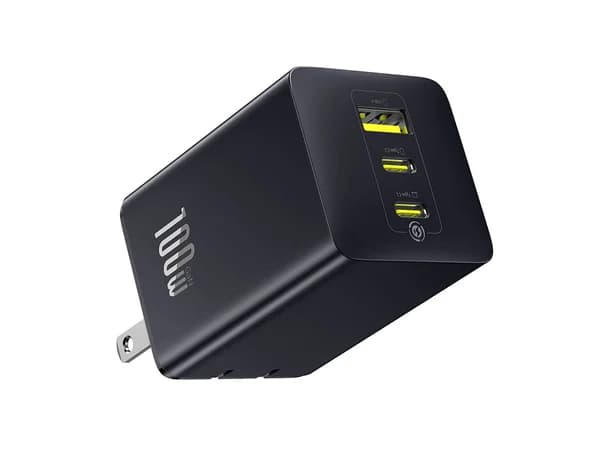
The Baseus PicoGo AH11 140W is the best value high-power charger for desk setups. With 4 ports and the broadest protocol support in this roundup, it charges everything from a MacBook Pro to earbuds.

Baseus PicoGo AH11 140W Review
The Baseus PicoGo AH11 140W is the best value high-power charger for desk setups. With 4 ports and the broadest protocol support in this roundup, it charges everything from a MacBook Pro to earbuds.
Baseus PicoGo AH11 140W Review
The Baseus PicoGo AH11 140W is the best value high-power charger for desk setups. With 4 ports and the broadest protocol support in this roundup, it charges everything from a MacBook Pro to earbuds.

Baseus PicoGo AH11 140W Pros & Cons
Pros
- 140W total output with PD 3.1 support
- 4 ports (3 USB-C + 1 USB-A) charge an entire desk of devices
- Broadest protocol support: PD 3.1, PPS, QC, UFCS, and SCP
- Better value than Anker 140W at $79.99 vs $89.99
Cons
- Large form factor — not ideal for travel
- No display or smart monitoring
- Power drops significantly when all 4 ports are in use
Overview
The Baseus PicoGo AH11 140W is the charger that wants to replace every other charger on your desk. Four ports, 140W of total power, and the broadest protocol support in this entire roundup make it the obvious choice for anyone who has looked at their power strip and thought, "there has to be a better way." Where most chargers force you to choose between power and versatility, the AH11 delivers both at a price that undercuts the more polished Anker 140W by a meaningful ten dollars.
The protocol list reads like a charging standards encyclopedia: PD 3.1, PPS, Quick Charge, UFCS, and Huawei's SCP. Whatever device you own or plan to own, this charger almost certainly speaks its language. The three USB-C ports and one USB-A port cover every combination of modern and legacy devices, from a 16-inch MacBook Pro down to wireless earbuds. What you give up is finesse. There is no smart display, no per-port monitoring, and the form factor is unapologetically large. This is a desk charger that stays on a desk, and it makes no apologies about that. If raw capability per dollar is what you are optimizing for, the AH11 is hard to beat.
Features Deep-Dive
140W Power Output and PD 3.1
The headline number is 140W, and that is enough to fast-charge even a 16-inch MacBook Pro at its maximum USB-C rate. The primary USB-C port delivers up to 140W when used alone via PD 3.1, which negotiates the higher 48V voltage rail for maximum efficiency. In practice, you will see a 16-inch MacBook Pro charge from 0 to 50% in roughly 30 minutes on the primary port, which is as fast as Apple's own 140W MagSafe charger over USB-C. When additional devices are connected, power redistributes across ports. Expect roughly 100W on the primary port and 30W split across the remaining ports during multi-device charging. The step-down is noticeable on paper but rarely problematic in practice, since most secondary devices like phones and tablets only need 20-30W to charge at full speed.
Protocol Breadth: PD 3.1, PPS, QC, UFCS, and SCP
This is where the AH11 genuinely stands apart from the competition. Supporting PD 3.1, PPS, Quick Charge, UFCS, and Huawei's Super Charge Protocol means this single charger can negotiate the fastest possible speed with devices from Apple, Samsung, Google, Xiaomi, Huawei, Oppo, and essentially every other manufacturer. Most competing chargers support PD and maybe PPS. The AH11 adds UFCS, which is the emerging unified fast-charging standard gaining traction across Chinese and international brands, and SCP, which is still relevant for Huawei device owners who would otherwise need a proprietary charger. For households with devices from multiple brands, this eliminates the need to keep brand-specific chargers on hand.
Four-Port Configuration
Three USB-C ports and one USB-A port give you the flexibility to charge an entire desk of devices simultaneously. A realistic daily scenario: laptop on port one at 100W, phone on port two at 27W, tablet on port three at 10W, and wireless earbuds on the USB-A port at 5W. The USB-A port tops out at 22.5W, which is enough for any USB-A device and supports Quick Charge for compatible Android phones. Port placement is sensible, with enough spacing between USB-C ports that even wide connectors or cables with thick strain reliefs do not block adjacent ports. The lack of a smart display means you are trusting the charger to allocate power intelligently rather than verifying it yourself, which is fine for most users but a trade-off worth noting for those who like confirmation.
Pricing Analysis
At $79.99, the Baseus PicoGo AH11 140W delivers a compelling value argument, especially when placed next to the Anker 140W 4-Port PD 3.1 at $89.99. Both chargers offer 140W across four ports with PD 3.1 support, but the AH11 saves you $10 while actually offering broader protocol support with UFCS and SCP. What you sacrifice for that savings is Anker's LCD display, ActiveShield 2.0, and the generally higher build quality fit and finish that Anker is known for. On a per-watt basis, the AH11 costs roughly $0.57 per watt of maximum output compared to $0.64 for the Anker, making it the most cost-efficient high-power charger in this roundup. For desk users who do not need portability or a display, that savings is straightforward.
Who Is This For?
- Desk warriors with a full ecosystem of devices who charge a laptop, phone, tablet, and earbuds at the same workspace every day. Four ports and 140W mean you can plug everything in and walk away without thinking about which charger goes where.
- Multi-brand households where family members use devices from Apple, Samsung, Google, and Huawei. The AH11's unmatched protocol breadth means one charger handles fast charging for all of them, eliminating the drawer full of brand-specific bricks.
- Value-focused buyers who want 140W capability without paying the Anker premium. The $10 savings over the Anker 140W may sound minor, but you are getting broader protocol support at the lower price, which makes this the better objective value.
Who Should NOT Use This
- Anyone who travels regularly. At this size and weight, the AH11 is a desk charger, full stop. It is significantly larger than 65W or 100W travel chargers and will eat valuable space in a carry-on. If you need high power on the go, a 100W charger with a smaller footprint is the smarter choice.
- Users who want charging visibility. Without a display or any indicator beyond basic LED lights, you have no way to confirm what wattage each device is receiving. If diagnosing slow-charging issues or verifying power allocation matters to you, the Anker 100W or 140W with their smart displays are worth the price difference.
Bottom Line
The Baseus PicoGo AH11 140W is the pragmatist's choice: maximum power, maximum protocol support, and a price that undercuts the most obvious competitor by ten dollars. It lacks the polish and smart features of Anker's offerings, but for users who just want to plug in four devices and have them all charge as fast as possible, it delivers exactly that. The form factor limits it to desk duty, but that is precisely where a 140W four-port charger belongs anyway.
FAQ
How does the power split work when all four ports are in use?
When all four ports are active, the AH11 redistributes its 140W budget dynamically based on each device's needs. A typical four-device scenario might look like 65W on the primary USB-C port, 30W on the second, 22.5W on the third, and 22.5W on USB-A. The exact split depends on what each device negotiates. The laptop port always gets priority, so your phone and tablet will charge slightly slower in a full-load scenario, but they still receive enough power for fast charging.
Is Baseus a reliable brand for high-wattage chargers?
Baseus has established itself as a credible player in the GaN charger space, with multiple well-reviewed products across power levels. Their chargers carry standard safety certifications (UL, FCC, CE) and the PicoGo line has been well-received by independent reviewers. They do not have the same brand recognition as Anker in the US market, but their engineering and quality control have been consistent in recent product generations.
Why is there no display on this charger when the Anker has one?
The omission of a display is a deliberate cost and design trade-off. Baseus is positioning the AH11 as a value-oriented powerhouse where every dollar goes toward charging capability and protocol support rather than monitoring features. The lack of a display also means a simpler internal design with fewer components that could fail, and slightly lower idle power consumption since there is no screen drawing power when devices are not connected.
Can this charge a MacBook Pro 16-inch at full speed?
Yes, the primary USB-C port delivers up to 140W via PD 3.1, which matches the maximum charging speed that the 16-inch MacBook Pro supports over USB-C. You will get the same 0-to-50% in roughly 30 minutes that Apple's own 140W charger provides. When other devices are plugged into the remaining ports, the primary port may step down to around 100W, which still charges the MacBook Pro at a fast rate, just not quite at its theoretical maximum.
Who Is Baseus PicoGo AH11 140W Best For?
Desk warriors who need to charge a laptop, tablet, phone, and earbuds simultaneously
The Bottom Line
The Baseus PicoGo AH11 140W is the best value high-power charger for desk setups. With 4 ports and the broadest protocol support in this roundup, it charges everything from a MacBook Pro to earbuds.
Buy on AmazonKey Specs
Scoring Breakdown
Maximum wattage output, power per port, and multi-device power distribution efficiency.
Physical size, weight, foldable prongs, and overall travel-friendliness.
Number of ports, port types (USB-C/USB-A), and multi-device charging flexibility.
Fast charging protocol support including PD 3.0/3.1, PPS, QC, UFCS, and SCP.
Materials, safety certifications (TUV, UL), thermal management, and overall construction.
Price-to-performance ratio, wattage-per-dollar, and included accessories like cables.
Display/monitoring, touch controls, smart power allocation, and device identification.