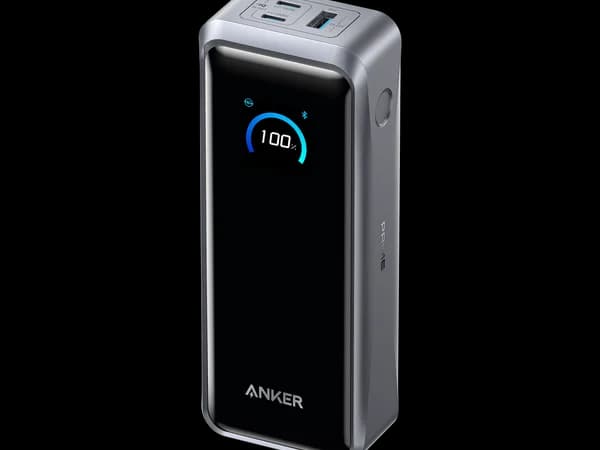
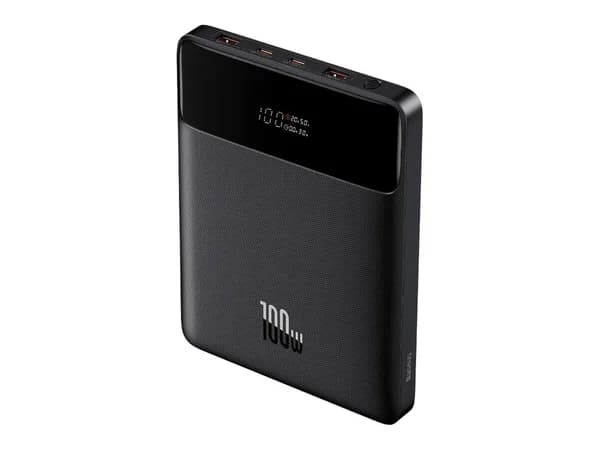
The Baseus Blade wins for most laptop users who need portable charging at a reasonable price. The Anker Prime wins for professionals who need maximum power output, fastest recharging, and premium build quality regardless of cost.
Anker Prime Power Bank (26K, 300W)
Power users and professionals who need maximum portable power for laptops and multiple devices
Baseus Blade Laptop Power Bank (100W, 20K)
Remote workers and travelers who need laptop-class 100W charging in a slim form factor

Score Comparison
Quick Verdict
Both the Anker Prime and the Baseus Blade can charge laptops on the go, but they target fundamentally different buyers. The Baseus Blade ($55-80) offers 100W USB-C output in an ultra-thin form factor with four ports and 20,000mAh capacity, making it the accessible entry point for laptop portable charging. The Anker Prime ($229.99) delivers 300W total output with 140W per USB-C port, 26,250mAh capacity at the airline-legal limit, 250W input for 60-minute recharging, and a smart display with app integration. The Blade is the power bank that makes laptop charging portable for everyone. The Prime is the power bank for professionals who treat portable power as critical infrastructure and are willing to pay accordingly.
Head-to-Head Comparison
Charging Power and Output
Winner: Anker Prime Power Bank
The numbers tell a clear story: 300W total output versus 100W total, with 140W per USB-C port on the Prime versus 100W per port on the Blade. For a single laptop, the Blade's 100W is sufficient for most USB-C laptops including the MacBook Pro 14-inch, MacBook Air, Dell XPS, and ThinkPad models. The Prime's 140W per-port exceeds what most wall chargers deliver and is specifically relevant for the MacBook Pro 16-inch, which can accept up to 140W via USB-PD 3.1.
The real separation appears in multi-device scenarios. The Prime can charge two MacBook Pros simultaneously at high wattage, something no other airline-safe power bank can match. The Blade can charge one laptop at full speed, but adding a second high-power device forces both to share the total output, reducing each to 45-65W depending on negotiation. For a single laptop and a phone, the Blade performs perfectly. For two laptops or a laptop under heavy load plus several accessories, the Prime's 300W ceiling provides headroom that the Blade simply cannot offer.
If your charging routine involves one laptop and one or two phones, the Blade's 100W is more than sufficient. If you carry two laptops, run demanding workloads during charging, or want the absolute fastest charging speed for any device, the Prime's power delivery is in a class of its own.
Battery Capacity
Winner: Anker Prime Power Bank
The Prime holds 26,250mAh (99.75Wh) versus the Blade's 20,000mAh (74Wh), a 35% capacity advantage. Both are airline-safe, but the Prime engineers the maximum possible capacity under the 100Wh TSA limit, sitting just 0.25Wh below the threshold.
In practical terms, the Prime provides approximately 1.3-1.5 full charges for a MacBook Pro 14-inch versus the Blade's 0.9-1.0 full charges. For a MacBook Air, the Prime delivers roughly 1.7 full charges versus the Blade's 1.2-1.3. The difference between getting one full laptop charge and getting one-and-a-half charges can be the difference between making it through a full workday without an outlet and running dry in the afternoon.
For phone-only charging, both provide ample capacity: the Prime offers roughly 5-6 full iPhone charges versus the Blade's 4-4.5. At this level, both are more than enough for multi-day phone use without a wall outlet.
Recharging Speed
Winner: Anker Prime Power Bank
This is one of the Prime's most significant advantages. Its 250W input acceptance rate fills the entire 99.75Wh battery from empty to full in approximately 60 minutes, with 0-50% taking only 13 minutes. The Blade accepts standard USB-C input at rates up to approximately 65W, which translates to a 2-3 hour recharge time for its 74Wh capacity.
The practical impact is substantial. With the Prime, a 15-minute charge during a coffee break adds roughly 25% capacity, enough for several hours of phone charging or 30 minutes of laptop power. With the Blade, the same 15-minute window adds roughly 10-12% capacity. If you have limited access to outlets and need to top up quickly between meetings, flights, or sessions, the Prime's input speed is transformative.
The caveat: reaching the Prime's 250W input speed requires a 200W+ USB-C charger, which Anker sells separately for $60-80. With a standard 65W charger, the Prime recharges at roughly the same rate as the Blade. The blazing-fast recharge is a real advantage, but it requires an additional investment in a compatible charger to realize.
Portability and Form Factor
Winner: Baseus Blade Laptop Power Bank
The Blade's ultra-thin 0.7-inch profile is its signature design achievement. At laptop-width dimensions and tablet thinness, it slides into a laptop sleeve alongside your computer without adding noticeable bulk. The flat form distributes its 490-gram weight across a large surface area, making it feel lighter in a bag than the number suggests.
The Prime at 600g is 22% heavier and significantly thicker, shaped more like a thick book than a flat tablet. It demands its own pocket or compartment in a bag rather than sharing space with a laptop. Neither product is pocket-friendly, but the Blade integrates into existing laptop carry systems while the Prime requires planning around it.
For daily commuters who add a power bank to their existing laptop bag, the Blade's form factor causes minimal disruption. The Prime, while not impractical to carry, is a deliberate addition that you pack intentionally rather than slide in absentmindedly.
Smart Features and Monitoring
Winner: Anker Prime Power Bank
Both products include digital displays showing remaining capacity and charging wattage, but the Prime takes monitoring significantly further. Its smart display shows real-time data for all three ports simultaneously, remaining capacity in both percentage and watt-hours, estimated time to empty or full, and temperature status. The companion Anker app extends this to your phone, adding charging history, custom power profiles, and ActiveShield 4.0 thermal diagnostics that perform 10 million temperature checks per day.
The Blade's display shows battery percentage and current wattage per port, which covers the essential information. It lacks an app, historical data, or thermal monitoring visibility. For most users, the Blade's display provides everything needed to manage charging. For professionals who want to optimize power allocation across devices, monitor battery health over time, or configure specific charging behaviors, the Prime's app integration adds genuine utility.
Value and Total Cost
Winner: Baseus Blade Laptop Power Bank
The math is stark: the Blade at $55 sale price costs roughly one-quarter of the Prime at $229.99. On a cost-per-watt-hour basis, the Blade delivers approximately $0.74/Wh at sale price versus the Prime's $2.30/Wh. The Blade provides roughly three times more value per dollar by every conventional measurement.
Factor in the Prime's recommended 200W charger ($60-80 additional), and the total Prime investment approaches $300-310. That buys approximately four Baseus Blades at sale prices, which would collectively provide 80,000mAh of total capacity versus the Prime's 26,250mAh.
The Prime's value argument rests entirely on capabilities that the Blade cannot match at any price: 140W per-port output, 300W total output, 250W input recharging, and app-integrated smart monitoring. If you need those specific capabilities, no amount of Blade purchases can replicate them. If you do not need them, the Blade delivers laptop charging at a fraction of the cost.
When to Choose Baseus Blade Laptop Power Bank
The Blade is the right choice when:
- You want laptop charging without the premium price: The Blade's 100W output charges most USB-C laptops at full speed for $55-80, making laptop portable charging accessible rather than a luxury purchase
- Your laptop draws 100W or less: MacBook Air, MacBook Pro 14-inch, Dell XPS 13/15, ThinkPad X1, and most Windows ultrabooks charge at full speed on 100W, making the Prime's extra wattage unnecessary
- Form factor matters: The 0.7-inch flat design slides into laptop sleeves and bags without requiring a dedicated compartment, integrating seamlessly into your existing carry
- You prioritize value over features: Four ports, a digital display, and 100W output at $55 is exceptional value that no competitor comes close to matching at this price point
When to Choose Anker Prime Power Bank
The Prime is the right choice when:
- You carry two laptops or high-power devices: The 300W total output and 140W per port handle dual-laptop charging that no other airline-safe power bank can match
- Recharge speed is critical: The 250W input fills the entire bank in 60 minutes, versus 2-3 hours for the Blade, which matters when outlet access is limited to brief windows
- You need maximum airline-safe capacity: The 99.75Wh capacity provides 35% more energy than the Blade, which can be the difference between making it through a full workday and running dry
- You are a professional who treats power as infrastructure: The smart display, app integration, ActiveShield monitoring, and premium build quality justify the cost when reliable portable power directly impacts your productivity and income
Final Recommendation
Choose the Baseus Blade for the vast majority of laptop portable charging needs. At $55-80, it delivers 100W output that charges most laptops at full speed, an ultra-thin form factor that integrates into any bag, and four ports that handle an entire desk of devices. It is the product that makes laptop portable charging practical and affordable for everyone, and it should be the default choice unless you have a specific reason to spend more.
Choose the Anker Prime if you are a professional whose workflow specifically demands more than what 100W and 74Wh can deliver. The 140W per-port output, 300W total, 99.75Wh capacity, and 60-minute recharging are capabilities that justify the $230 price tag only when they directly solve a problem that the Blade cannot. The Prime is a professional tool priced like one. If you need it, you know you need it.
Pricing & Features
Making Your Decision

When to Choose Anker Prime Power Bank (26K, 300W)
Power users and professionals who need maximum portable power for laptops and multiple devices
The Anker Prime 26K 300W is the ultimate portable power bank. With 300W output, 99.75Wh capacity (just under TSA limits), and 250W input, it's unmatched for professionals who need serious portable power.
Strengths
- 300W total output powers 2 MacBook Pros simultaneously
- 26,250mAh (99.75Wh) — maximum airline-safe capacity
- 250W input charges 0-50% in 13 minutes, 100% in 60 minutes
- Smart display + Anker app with PowerIQ 4.0 and ActiveShield 4.0
Limitations
- Most expensive power bank at $230
- Heaviest at 600g — definitely not pocket-sized
- Overkill for casual phone-only users

When to Choose Baseus Blade Laptop Power Bank (100W, 20K)
Remote workers and travelers who need laptop-class 100W charging in a slim form factor
The Baseus Blade is the best power bank for laptop charging. Its 100W output, ultra-slim design, and 4-port layout make it the ideal travel companion for MacBook and laptop users.
Strengths
- 100W USB-C output charges MacBook Pro 14" to 50% in 30 minutes
- Ultra-thin 0.7" laptop-style form factor slips into laptop sleeves
- 4-port charging (2x USB-C 100W + 2x USB-A 30W) for entire desk setup
- Digital display shows real-time wattage for each port
Limitations
- Heavier at 490g — not pocket-friendly
- Large form factor designed for bags, not pockets
- Plastic build feels less premium than metal competitors