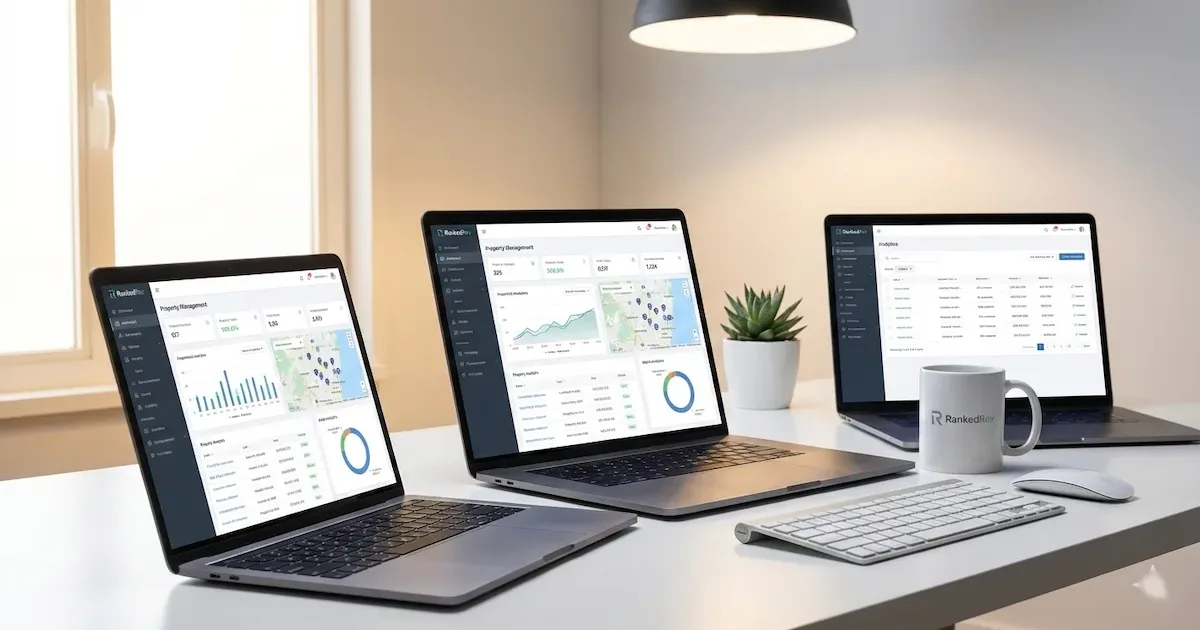
Best Property Management Software in 2026: 16 Platforms Reviewed
We reviewed 16 property management platforms from free tools to enterprise systems. Here are the best for every portfolio size.

Property Management Software Has Gotten Good
Five years ago, most small landlords managed their properties with spreadsheets, paper checks, and a phone that rang at midnight with maintenance emergencies. The software that existed was either enterprise-priced or barely functional. That gap has closed dramatically. In 2026, you can get a genuinely capable property management platform for free, and the paid options deliver automation that would have required a full-time assistant a few years ago.
I have spent the past several weeks evaluating 16 property management platforms across every price point, from free tools designed for first-time landlords to enterprise systems managing thousands of multifamily units. The category has matured, but the range of quality and pricing is wider than almost any other software market I cover. A landlord with 5 units and a management company with 5,000 units have fundamentally different needs, and the best platform for each looks nothing alike.
This guide breaks down the platforms that matter, organized by who they actually serve. For the complete ranked list with detailed scoring across eight criteria, visit our property management software category page.
What to Look For in Property Management Software
Here are the criteria that matter most, aligned with our scoring methodology.
Core features and completeness. At minimum, you need rent collection, lease management, tenant screening, and maintenance tracking. The best platforms handle the entire landlording lifecycle from listing a vacancy through move-out. Gaps in core features mean bolting on additional tools, which adds complexity and cost.
Accounting and financial reporting. This is where platforms diverge sharply. Some offer basic income/expense tracking that barely improves on a spreadsheet. Others provide full double-entry accounting, trust ledger separation, and one-click tax reports. If you manage properties for owners or need clean Schedule E reports at tax time, accounting depth is not optional.
Ease of use. The most powerful platform is worthless if your team cannot learn it. Setup time, interface design, learning curve, and mobile app quality vary enormously. Some platforms require weeks of training; others are productive on day one.
Pricing and value. Pricing models range from completely free to custom enterprise quotes. Per-unit surcharges, onboarding fees, feature gating, and annual contract requirements all affect the true cost. The cheapest subscription is not always the lowest total cost.
Scalability. A platform that works for 10 units may not work for 100. Lease limits, storage caps, team seat restrictions, and property-type limitations create upgrade thresholds. Consider where your portfolio will be in two years, not just where it is today.
Our Top Picks
Buildium: Best All-Around for Small-to-Mid Portfolios

Buildium hits the sweet spot that the largest number of property managers occupy: 50-500 residential units, professional accounting requirements, and a team that needs to get productive quickly. The onboarding experience is smoother than almost any competitor. The accounting module handles everything from daily rent tracking through year-end 1099 e-filing without requiring a finance background. Owner portals generate presentation-ready statements that maintain professional relationships with property owners.
The mobile app is consistently rated as the weakest part of the platform, and per-unit pricing escalates as portfolios grow. But for the core residential management workflow, Buildium delivers the most balanced combination of capability and accessibility in the mid-market. See our full review for the detailed breakdown.
AppFolio: Best for Growing Management Companies

AppFolio is the platform that management companies graduate to when they need AI-powered automation and marketing tools. The AI leasing assistant handles prospect communication, listing optimization, and lead tracking automatically. The marketing module manages paid advertising campaigns across channels. Multi-property-type support covers residential, commercial, student housing, and community associations in one system.
The 50-unit minimum and annual contract requirement filter out small landlords by design. AppFolio targets management companies that are actively growing and need software that scales with them. For that audience, it delivers the most modern interface with the strongest automation in the category. Read our full review for the complete analysis.
TurboTenant: Best Free Platform

TurboTenant has built the most comprehensive free plan in property management software. The free tier covers the full vacancy-to-lease cycle: listing syndication to 28+ sites, applicant-paid screening, rent collection, maintenance tracking, and lease e-signing. There are no unit limits, no property limits, and no trial expiration.
The paid tiers ($149-199/year) use flat annual pricing rather than per-unit fees, which means a landlord with 50 properties pays the same as a landlord with 5. For budget-conscious landlords who refuse to pay a monthly subscription, TurboTenant is the obvious first choice. See our full review for the full feature breakdown.
DoorLoop: Best User Interface

DoorLoop proves that user experience matters in property management software. With a 4.89/5 rating on G2 from over 1,800 reviews, it is the highest-rated platform in the category for interface design. The AI-powered features, including an AI Assistant and AI Inspections, point toward the future of the category. Multi-property-type support covers residential, commercial, student housing, and HOAs.
The premium pricing ($59/month base plus $3/unit surcharge) makes it the most expensive option in the mid-market tier. Key features like free eSignatures and free ACH payments are locked behind the $169/month Premium plan. But for managers who believe UX quality translates directly into operational efficiency, DoorLoop delivers. Read our full review for the pricing analysis.
Head-to-Head: Buildium vs AppFolio
These two are the most commonly compared platforms in the category, and the decision usually comes down to portfolio size.
Under 100 units: Buildium wins. Lower entry price ($62/month vs AppFolio's $70+ with minimums), no annual contract requirement, faster onboarding, and accounting that is more accessible for non-accountants. Buildium covers the full residential management workflow at a lower total cost for smaller portfolios.
Above 200 units: AppFolio wins. AI-powered automation saves measurable time on leasing and marketing. Multi-property-type support handles commercial and student housing alongside residential. The modern interface and mobile-first portals provide a better experience for tenants and owners at scale.
100-200 units: It depends. If your portfolio is growing quickly and includes multiple property types, AppFolio's capabilities justify the premium. If your portfolio is stable residential properties with predictable turnover, Buildium's simplicity and cost advantage hold. For the full comparison, see our Buildium vs AppFolio article.
Budget vs Premium: Is Paid Software Worth It?
The gap between free and paid property management software is smaller than it has ever been. TurboTenant's free tier covers listings, screening, rent collection, and maintenance. Innago provides all core features at no cost with personal support. At what point does paying $62-169/month for a premium platform make financial sense?
Paid software justifies its cost when:
- You manage properties for other owners and need professional accounting, owner portals, and trust accounting
- Your portfolio turns over frequently and you benefit from marketing automation and listing optimization
- You have a team (not just yourself) and need multi-user access with role-based permissions
- Financial reporting requirements demand more than basic income/expense tracking
Free software is sufficient when:
- You self-manage a small portfolio (under 20 units) with stable, long-term tenants
- Your accounting needs are basic and you handle taxes with a CPA
- Listing syndication and basic screening cover your vacancy workflow
- You are comfortable with email-only or limited customer support
The Bottom Line
The best property management software in 2026 serves every segment of the market. Buildium leads the mid-market with the most balanced combination of features and accessibility. AppFolio leads for growing companies that need AI automation and multi-type support. TurboTenant leads the free tier with the most comprehensive no-cost platform. And DoorLoop leads on user experience for teams that value interface quality.
The right platform depends on your portfolio size, growth trajectory, and which pain points you need solved first. Start with the free options if you are unsure. Upgrade when you hit limitations that cost you time or money. The best property management software is the one your team actually uses consistently.
Frequently Asked Questions
What is the best free property management software?
TurboTenant offers the most comprehensive free plan with listing syndication to 28+ sites, tenant screening, rent collection, and maintenance tracking. Innago is the best completely free option with no paid tiers and personal account representatives. Avail provides state-specific lease templates on its free tier. Each has slightly different strengths, but TurboTenant covers the most ground at zero cost.
How much does property management software cost?
Costs range from $0 (TurboTenant, Innago free tiers) to $250+/month (Propertyware, enterprise platforms). Most paid platforms for small-to-mid portfolios cost $15-100/month. The most popular mid-market options (Buildium, DoorLoop, Yardi Breeze) range from $59-100/month. Per-unit surcharges, onboarding fees, and annual contracts can significantly increase the actual cost beyond advertised prices.
Do I need property management software for a single rental property?
For a single property with a stable tenant, you can manage with basic tools. But even for one unit, a free platform like TurboTenant or Innago streamlines rent collection, provides maintenance tracking, and creates a digital record of all transactions. The time investment to set up is minimal, and having organized records matters at tax time and in any landlord-tenant dispute.
Can I switch property management software later?
Yes, though migration complexity varies. Moving from a simple platform (like TurboTenant) to a more capable one (like Buildium) is straightforward since you are adding features. Moving from an entrenched platform (like Rent Manager or Entrata) to another is more complex due to data migration, workflow reconfiguration, and team retraining. Most platforms offer data import tools, but plan for a transition period of 2-4 weeks.
You Might Also Like
Best Portable Power Stations in 2026
 James Mitchell
Best Mechanical Keyboards in 2026
 Marcus Rivera
Best Travel eSIMs 2026: A Complete Buyer's Guide
James Mitchell