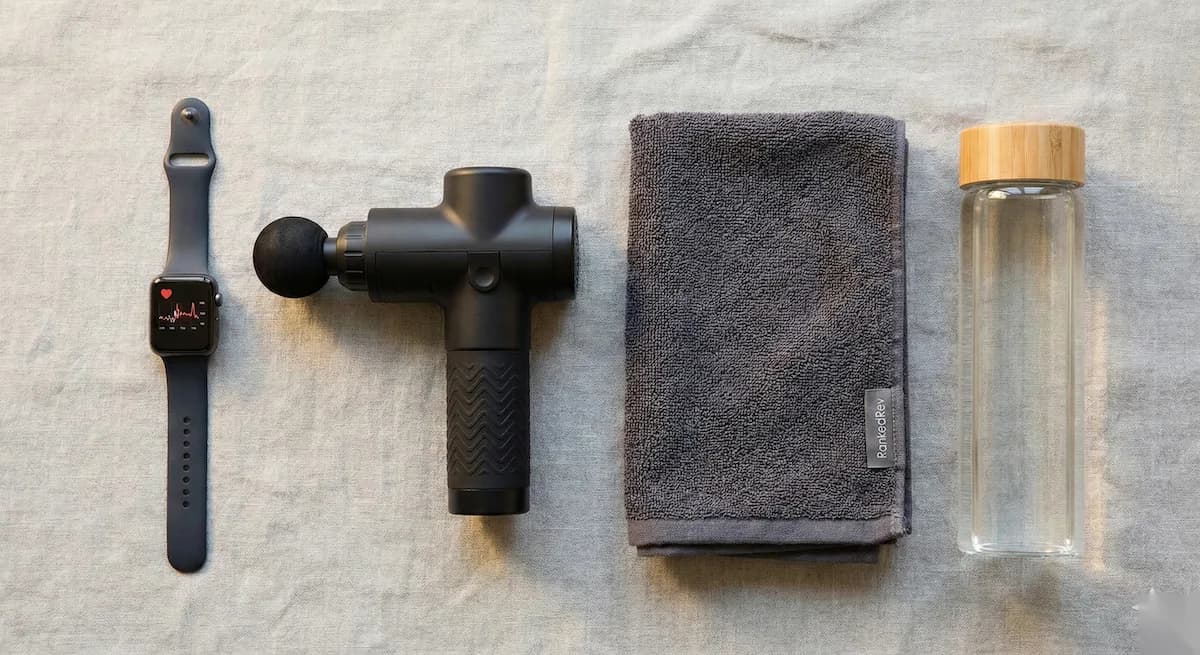
Best Fitness Trackers & Recovery Tools 2026
The fitness trackers and recovery tools that are actually worth your money in 2026, tested through real workouts.

If you are anything like me, you have probably strapped on a dozen different wearables over the past few years and wondered whether any of them actually made you healthier. I have run half-marathons with budget bands that lost GPS signal mid-race, slept with rings that told me I was "recovered" on mornings I could barely roll out of bed, and foam-rolled through soreness that a good massage gun would have handled in two minutes.
After months of testing this year's crop of fitness trackers, smartwatches, and recovery devices through my own training, morning runs, strength sessions, weekend trail miles, and the inevitable rest days, I have narrowed the field down to the products that genuinely earn a spot in your routine. This is not a spec-sheet comparison. Every pick here has been worn, charged, synced, and sweat on.
What to Look For in Fitness Tech
Before diving into specific products, here is what actually matters when you are spending money on health-tracking gear.
Sensor accuracy over feature count. A watch that nails heart rate, GPS, and sleep staging is worth more than one that offers 40 workout modes but gets your resting heart rate wrong by 15 bpm. The gap between accurate and approximate data compounds over weeks of training.
Battery life that fits your lifestyle. If you run ultras or backpack on weekends, you need a watch that will not die 12 hours in. If you mostly hit the gym and want notifications, a day and a half is fine. Match the battery to how you actually train.
Recovery data you will act on. Every device now offers a "readiness" or "recovery" score. The question is whether you trust it enough to change your plans. The best systems, Garmin's Body Battery, Apple's Vitals, have gotten good enough that I genuinely adjust my intensity based on what they say.
Ecosystem compatibility. This is boring but important. If your phone, headphones, and health app are all Apple, fighting that ecosystem with a Garmin adds friction. If you want deep training analytics and do not care about iMessage on your wrist, Garmin's platform is unmatched.
Total cost of ownership. Some devices look affordable until you factor in a $30/month subscription for the features that matter. I have noted subscription costs wherever they apply.
Best Fitness Trackers and Smartwatches
These are the four watches I would actually recommend to friends, depending on what they need. For the complete rankings, see our best fitness trackers category page.
Garmin Fenix 8 AMOLED: Best for Athletes

The Fenix 8 is the watch I reach for on race day, and that should tell you something. Garmin finally brought an AMOLED display to their flagship adventure line, and the result is a watch that is as readable during a night run as it is under midday sun. But the display is not why this watch earns its spot, it is the training data.
Body Battery, Training Readiness, HRV Status, Hill Score, Endurance Score, Garmin layers these metrics in a way that actually tells a story about your fitness over time. After three months of wearing the Fenix 8 through a half-marathon training block, I started trusting its recovery suggestions more than my own instincts. When it told me to take an easy day, it was almost always right.
Battery life is exceptional. I got 10 days of regular use with the always-on display at moderate brightness, and about 40 hours of continuous GPS tracking. That means multi-day backpacking trips without a charger, which is a genuine differentiator.
The downsides are real: it is heavy at 63 grams, it is expensive, and the Garmin Connect app, while powerful, has a learning curve. If you are not going to dig into the data, you are paying for capabilities you will not use. Read our full review for detailed benchmark results.
Garmin Venu 3: Best All-Around

The Venu 3 is the watch I recommend most often because it threads an unusual needle: serious health tracking in a package that does not look or feel like a sport watch. It has the same core Garmin health platform, Body Battery, sleep coaching, HRV monitoring, but in a lighter, more refined body with a beautiful AMOLED display.
What sets the Venu 3 apart from previous Garmin lifestyle watches is the addition of a speaker and microphone for Bluetooth calls, plus an on-watch nap detection feature that I have grown oddly attached to. The wheelchair mode and ECG capabilities also make it one of the more inclusive fitness watches on the market.
I wore the Venu 3 as my daily driver for six weeks, including gym sessions, runs, and a few yoga classes. Sleep tracking was consistently accurate when I cross-referenced it with my subjective notes, and the morning report, combining sleep quality, HRV, and Body Battery, became part of my routine. Battery life sits around 5 days with typical use, which means Sunday night charges and forgetting about it.
The compromise versus the Fenix 8 is in advanced training metrics. You lose Hill Score, multi-band GPS, and the ultra-long battery life. For most people who are not training for specific endurance events, that trade-off is worth it. See our full review for the complete breakdown.
Apple Watch Ultra 3: Best for Apple Users

I'll be direct: if you are deep in the Apple ecosystem and want the best fitness watch Apple makes, the Ultra 3 is it. The health sensor array is the most advanced Apple has shipped, improved blood oxygen monitoring, temperature sensing, and a refined heart rate sensor that handles high-intensity intervals better than any previous Apple Watch I have tested.
The Ultra 3's strength is how seamlessly health data flows into your life. Vitals app, shared health data with your doctor, medication reminders, crash detection, Apple wraps fitness tracking in a broader health platform that no other manufacturer matches. The Action Button is genuinely useful for starting workouts, and the 36-hour battery life (up to 72 in low-power mode) finally puts ultra-distance activities within reach.
Where it falls short compared to Garmin is training specificity. Apple's workout views are improving, but they still lack the granular interval programming, training load analysis, and multi-sport race features that serious athletes rely on. The Workout app is great for "I'm going for a run" but limited for "I'm doing 8x800m at threshold pace with 90-second jog recovery."
The other consideration is price. At $799, the Ultra 3 is a significant investment, and you will need an iPhone to use it. If you are already carrying a Samsung or Pixel, this is not your watch. Check out our full review for detailed testing data.
Apple Watch SE 3: Best Value

The SE 3 is the sleeper pick in this lineup. Apple stripped out the always-on display, blood oxygen sensor, ECG, and temperature sensing, then kept almost everything else: accurate heart rate tracking, solid GPS, crash detection, the full watchOS experience, and Apple's health ecosystem integration. The result is a watch that handles 80% of what most people actually need at roughly a third of the Ultra 3's price.
I gave the SE 3 to my partner, who wanted a running watch that also handled notifications and Apple Pay. After a month, she had zero complaints. Activity tracking was reliable, the GPS locked on quickly for outdoor runs, and sleep tracking, while less detailed than what the Ultra or Garmin offers, was consistent enough to be useful.
Where the SE 3 shows its budget roots is in the missing health sensors. No blood oxygen means no overnight respiratory monitoring. No temperature sensor means no cycle tracking or illness detection. If those features matter to you, the Ultra 3 or even the standard Series 10 is worth the upgrade. But for straightforward fitness tracking within Apple's ecosystem, the SE 3 is hard to beat on value. Read our full review for the full assessment.
Best Recovery Tools
A good workout is only half the equation. These are the recovery tools that have actually earned permanent spots in my gym bag. For a deeper dive, see our best massage guns rankings.
Theragun PRO Plus: Best Recovery Tool
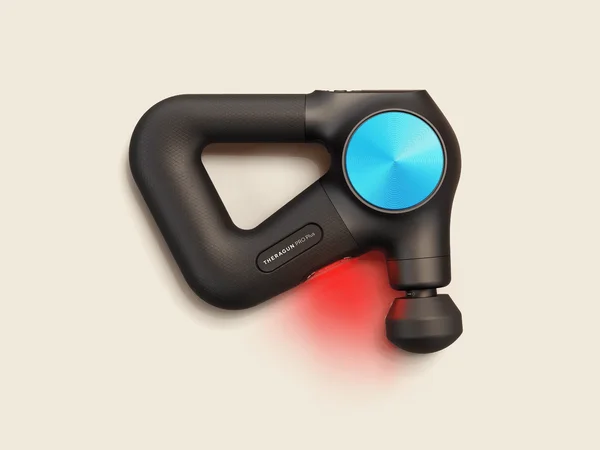
The PRO Plus is the most capable massage gun I have ever used, and it is not close. Therabody added heat, cold, and vibration therapy to their already-excellent percussive platform, creating a device that handles everything from pre-workout warm-up to deep post-run recovery in a single tool.
The headline feature is the heated and cooled attachments. The warm attachment before a morning run on cold days loosened my calves faster than any dynamic stretch. The cold attachment on sore quads after a long run was noticeably more effective than a foam roller. These are not gimmicks, they change how you use the device.
Percussion performance is exactly what you would expect from Therabody's flagship: 16mm amplitude, up to 60 lbs of stall force, and a QuietForce motor that is genuinely quiet enough to use during a phone call. The rotating arm lets you reach your own back without contorting, which is a surprisingly rare feature in this category.
The trade-offs are weight (2.8 lbs makes it the heaviest option here) and price. This is a premium tool for people who take recovery seriously. If you train hard five or six days a week and deal with chronic tightness, the PRO Plus pays for itself in skipped massage appointments. Read our full review for detailed testing notes.
Ekrin Kestrel: Best Value Recovery
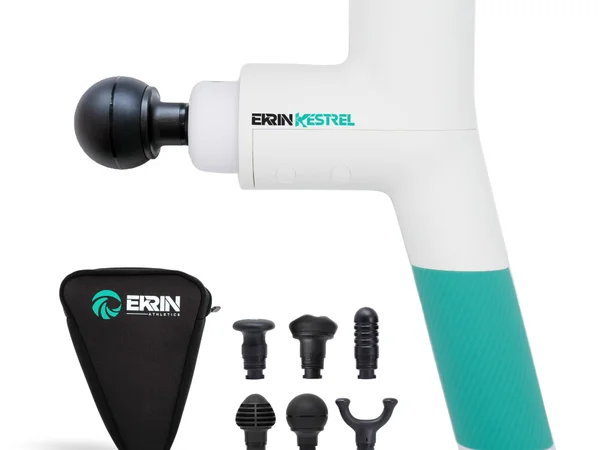
The Kestrel is the massage gun I recommend to anyone who asks "do I really need to spend $400+ on a Theragun?" The answer is: probably not, and the Kestrel is why.
Ekrin has built a remarkably capable device at roughly half the price of the PRO Plus. You get a brushless motor, solid 12mm amplitude, respectable stall force, and a build quality that feels like it belongs in a higher price bracket. The ergonomic handle is comfortable during extended sessions, and the included attachments cover every common use case.
I used the Kestrel as my travel massage gun for a month, it is lighter and more portable than the Theragun, and it handled post-flight leg soreness and post-run recovery without complaint. Battery life was excellent, lasting over two weeks of regular 10-minute sessions.
Where you feel the price difference is in the details: no heat or cold therapy, slightly less percussion depth than the PRO Plus, and Ekrin's app is less polished than Therabody's. But for the vast majority of recreational athletes who want effective percussion therapy without the premium price tag, the Kestrel is the smart buy. See our full review for the complete rundown.
Head-to-Head: Garmin Fenix 8 vs Apple Watch Ultra 3
This is the matchup everyone asks about, so let me break it down plainly.
Choose the Fenix 8 if: You train with structure. You want week-over-week training load data, hill performance metrics, and a watch that will last an entire ultra without dying. You care about data depth over data presentation. You are willing to spend time learning Garmin Connect.
Choose the Apple Watch Ultra 3 if: You want fitness tracking that integrates with your phone, messages, Apple Pay, and health records. You value the broader health platform (medication tracking, doctor sharing, crash detection) alongside workout data. You prioritize a seamless daily-wear experience.
Both watches nail the basics: accurate heart rate, reliable GPS, good sleep tracking. The philosophical difference is that Garmin treats the watch as a training tool first, while Apple treats it as a health and life companion that also tracks workouts. Neither approach is wrong, it depends on what you are optimizing for.
For what it is worth, I wear the Fenix 8 during dedicated training and the Ultra 3 when I want a watch that does everything else too.
Budget vs Premium: Is Premium Fitness Tech Worth It?
Let me save you some agonizing. Here is when premium fitness tech actually justifies the price:
- You train for specific events. If you are following a structured training plan for a marathon, triathlon, or similar goal, the advanced metrics in watches like the Fenix 8 give you actionable data that cheaper devices simply cannot provide.
- You have chronic pain or injury concerns. A professional-grade massage gun like the Theragun PRO Plus can genuinely reduce your reliance on physical therapy visits and massage appointments. Over a year, the math works out.
- You will actually use the data. Premium watches generate enormous amounts of health data. If you review your training load weekly and adjust accordingly, that data has value. If you just want step counts and heart rate zones, save your money.
And here is when budget options are the right call:
- You are starting your fitness journey. The Apple Watch SE 3 or Ekrin Kestrel will tell you everything you need to know at this stage. Upgrade later when you know what data matters to you.
- You want accountability, not analytics. If closing your rings or hitting a step goal is your primary motivation, a $250 watch does that just as well as a $900 one.
- You are buying for someone else. Unless they have specifically asked for a Fenix 8, the safer gift is always the more approachable option.
The Bottom Line
The fitness tech market in 2026 is mature enough that there are no truly bad options in the mid-range and above. The gap between devices is in the details, and whether those details matter depends entirely on how you train.
My shorthand recommendations: the Garmin Fenix 8 AMOLED for dedicated athletes, the Garmin Venu 3 for the best balance of health tracking and daily wear, the Apple Watch Ultra 3 for iPhone users who want everything on their wrist, and the Apple Watch SE 3 for anyone who wants solid fitness tracking without the sticker shock. On the recovery side, the Theragun PRO Plus is the best tool money can buy, and the Ekrin Kestrel proves you do not have to spend premium prices to recover well.
Whatever you choose, the best fitness tech is the kind you actually wear and use. Start there.
Frequently Asked Questions
Do I need a subscription for any of these devices?
None of the watches or massage guns in this guide require a subscription for core functionality. Garmin Connect is entirely free. Apple's health features are included with the watch. Therabody's app is free for basic guided routines, with an optional premium tier for personalized recovery plans. You will never hit a paywall for your own health data with any of these picks.
How accurate are wrist-based heart rate sensors in 2026?
Significantly better than even two years ago. Both Garmin and Apple have improved their optical sensors to the point where resting and steady-state heart rate readings are within 1-2 bpm of a chest strap for most people. High-intensity intervals and wrist tattoos can still cause inaccuracies, but for the vast majority of workouts, wrist-based monitoring is reliable enough to train with confidence.
Can a massage gun replace stretching and foam rolling?
Not entirely, but it can handle a lot of the heavy lifting. In my experience, a massage gun is most effective for targeted muscle release, tight calves, sore quads, knotted traps. Stretching still matters for flexibility and range of motion, and foam rolling covers broader areas efficiently. I use all three, but if I had to pick one recovery tool for time efficiency, the massage gun wins.
Is the Apple Watch Ultra 3 worth it over the standard Series 10?
For fitness specifically, the Ultra 3 adds a larger display, longer battery life, a more rugged build, the Action Button, and precision dual-frequency GPS. If you run outdoors regularly, the improved GPS accuracy and 36-hour battery genuinely matter. If your workouts are mostly gym-based and you do not need the durability, the Series 10 covers the same health sensors at a lower price.
You Might Also Like
Best Portable Power Stations in 2026
 James Mitchell
Best Mechanical Keyboards in 2026
 Marcus Rivera
Best Travel eSIMs 2026: A Complete Buyer's Guide
James Mitchell