
VIOFO A229 Ultra 2CH Review
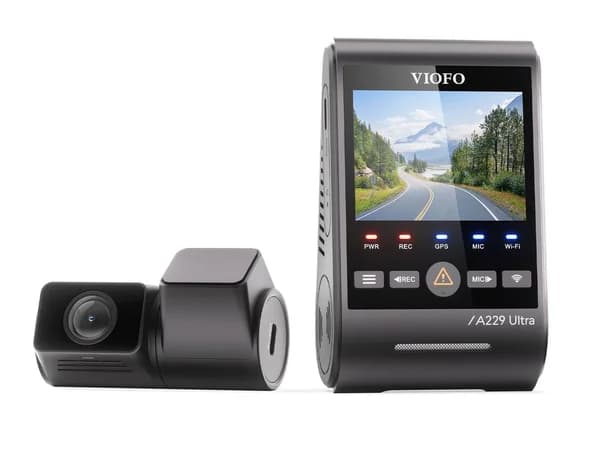
The VIOFO A229 Ultra 2CH delivers the best bang-for-buck in the dual 4K dash cam segment. Both front and rear cameras use Sony STARVIS 2 sensors for outstanding day and night footage. It lacks cloud features, but for pure video quality and reliability, it's hard to beat at $330.

VIOFO A229 Ultra 2CH Review
The VIOFO A229 Ultra 2CH delivers the best bang-for-buck in the dual 4K dash cam segment. Both front and rear cameras use Sony STARVIS 2 sensors for outstanding day and night footage. It lacks cloud features, but for pure video quality and reliability, it's hard to beat at $330.
VIOFO A229 Ultra 2CH Review
The VIOFO A229 Ultra 2CH delivers the best bang-for-buck in the dual 4K dash cam segment. Both front and rear cameras use Sony STARVIS 2 sensors for outstanding day and night footage. It lacks cloud features, but for pure video quality and reliability, it's hard to beat at $330.

VIOFO A229 Ultra 2CH Pros & Cons
Pros
- 4K front + 4K rear with dual Sony STARVIS 2 sensors — best dual resolution available
- Exceptional night vision thanks to STARVIS 2 technology on both channels
- 5GHz Wi-Fi for fast footage transfers to phone
- Reliable supercapacitor design withstands extreme temperatures
Cons
- No built-in LTE or cloud connectivity — local storage only
- ADAS features are basic compared to Thinkware or BlackVue
- Requires separate hardwire kit for parking mode
Overview
The VIOFO A229 Ultra 2CH is the camera that makes the premium dash cam segment uncomfortable. At $330, it delivers true dual 4K recording -- front and rear -- using the same Sony STARVIS 2 IMX678 sensors found in cameras costing $100-$250 more. That rear camera upgrade is the headline: where the older A229 Pro paired a 4K front with a 2K rear, the Ultra puts matched 4K IMX678 sensors on both channels, closing the resolution gap that previously required stepping up to significantly pricier systems.
What VIOFO sacrificed to hit this price is connectivity. There is no built-in LTE modem, no cloud platform, no remote live view. You get local recording to microSD, 5GHz Wi-Fi transfers to your phone, and that is it. For drivers who see a dash cam primarily as an insurance policy -- record everything in the highest quality possible and retrieve footage when needed -- that trade-off is perfectly rational. For those who want push notifications when someone bumps their parked car or live GPS tracking from their desk, the BlackVue DR970X or Thinkware U3000 Pro remain the better investments despite their higher price tags.
Features Deep-Dive
Dual Sony STARVIS 2 IMX678 Sensors
The IMX678 is Sony's 1/1.8-inch, 8-megapixel STARVIS 2 sensor, and VIOFO put one in both the front and rear units. This matters because dash cam rear cameras have historically been an afterthought -- lower resolution sensors with inferior low-light capability, producing footage where license plates dissolve into blur at highway speeds. The A229 Ultra eliminates that disparity entirely. Both channels record 4K at 30fps through f/1.8 aperture lenses with 140-degree fields of view, and both benefit from STARVIS 2's generational improvement in light sensitivity and dynamic range over the original STARVIS technology.
In practice, the rear camera captures license plates and vehicle details with noticeably more clarity than 2K rear cameras, particularly in challenging conditions like rain, dusk, or parking garages. HDR processing handles the headlight glare problem that plagues nighttime rear footage, reducing blooming without washing out the surrounding scene. The dual 4K approach does generate large files -- budget for a 256GB or 512GB microSD card rather than 128GB -- but the footage quality justifies the storage cost.
5GHz Wi-Fi and GPS Integration
VIOFO equipped the A229 Ultra with a 5GHz Wi-Fi module rather than the 2.4GHz connections still common in this price range. The practical benefit is transfer speed: pulling a two-minute 4K clip to your phone takes roughly 30-40 seconds instead of several minutes. When you need footage after an incident -- at the scene, with the other driver waiting -- that speed difference genuinely matters. The VIOFO app handles clip browsing, download, and basic settings adjustments competently, though it lacks the polish of BlackVue or Garmin's offerings.
GPS logging embeds speed and location data directly into each video file, using quad-mode satellite positioning (GPS, GLONASS, Galileo, and BeiDou) for reliable lock times across regions. The recorded GPS data can be overlaid on footage during playback, which strengthens any insurance or legal claim by providing objective speed and location evidence alongside the video.
Supercapacitor Design and Parking Mode
The A229 Ultra uses a supercapacitor instead of a lithium-ion battery, and this is a deliberate engineering choice for reliability. Lithium batteries degrade in the temperature extremes that car interiors routinely experience -- dashboards in summer sun easily exceed 140 degrees Fahrenheit. Supercapacitors handle the A229 Ultra's rated operating range of -20 to 65 degrees Celsius (-4 to 149 degrees Fahrenheit) without the swelling, capacity loss, or fire risk that batteries face over time.
The trade-off is that a supercapacitor stores only enough energy for a safe shutdown when power is cut, not sustained recording. Parking mode therefore requires the separately purchased HK6 hardwire kit (around $33) to draw power from your vehicle's electrical system. Once hardwired, the camera offers three parking modes: auto event detection with a 15-second pre-buffer, time-lapse recording at selectable frame rates (1 to 10 fps), and low-bitrate continuous recording. The hardwire kit includes a voltage cutoff to protect your car battery. It is an extra purchase and installation step, but the supercapacitor approach means the camera itself will likely outlast any battery-powered competitor left baking on a windshield for years.
Pricing Analysis
At $330, the A229 Ultra 2CH undercuts every comparable dual 4K system in our roundup. The Miofive S1 Ultra offers dual 4K at $200 but uses built-in eMMC storage rather than replaceable microSD, and its sensor technology does not match the IMX678's low-light performance. Moving up, VIOFO's own A329S 2CH at $430 adds 4K at 60fps and SSD support, but costs $100 more for advantages most drivers will never notice. The BlackVue DR970X-2CH Plus II at $464 pairs a 4K front with only a 1080p rear -- technically inferior resolution for $134 more, though it adds the cloud connectivity the VIOFO lacks. The Thinkware U3000 Pro at $580 nearly doubles the price for its radar parking mode and LTE features.
The A229 Ultra's value proposition is straightforward: if you prioritize video quality per dollar spent and do not need cloud features, nothing else in this roundup comes close. Factor in the $33 hardwire kit for parking mode and a 256GB microSD card (around $25), and your all-in cost is still under $390 -- less than the base price of any cloud-connected competitor.
Who Is This For?
VIOFO A229 Ultra 2CH works best for:
- Value-conscious drivers who refuse to compromise on video quality: You want the best possible footage from both front and rear for insurance protection without paying the $450+ premium that cloud-connected cameras demand. The dual IMX678 sensors deliver footage quality that matches or exceeds cameras costing nearly twice as much.
- Hot-climate vehicle owners: If your car sits in direct sun regularly, the supercapacitor design eliminates the lithium battery degradation problem entirely. The -20 to 65 degree Celsius operating range covers virtually every real-world scenario without the slow battery death that plagues competitors after a year or two.
- DIY installers comfortable with basic wiring: The A229 Ultra rewards a one-time hardwire installation with reliable 24/7 parking protection. If you are comfortable running a hardwire kit (or paying a shop $50-$75 to do it), you get a complete front-and-rear surveillance system for well under $400 total.
Who Should NOT Use This
VIOFO A229 Ultra 2CH might not be the right choice if:
- You need remote monitoring or cloud access: Without LTE or any cloud platform, you cannot check on your car remotely, receive push alerts, or live-stream footage from your phone. If remote access is non-negotiable, the BlackVue DR970X-2CH Plus II or Thinkware U3000 Pro are worth their premium specifically for this capability.
- You want plug-and-play parking mode without hardwiring: The supercapacitor cannot power recording on its own, so parking mode requires the separate hardwire kit and installation. If running wires to your fuse box sounds like a dealbreaker, the Garmin Dash Cam X310 offers simpler parking solutions out of the box, and the Thinkware U3000 Pro's radar-based parking mode is the most capable available.
- You rely on advanced driver assistance alerts: The A229 Ultra's ADAS features are basic compared to the Thinkware U3000 Pro's AI-powered collision warnings and pedestrian detection. If you want your dash cam to double as an active safety system, the VIOFO falls short of that benchmark.
Bottom Line
The VIOFO A229 Ultra 2CH delivers the dual 4K video quality of a $450+ system at $330 by cutting connectivity features most drivers never use. If your priority is capturing the clearest possible evidence from both front and rear cameras -- and you do not need cloud monitoring -- it is the best value in our roundup by a significant margin.
FAQ
Does the VIOFO A229 Ultra 2CH support H.265 recording?
Yes. The A229 Ultra supports both H.264 and H.265 (HEVC) video codecs. H.265 roughly halves file sizes compared to H.264 at equivalent quality, which is particularly valuable when recording dual 4K streams. With H.265 enabled on a 512GB microSD card, expect approximately 30-40 hours of continuous dual-channel recording before the oldest files are overwritten by loop recording.
How does it compare to the VIOFO A229 Pro 2CH?
The critical difference is the rear camera. The A229 Pro pairs a 4K front (IMX678) with a 2K rear (IMX675), while the Ultra puts the same 4K IMX678 sensor in both channels. If rear-facing footage quality matters to you -- and for rear-end collision evidence, it absolutely should -- the Ultra's $30-$50 premium over the Pro is easily justified. Everything else (Wi-Fi, GPS, supercapacitor, parking modes) is essentially identical between the two models.
Can I install parking mode myself, and is it worth it?
The HK6 hardwire kit installation takes 30-60 minutes for someone with basic automotive wiring experience. You connect two wires to your fuse box (one constant power, one accessory-switched) and route the cable behind trim panels to the camera. The kit includes a voltage cutoff that disconnects the camera before your car battery drops too low to start. For anyone who parks on streets or in public lots, hardwired parking mode with buffered event detection is the single most useful dash cam feature -- it captures the 15 seconds before and 30 seconds after any impact or motion event, which is exactly the footage you need if someone hits your parked car and drives away.
Who Is VIOFO A229 Ultra 2CH Best For?
Drivers who want the best dual 4K video quality with excellent night vision at a reasonable price
The Bottom Line
The VIOFO A229 Ultra 2CH delivers the best bang-for-buck in the dual 4K dash cam segment. Both front and rear cameras use Sony STARVIS 2 sensors for outstanding day and night footage. It lacks cloud features, but for pure video quality and reliability, it's hard to beat at $330.
Buy on AmazonKey Specs
Scoring Breakdown
Resolution, HDR capability, frame rate, sensor quality (STARVIS 2), and overall daytime/rainy footage clarity
Low-light performance, infrared capability, STARVIS 2 sensor optimization, and license plate readability at night
ADAS (collision/lane departure alerts), AI parking mode, cloud storage, LTE connectivity, and app intelligence
Supercapacitor vs battery, operating temperature range, weather resistance, longevity, and warranty
Installation difficulty, app quality, display usability, WiFi transfer speed, voice control, and setup simplicity
Front and rear camera coverage angles, minimizing blind spots
Price-to-performance ratio considering included accessories (SD cards, CPL filters, hardwire kits)