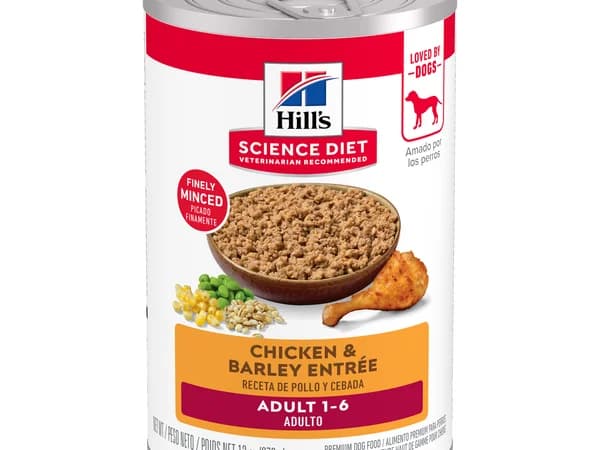

Hill's Science Diet Adult Chicken & Barley Entree Review
Hill's Science Diet wet food follows the same formula as their dry — strong nutritional science, precise formulation, but ingredient quality that doesn't match the price. By-product meal at ~$11/day is a hard sell when competitors offer named-protein formulas for similar money. Best used in combination with Hill's dry food on vet recommendation.

Hill's Science Diet Adult Chicken & Barley Entree Review
Hill's Science Diet wet food follows the same formula as their dry — strong nutritional science, precise formulation, but ingredient quality that doesn't match the price. By-product meal at ~$11/day is a hard sell when competitors offer named-protein formulas for similar money. Best used in combination with Hill's dry food on vet recommendation.
Hill's Science Diet Adult Chicken & Barley Entree Review
Hill's Science Diet wet food follows the same formula as their dry — strong nutritional science, precise formulation, but ingredient quality that doesn't match the price. By-product meal at ~$11/day is a hard sell when competitors offer named-protein formulas for similar money. Best used in combination with Hill's dry food on vet recommendation.

Hill's Science Diet Adult Chicken & Barley Entree Pros & Cons
Pros
- Developed by veterinary nutritionists with feeding trial validation
- Precise nutrient balance optimized for adult dog maintenance
- Good safety record for wet food lines over the past 5+ years
Cons
- Contains chicken by-product meal — not a premium protein source
- Premium pricing (~$11/day) for ingredient quality that trails competitors
- Minimal sourcing transparency on ingredient origins
Overview
Hill's Science Diet is the other veterinary darling alongside Pro Plan — recommended in clinics, sold in vet offices, and backed by decades of nutritional research. The formulation science is legitimate: precise nutrient ratios optimized for adult maintenance, feeding trial validation, and a commitment to measurable health outcomes. Where Hill's stumbles is the same place Pro Plan does: the ingredient list doesn't match the price.
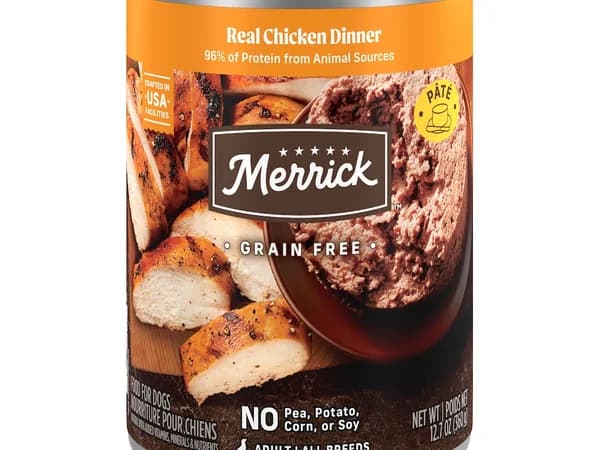
At $3.69 per 13 oz can (~$0.28/oz), you're firmly in premium territory, yet chicken by-product meal leads the protein sourcing. For the same money, Merrick offers deboned chicken first, and for less, Blue Buffalo delivers real chicken with visible vegetables. Hill's value proposition depends almost entirely on whether your veterinarian has specifically recommended it for your dog — and whether you weight nutritional science above ingredient sourcing.
Features Deep-Dive
Veterinary Nutritional Science
Hill's employs over 220 veterinarians, PhD nutritionists, and food scientists — more than any other pet food company. Their formulations are backed by peer-reviewed research published in veterinary journals, and every Science Diet product undergoes feeding trials. The result is a food with precisely calibrated nutrient ratios: optimal calcium-to-phosphorus balance, controlled sodium for kidney health, and targeted amino acid profiles. This level of nutritional precision is genuinely difficult to replicate without Hill's research infrastructure.
The By-Product Paradox
Here's the tension: Hill's nutritional scientists argue (with evidence) that chicken by-product meal is a concentrated, nutrient-dense protein source that includes organ meats rich in vitamins and minerals. They're not wrong — liver, heart, and gizzards are nutritionally superior to muscle meat in many respects. But the "by-product" label also permits less desirable parts, and Hill's doesn't specify which organs are included. For consumers who want transparency, this ambiguity is frustrating, regardless of the science supporting by-products as a category.
Safety and Manufacturing
Hill's wet food line has maintained a clean safety record for over five years, though the broader Hill's brand experienced a significant voluntary recall in 2019 affecting some canned dog food products due to elevated vitamin D levels. The company responded with enhanced testing protocols and greater transparency about their quality control processes. The wet food lines currently on the market have been manufactured under these updated standards.
Pricing Analysis
At $3.69 per 13 oz can (~$0.28/oz), Hill's Science Diet is the most expensive mid-range-to-premium option that still uses by-products. For context: Merrick costs $0.30/oz with deboned chicken first, and Blue Buffalo costs $0.23/oz with real chicken and no by-products. You're paying a 20% premium over Blue Buffalo for worse ingredient transparency but better nutritional science. A 50-pound dog eating Hill's wet food daily costs roughly $7-9 per day, or $210-270 per month. The pricing only makes sense if your veterinarian has identified specific nutritional needs that Hill's formulation addresses.
Who Is This For?
Hill's Science Diet Adult Chicken & Barley Entree works best for:
- Dogs on veterinary recommendation where your vet has identified specific nutritional requirements that Hill's precise formulation addresses — this is where the science backing genuinely matters
- Owners already feeding Hill's dry food who want a cohesive wet-dry system designed to complement each other nutritionally
- Health-condition management where Hill's broader product ecosystem (Prescription Diet) might be needed in the future, and you want to keep your dog on the same brand family
- Owners who trust veterinary nutritional science over ingredient label reading as the primary measure of food quality
Who Should NOT Use This
Hill's Science Diet Adult Chicken & Barley Entree might not be the right choice if:
- You prioritize ingredient quality per dollar — at $0.28/oz with by-products, Merrick ($0.30/oz) and Blue Buffalo ($0.23/oz) both offer significantly better ingredient sourcing
- Ingredient transparency is important — Hill's provides less information about specific protein sources and ingredient origins than competitors at the same price point
- You're buying without vet guidance — the premium pricing is hard to justify without a veterinary recommendation driving the choice
Bottom Line
Hill's Science Diet is excellent nutrition wrapped in a mediocre ingredient list at a premium price. The science is real, the formulation is precise, and the veterinary backing is earned. But unless your vet has specifically recommended it, you'll find better ingredient quality for the same or less money from several competitors.
FAQ
Why is Hill's so expensive when it uses by-products?
You're paying for the nutritional science, not the ingredient sourcing. Hill's invests more in research, feeding trials, and veterinary partnerships than almost any pet food company. The formulation precision — specific nutrient ratios, bioavailability optimization — is what drives the cost, not the raw ingredient quality.
Should I switch from Hill's if my vet recommended it but I'm concerned about ingredients?
Talk to your vet before switching. If they recommended Hill's for a specific health reason (weight management, digestive sensitivity, kidney support), the precise formulation may be more important than ingredient sourcing for your dog's condition. If the recommendation was general, ask about alternatives like Blue Buffalo or Merrick.
Is the Science Diet wet food the same formula as the Prescription Diet?
No. Science Diet is the over-the-counter wellness line. Prescription Diet requires a veterinary prescription and is formulated for specific medical conditions (kidney disease, food allergies, weight management). They share Hill's research platform but target different nutritional needs.
Who Is Hill's Science Diet Adult Chicken & Barley Entree Best For?
Vet-recommended feeding programs that pair with Hill's dry food
The Bottom Line
Hill's Science Diet wet food follows the same formula as their dry — strong nutritional science, precise formulation, but ingredient quality that doesn't match the price. By-product meal at ~$11/day is a hard sell when competitors offer named-protein formulas for similar money. Best used in combination with Hill's dry food on vet recommendation.
Try Hill's Science Diet Adult Chicken & Barley Entree TodayKey Specs
Scoring Breakdown
Quality of protein sources (named meats vs byproducts), use of whole ingredients, absence of fillers (corn, wheat, soy), artificial colors/flavors/preservatives. Rewards fresh/real protein as first ingredient.
Protein/fat/moisture balance, vitamin/mineral completeness, caloric density appropriate for adult dogs, AAFCO compliance with feeding trial data.
Named vs unnamed protein sources, sourcing clarity (country of origin, farm certifications), traceability, absence of vague ingredient terms.
Brand recall history over last 5+ years, manufacturing standards, third-party contamination testing, FDA compliance track record.
Customer satisfaction for taste acceptance, texture quality (pate, stew, loaf, chunks in gravy), consistency, and appetite response across dog sizes and breeds.
Daily feeding cost for a 50 lb dog relative to ingredient quality. Cost-per-ounce and cost-per-calorie normalized. Best quality per dollar spent, not cheapest overall.