
Belkin BoostCharge Pro 3-Port 70W Review
The Belkin BoostCharge Pro 70W combines Belkin's reputation for safety with a practical 3-port design. It's the charger to choose when build quality and certifications matter more than raw specs.

Belkin BoostCharge Pro 3-Port 70W Review
The Belkin BoostCharge Pro 70W combines Belkin's reputation for safety with a practical 3-port design. It's the charger to choose when build quality and certifications matter more than raw specs.
Belkin BoostCharge Pro 3-Port 70W Review
The Belkin BoostCharge Pro 70W combines Belkin's reputation for safety with a practical 3-port design. It's the charger to choose when build quality and certifications matter more than raw specs.

Belkin BoostCharge Pro 3-Port 70W Pros & Cons
Pros
- Premium Belkin build quality with industry-leading safety certifications
- 3 ports (2 USB-C + 1 USB-A) for flexible multi-device charging
- 70W total output with intelligent power distribution
- Clean white design complements Apple accessories
Cons
- Higher price at $51.99 for 70W output
- Bulkier than some dual-port competitors
- No display or smart power monitoring
Overview
The Belkin BoostCharge Pro 70W is the charger you buy when you want to stop thinking about chargers. It is not the cheapest, not the most powerful, and not the most feature-rich option in the mid-range segment. What it is, reliably and without qualification, is the safest and most thoroughly certified multi-port charger you can buy for under $55. Belkin's decades-long history as a trusted accessories manufacturer, combined with industry-leading safety certifications and a build quality that feels like it was designed by engineers who also build surge protectors, makes the BoostCharge Pro the default recommendation for anyone who prioritizes peace of mind over peak specifications.
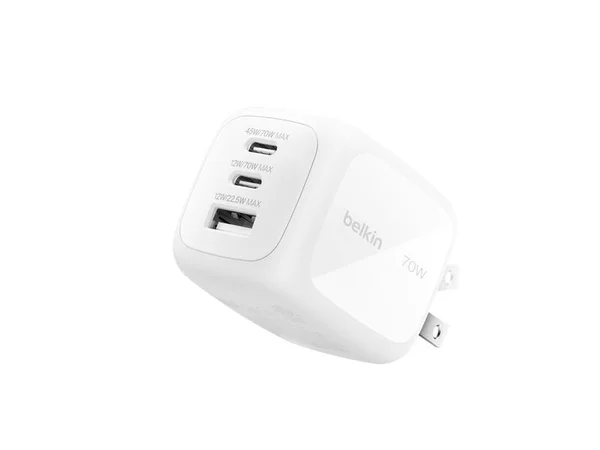
The three-port layout -- two USB-C and one USB-A -- covers the realistic charging needs of most households and desks. The primary USB-C port delivers up to 70W for laptop charging, while the secondary ports handle phones, tablets, and accessories. The clean white design is unmistakably Apple-adjacent, looking perfectly at home next to an iMac or on a white IKEA desk. At $51.99, it costs more per watt than competitors like the Baseus PicoGo AE11, but the premium buys tangible build quality, certified safety margins, and a brand with a support infrastructure that has been handling warranty claims since before USB-C existed.
For families, shared workspaces, and anyone who has ever worried about a cheap charger damaging an expensive device, the BoostCharge Pro offers something no spec sheet can quantify: confidence that nothing will go wrong.
Features Deep-Dive
Safety Certifications and Protection Systems
Where most charger reviews bury safety in a bullet point, the BoostCharge Pro makes it a headline feature. Belkin submits their chargers to UL, CE, and FCC certification testing -- standard for reputable brands -- but goes further with their own internal testing protocols that exceed certification minimums. The charger includes over-voltage protection, over-current protection, over-temperature protection, short-circuit protection, and foreign object detection.
What makes this meaningful in practice is not the list of protections (most decent chargers claim similar features) but Belkin's track record. Their Connected Equipment Warranty, while separate from the charger warranty, reflects a company culture that takes device safety seriously enough to insure connected equipment against damage. The BoostCharge Pro does not include this specific coverage, but the engineering philosophy carries over. Internal component quality, thermal management tolerances, and voltage regulation precision are all areas where Belkin traditionally overbuilds rather than cutting to the minimum viable specification.
For users who charge $1,000 to $2,000 laptops and phones, the marginal cost difference between a budget charger and a Belkin is trivial compared to the cost of a device damaged by a power delivery fault. The BoostCharge Pro is insurance that comes in charger form.
Intelligent Power Distribution Across Three Ports
The BoostCharge Pro's three-port layout (2 USB-C + 1 USB-A) uses intelligent power distribution to allocate the 70W total across active ports. When only the primary USB-C port is in use, it delivers the full 70W -- enough for any MacBook Air and most ultrabooks. When the second USB-C port draws power, the charger redistributes: typically 45W to the primary and 25W to the secondary, though exact splits vary based on device negotiation.
The USB-A port operates at up to 12W, which is sufficient for AirPods, an Apple Watch (via USB-A to USB-C cable), or older devices that have not transitioned to USB-C. Unlike some competitors that treat USB-A as an afterthought with minimal power, Belkin allocates enough wattage to the USB-A port to actually charge devices at a reasonable speed rather than a trickle.
The intelligence in the power distribution matters most when devices are added and removed mid-charge. Unplugging a phone from the secondary port automatically reallocates that wattage back to the primary port without interrupting or renegotiating the laptop's charging session. This seamless rebalancing prevents the brief charging pauses that plague some cheaper multi-port chargers when port loads change.
Build Quality and Design Aesthetic
The BoostCharge Pro's white polycarbonate shell is the thickest and most rigid of any charger in the mid-range segment. There is zero flex when you squeeze it, no mold line visible without a magnifying glass, and a matte finish that resists both fingerprints and the yellowish discoloration that plagues white plastic chargers from lesser brands over time. The weight is substantial -- heavier than the Baseus PicoGo AE11 by a noticeable margin -- which keeps it planted on a desk rather than getting dragged around by cable weight.
The design is deliberately understated. No accent colors, no textured grips, no visible branding beyond a small Belkin logo on the face. It is the charging equivalent of a white appliance: designed to blend in rather than stand out. For shared spaces like kitchens, living rooms, or office conference tables where a charger needs to look appropriate rather than personal, the BoostCharge Pro's neutrality is an asset. It does not look like a gaming accessory, a tech gadget, or a piece of test equipment. It just looks like it belongs.
The form factor is, however, the trade-off for that build quality. It is bulkier than the Mophie Speedport or Baseus PicoGo AE11, and the prongs do not fold. This makes it less ideal for travel and more suited to semi-permanent desk or nightstand placement -- a charger that lives in one spot and does its job without being moved.
Pricing Analysis
At $51.99, the BoostCharge Pro sits at the top of the mid-range price bracket. The Baseus PicoGo AE11 delivers 67W and three ports for $39.99 -- $12 less with nearly identical port count and only 3W less total output. The Mophie Speedport costs $49.95 but provides only two ports. The Baseus EnerFill FE11 100W costs $49.99 with 30W more total output and the same port count.
On a pure specification basis, the BoostCharge Pro loses every value comparison in this tier. But specifications alone do not capture what Belkin provides. The premium buys certifications from a company with a decades-long safety track record, build quality that outlasts cheaper alternatives by years, a design appropriate for shared spaces, and customer support from a brand with retail presence and established warranty processes. If you have ever dealt with an Amazon marketplace charger brand's customer service -- or lack thereof -- you understand the value of Belkin's support infrastructure.
The real comparison is not BoostCharge Pro versus Baseus but BoostCharge Pro versus the risk calculus of charging expensive devices with a less-proven brand. For users who own a $2,000 MacBook Pro and a $1,200 iPhone, the $12 premium over a Baseus charger is a rounding error in their device investment.
Who Is This For?
- Safety-first buyers who charge expensive devices and want the highest-confidence power delivery from a manufacturer with decades of safety engineering history and certifications that exceed minimum requirements
- Families and shared-space users who need a charger that works for everyone -- the three-port layout handles a laptop, a phone, and a USB-A device simultaneously, while the neutral white design fits any room without looking like someone's personal tech accessory
- Long-term thinkers who plan to use one charger for 3 to 5 years rather than replacing budget options annually, and who value the build quality and brand warranty that supports that timeline
- Apple ecosystem households where the white design, Apple-adjacent aesthetic, and proven compatibility with MacBooks and iPhones make it a natural complement to existing hardware
Who Should NOT Use This
- Budget-conscious buyers who compare on specifications: If your primary metric is watts-per-dollar or ports-per-dollar, the BoostCharge Pro loses to virtually every competitor. The Baseus PicoGo AE11 offers a nearly identical experience for $12 less, and the Baseus EnerFill FE11 delivers 30W more for $2 less.
- Travelers who need portability: The non-folding prongs and bulkier body make this a desk charger, not a travel charger. The Baseus PicoGo AE11 with foldable prongs or the Mophie Speedport with its slimmer profile are substantially better for bags and carry-ons.
- Tech enthusiasts who want features beyond charging: No display, no companion app, no real-time wattage monitoring. The BoostCharge Pro charges your devices and nothing more. If visibility into your charging data matters, the Anker Smart Display models are the only options that provide it.
Bottom Line
The Belkin BoostCharge Pro 70W is the Toyota Corolla of USB-C chargers: it will never excite you, but it will never let you down. The build quality is the best in the mid-range segment, the safety certifications are the most thorough, and the brand behind it has been making reliable accessories longer than most competitors have existed. You pay a modest premium for that assurance, and the premium is modest enough that most buyers should not think twice about it. If you want the charger you can forget about once you plug it in, this is the one.
FAQ
Is the $12 premium over the Baseus PicoGo AE11 actually worth it?
That depends on what you are charging and how long you plan to keep it. If you charge a $300 Chromebook and replace your charger every year anyway, no -- the Baseus is the smarter buy. If you charge a $2,000 MacBook Pro and want a charger that lasts 3 to 5 years with the backing of a brand that will honor its warranty, the $12 is negligible. Belkin's quality control and safety testing are genuinely more rigorous than budget brands, and that matters more for expensive devices than cheap ones.
Can the BoostCharge Pro fast-charge a Samsung Galaxy phone?
Yes. The USB-C ports support PD 3.0 and PPS, which covers Samsung's Adaptive Fast Charging requirements. A Galaxy S24 or S25 series phone will charge at its full supported speed on the secondary USB-C port. The primary USB-C port also works but is better reserved for a laptop or tablet that needs the higher wattage allocation.
Why don't the prongs fold? Is this an oversight?
Belkin likely chose fixed prongs for durability and electrical contact reliability. Folding hinge mechanisms are a common failure point in chargers over time, and fixed prongs maintain a consistent, solid connection with the outlet. This is consistent with Belkin's philosophy of prioritizing reliability over convenience. The trade-off is reduced portability, which is why the BoostCharge Pro is best suited for desk or nightstand use rather than travel.
How does this compare to the Belkin BoostCharge 45W or 65W models?
The 70W Pro model sits at the top of Belkin's consumer multi-port lineup. It adds more total wattage and the "Pro" build quality tier, which includes denser internal components and more thorough thermal management. If your highest-draw device is a phone or tablet (not a laptop), the lower-wattage Belkin models save money without sacrificing anything practical. But if you charge a laptop, the 70W Pro's primary port wattage makes a meaningful difference in charging speed.
Who Is Belkin BoostCharge Pro 3-Port 70W Best For?
Users who prioritize safety certifications and brand reliability from a trusted accessory maker
The Bottom Line
The Belkin BoostCharge Pro 70W combines Belkin's reputation for safety with a practical 3-port design. It's the charger to choose when build quality and certifications matter more than raw specs.
Buy on AmazonKey Specs
Scoring Breakdown
Maximum wattage output, power per port, and multi-device power distribution efficiency.
Physical size, weight, foldable prongs, and overall travel-friendliness.
Number of ports, port types (USB-C/USB-A), and multi-device charging flexibility.
Fast charging protocol support including PD 3.0/3.1, PPS, QC, UFCS, and SCP.
Materials, safety certifications (TUV, UL), thermal management, and overall construction.
Price-to-performance ratio, wattage-per-dollar, and included accessories like cables.
Display/monitoring, touch controls, smart power allocation, and device identification.