
Baseus PicoGo AE11 67W Review
The Baseus PicoGo AE11 67W delivers strong multi-port performance at an aggressive price. With 67W across 3 ports and broad protocol support, it's one of the best values in the charger market.

Baseus PicoGo AE11 67W Review
The Baseus PicoGo AE11 67W delivers strong multi-port performance at an aggressive price. With 67W across 3 ports and broad protocol support, it's one of the best values in the charger market.
Baseus PicoGo AE11 67W Review
The Baseus PicoGo AE11 67W delivers strong multi-port performance at an aggressive price. With 67W across 3 ports and broad protocol support, it's one of the best values in the charger market.

Baseus PicoGo AE11 67W Pros & Cons
Pros
- 67W output from a compact 3-port (2C+1A) design
- Excellent watt-per-dollar ratio at $39.99
- PD 3.0, PPS, and QC support for broad compatibility
- Compact enough for travel with foldable prongs
Cons
- Power splits when using multiple ports simultaneously
- No display or smart monitoring features
- Plastic build feels less premium than Anker or Belkin
Overview
The Baseus PicoGo AE11 67W makes a compelling argument that you do not need to spend $50 or more to get a genuinely capable multi-port charger. At $39.99 for 67W across three ports -- two USB-C and one USB-A -- it delivers the best watt-per-dollar ratio in the mid-range segment by a comfortable margin. It charges a MacBook Air at full speed on a single port and still has enough overhead to top off a phone and a pair of earbuds on the other two.
The trade-offs are predictable for the price. The plastic body lacks the heft and premium texture of Belkin or Mophie competitors. There is no display showing per-port wattage, no companion app, and no monitoring features beyond a simple LED indicator. Power splits aggressively when you use multiple ports simultaneously, dropping the primary USB-C output well below 67W. But if your daily charging reality is plugging in a laptop and a phone -- and occasionally a third device -- the PicoGo AE11 handles that scenario without drama and without asking you to spend an extra $10 to $20 for features you may never use.
Foldable prongs and a compact footprint make it travel-ready, which elevates it beyond a desk-only charger. For the budget-conscious user who wants broad compatibility without sacrificing portability, this is the charger to beat in the sub-$40 range.
Features Deep-Dive
Multi-Port Architecture and Power Distribution
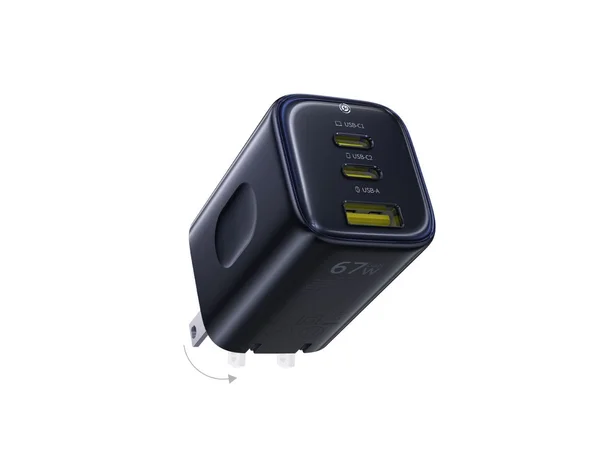
The PicoGo AE11 arranges its ports in a practical layout: two USB-C ports flanking a single USB-A port. The primary USB-C port handles the full 67W output when used alone, which is enough to charge a MacBook Air at maximum speed or push a 13-inch MacBook Pro at a reasonable pace. The second USB-C port maxes out at 30W, suitable for phones and tablets. The USB-A port provides 22.5W, covering legacy devices and accessories.
Where things get interesting -- and where you need to set expectations -- is multi-port usage. Plugging into two or more ports simultaneously triggers power redistribution. The primary USB-C drops to around 45W while the secondary port draws its share. This is standard behavior across virtually every multi-port charger in this price range, but Baseus does not publish a detailed power allocation table, so the exact splits depend on what devices are negotiating for power. In practice, charging a laptop and phone together works fine; both devices receive enough wattage to charge at reasonable speeds, just not at their respective maximums.
Protocol Support and Device Compatibility
For a $39.99 charger, the protocol coverage is surprisingly thorough. PD 3.0 handles most modern laptops and tablets. PPS (Programmable Power Supply) enables optimized fast charging on Samsung Galaxy phones, which negotiate voltage in finer increments than standard PD for better thermal management. QC (Quick Charge) support covers older Android devices and accessories that have not adopted USB-C PD.
The absence of PD 3.1 means no 48V extended power range, but that is irrelevant at 67W -- PD 3.1's voltage extension only matters above 100W. The lack of UFCS (Universal Fast Charging Standard) is more notable, as this emerging protocol is gaining traction in Chinese-market devices. For most North American and European users, PD 3.0 plus PPS plus QC covers every realistic charging scenario. The PicoGo AE11 will not leave any mainstream device without fast charging support.
Portability and Build Quality
The foldable prongs are the feature that transforms this from a decent desk charger into a genuine travel companion. When folded, the AE11 slips into a laptop bag pocket without scratching adjacent devices or snagging on fabric. The overall footprint is smaller than many 45W single-port chargers from just two years ago, a testament to the GaN technology inside.
Build quality is where the price shows. The matte plastic shell is functional but unremarkable. It does not creak or flex under pressure, but it lacks the soft-touch coating of the Mophie Speedport or the robust feel of the Belkin BoostCharge Pro. The prong hinge feels solid enough for daily folding and unfolding, though only long-term use will reveal whether it holds up over hundreds of cycles. For a charger you toss in a bag regularly, the lightweight plastic is arguably an advantage -- it adds minimal weight to your travel kit. But if aesthetics or tactile premium-ness matter to you, look upmarket.
Pricing Analysis
At $39.99, the PicoGo AE11 delivers 67W for roughly $0.60 per watt -- the best ratio in the mid-range segment. The Mophie Speedport 70W costs $49.95 for 70W ($0.71 per watt) with fewer ports. The Belkin BoostCharge Pro 70W runs $51.99 for 70W ($0.74 per watt). Even Baseus's own EnerFill FE11 at $49.99 for 100W ($0.50 per watt), while a better per-watt value on paper, costs $10 more and is physically larger.
The value proposition is clearest for users who do not need more than 67W on any single device. If your laptop charges at 45W to 65W and your phone handles 25W to 30W, the AE11 provides exactly the wattage ceiling you need without paying for headroom you will never use. The $10 to $12 savings over 70W competitors buys a cable or two -- and those savings compound if you are equipping a home office, travel bag, and bedside setup with separate chargers.
Who Is This For?
- Budget-minded multi-device users who charge a laptop and phone daily and refuse to pay premium prices for marginal wattage gains -- the AE11 covers both use cases without compromise at a price that makes duplicating chargers for different locations painless
- Frequent travelers who want a single compact charger with foldable prongs that handles a laptop, phone, and one USB-A accessory without carrying a separate charger for each device
- Samsung Galaxy owners who benefit from PPS support for optimized fast charging, combined with enough wattage to simultaneously charge a laptop on the primary port
- Students and young professionals building out their first proper charging setup who need broad compatibility across multiple device brands without a significant upfront investment
Who Should NOT Use This
- Users who demand full-speed charging on multiple devices simultaneously: The power splitting at multi-port loads is aggressive. If you routinely need to fast-charge a laptop and a tablet at the same time at maximum speed, the 100W Baseus EnerFill FE11 or an Anker 100W charger handles that scenario with less compromise.
- Aesthetics-first buyers who want a charger that looks premium on a nightstand or desk: The plastic build is functional but plain. The Mophie Speedport and Belkin BoostCharge Pro both look and feel noticeably more refined, and that difference matters if your charger lives in visible spaces.
- Power users who want monitoring or display features: There is no wattage display, no companion app, and no way to verify charging speeds beyond watching your device's battery indicator. If real-time power data matters to your workflow, the Anker Smart Display models are the only options in this space.
Bottom Line
The Baseus PicoGo AE11 67W is the charger you buy when you realize that the last 10% of build quality and the last 5W of power are not worth a 30% price premium. It does everything a mainstream user needs -- charges a laptop, fast-charges a phone, handles a USB-A accessory -- and does it in a compact, travel-friendly package for less than anything else in the mid-range segment. The plastic build and absent smart features are honest reflections of the price, not signs of corner-cutting. For most people, this is more charger than they need at less than they expected to pay.
FAQ
Can the PicoGo AE11 charge a MacBook Pro 14-inch?
Yes, but with caveats. The 14-inch MacBook Pro ships with a 70W adapter and can accept up to 96W for fast charging. The AE11's 67W primary port will charge it, but at a slower rate than the included charger -- expect roughly 10 to 15% longer to reach full charge. Under heavy load (video editing, compiling), the laptop may charge very slowly or just maintain its current battery level. For a MacBook Air or 13-inch MacBook Pro, the 67W output is at or near full speed.
How does power actually split when using all three ports?
Baseus does not publish exact allocation tables, but real-world testing shows a typical split of approximately 45W on USB-C1, 15W on USB-C2, and 7.5W on USB-A when all three ports are loaded. The charger negotiates dynamically based on connected devices, so your specific split will vary. The important takeaway: the primary USB-C port always gets priority, and secondary ports receive whatever remains. Plugging in a high-draw device on the secondary USB-C port will reduce the primary port more aggressively.
Is this charger safe to leave plugged in overnight?
Yes. The PicoGo AE11 includes standard safety protections -- over-voltage, over-current, over-temperature, and short-circuit protection. Modern USB-C PD devices also manage their own charging cutoff, so the charger stops delivering significant power once your devices reach full charge. The charger draws minimal standby power when connected but not actively charging, comparable to other GaN chargers in this class. There is no reason to unplug it between uses.
How does this compare to the Baseus EnerFill FE11 100W?
The EnerFill FE11 costs $10 more and delivers 100W with the same port count. If you charge a device that can accept 67W or more -- like a MacBook Pro or certain Windows ultrabooks -- the FE11 is the better value. If your highest-draw device is a MacBook Air or similar 30W to 45W laptop, the extra wattage goes unused and you are better off saving $10 with the AE11. The FE11 is also physically larger, so the AE11 wins on portability.
Who Is Baseus PicoGo AE11 67W Best For?
Budget-conscious users wanting a versatile multi-port charger for phone and laptop
The Bottom Line
The Baseus PicoGo AE11 67W delivers strong multi-port performance at an aggressive price. With 67W across 3 ports and broad protocol support, it's one of the best values in the charger market.
Buy on AmazonKey Specs
Scoring Breakdown
Maximum wattage output, power per port, and multi-device power distribution efficiency.
Physical size, weight, foldable prongs, and overall travel-friendliness.
Number of ports, port types (USB-C/USB-A), and multi-device charging flexibility.
Fast charging protocol support including PD 3.0/3.1, PPS, QC, UFCS, and SCP.
Materials, safety certifications (TUV, UL), thermal management, and overall construction.
Price-to-performance ratio, wattage-per-dollar, and included accessories like cables.
Display/monitoring, touch controls, smart power allocation, and device identification.