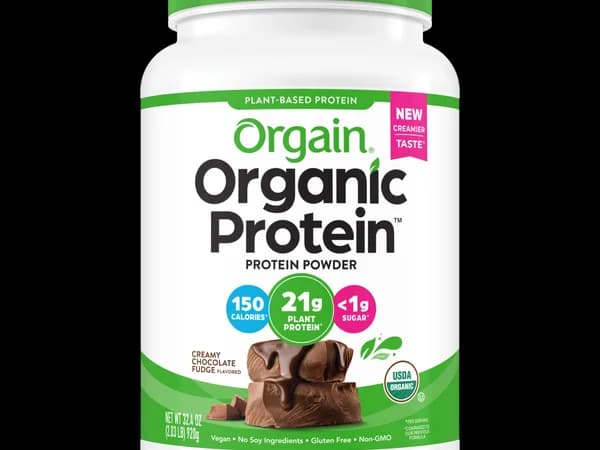

Orgain Organic Plant-Based Protein Powder Review
Orgain offers affordable USDA Organic plant protein with good taste, but Consumer Reports found lead at 143% over CA Prop 65 limits. The organic certification and pleasant flavor make it appealing, but the heavy metal data is a significant concern that health-conscious buyers should weigh carefully.

Orgain Organic Plant-Based Protein Powder Review
Orgain offers affordable USDA Organic plant protein with good taste, but Consumer Reports found lead at 143% over CA Prop 65 limits. The organic certification and pleasant flavor make it appealing, but the heavy metal data is a significant concern that health-conscious buyers should weigh carefully.
Orgain Organic Plant-Based Protein Powder Review
Orgain offers affordable USDA Organic plant protein with good taste, but Consumer Reports found lead at 143% over CA Prop 65 limits. The organic certification and pleasant flavor make it appealing, but the heavy metal data is a significant concern that health-conscious buyers should weigh carefully.

Orgain Organic Plant-Based Protein Powder Pros & Cons
Pros
- USDA Organic and Non-GMO Project Verified with 21g plant-based protein
- Good taste consistently praised in user reviews for a plant-based powder
- Affordable at $1.80/serving compared to premium plant-based competitors
Cons
- Consumer Reports found 0.72μg lead/serving — 143% over CA Prop 65 limit
- Uses organic erythritol and stevia which some find has an aftertaste
- No NSF or Informed Sport certification for banned substance testing
Overview
Orgain Organic Plant-Based Protein Powder has become one of the most popular plant-based proteins in America, and if you have walked through the supplement aisle at Costco, Target, or Whole Foods, you have almost certainly seen it. The brand was founded by Dr. Andrew Abraham, a physician who developed Orgain products during his own cancer treatment recovery when he could not find a clean, organic nutritional supplement that actually tasted acceptable. That origin story is genuine, and it informs the product's formulation philosophy: USDA Organic, Non-GMO Project Verified, 21g of plant-based protein per serving, and a taste profile that is consistently described — even by plant protein skeptics — as one of the best in the category.
At $1.80 per serving, Orgain undercuts premium plant-based competitors like Vega Sport ($3.00) and Garden of Life SPORT ($2.67) by a significant margin while maintaining organic certification. For budget-conscious consumers who want organic plant protein, the value proposition is straightforward and compelling.
But there is a serious caveat that any honest review must address directly. Consumer Reports testing found 0.72 micrograms of lead per serving in Orgain — 143% over California's Proposition 65 safe harbor limit of 0.5 micrograms per day. This is not a borderline finding. Orgain exceeded the Prop 65 threshold by nearly half again, and for a product marketed on health, purity, and organic credentials, the disconnect is jarring. Like Garden of Life SPORT, Orgain faces the uncomfortable reality that organic plant-based proteins can — and do — contain elevated levels of naturally occurring heavy metals absorbed from soil. Orgain also lacks NSF Certified for Sport or Informed Sport certification, which means it has no independent banned-substance testing for athletes. The product you are buying is genuinely organic, genuinely good-tasting, and genuinely affordable. It also genuinely contains lead at levels that exceed California's safety threshold. Both of these things are true simultaneously, and any review that omits either one is doing you a disservice.
Features Deep-Dive
Taste: The Rare Plant Protein People Actually Enjoy Drinking
If there is one thing that distinguishes Orgain from the broader plant-based protein market, it is taste. Plant proteins have a well-earned reputation for chalky, gritty, earthy-tasting formulations that people endure rather than enjoy. Orgain has largely solved this problem. The Creamy Chocolate Fudge flavor, in particular, has achieved near-universal praise in user reviews — it tastes like a chocolate milkshake, not a health obligation. The Vanilla Bean and Peanut Butter flavors are also well-regarded, though they cannot entirely mask the slight earthiness inherent to pea and brown rice protein. Orgain achieves this palatable taste through a combination of organic erythritol (a sugar alcohol with essentially zero calories and no blood sugar impact) and stevia leaf extract. This sweetener combination works well for most people, but it is not without trade-offs. Some users detect a lingering aftertaste from the stevia, and erythritol can cause mild digestive discomfort (primarily bloating) in sensitive individuals when consumed in larger quantities. The texture is smoother than many competitors — notably smoother than Garden of Life SPORT — though it does not match the silk-like dissolution of a good whey protein. In a blender with ice and a banana, the difference from whey becomes nearly imperceptible. The wide retail availability means you can often find single-serve packets or ready-to-drink versions to test flavors before committing to a full tub.
Organic Credentials and What They Cover
Orgain carries both USDA Organic and Non-GMO Project Verified certifications, which address two distinct aspects of the product. The USDA Organic seal means the plant ingredients — organic pea protein, organic brown rice protein, and organic chia seeds — were grown without synthetic pesticides, synthetic fertilizers, or genetic modification, and that the product meets federal organic processing standards. The Non-GMO Project Verified seal provides additional third-party verification of the non-GMO claim through independent testing. These certifications are meaningful and legitimate. They tell you something real about how the raw ingredients were produced and processed. What they do not tell you is anything about the heavy metal content of the final product. This distinction is critical because many consumers interpret "USDA Organic" as a comprehensive purity guarantee — a signal that the product has been vetted for everything harmful. It has not. Organic certification addresses agricultural inputs (pesticides, fertilizers, GMOs) but not the naturally occurring mineral content of the soil those crops grow in. Lead exists in soil. Plants absorb it. Organic plants absorb it just as readily as conventional plants. Understanding this distinction is essential to making an informed purchasing decision.
The Consumer Reports Lead Finding: Full Context
Consumer Reports found 0.72 micrograms of lead per serving in Orgain Organic Protein Powder, which exceeds California's Proposition 65 safe harbor level of 0.5 micrograms per day by 143%. Here is what you need to understand about this finding. First, Prop 65 limits are among the most conservative safety thresholds in the world — they are calculated by taking the level of exposure that produces no observable adverse effect in animal studies and dividing by 1,000. The FDA does not set specific limits for lead in protein powders. So Orgain does not violate any federal regulation, but it does exceed the state threshold that California has determined warrants consumer notification. Second, the 0.72 micrograms per serving assumes you consume one serving per day. If you use more than one serving or consume other foods that contribute lead (and most people do — lead is present in trace amounts in many foods, tap water, and even the air in some areas), your total daily exposure increases. Third, lead is cumulative in the body — it is stored primarily in bones, with a biological half-life measured in decades. The health effects of chronic low-level lead exposure are well-documented and include cardiovascular effects, kidney damage, and neurological impacts. This does not mean that drinking one Orgain shake will harm you. It means that daily consumption over extended periods contributes to a cumulative lead burden that some health authorities consider concerning. The fact that this product is marketed to health-conscious consumers — and specifically marketed as "organic" and "clean" — makes the lead finding particularly relevant to the purchasing decision.
Protein Content and Source Quality
Orgain delivers 21g of protein per serving from a blend of organic pea protein, organic brown rice protein, and organic chia seeds. This is lower than the 30g offered by Vega Sport and Garden of Life SPORT, which means you get less protein per serving at a lower per-serving cost. On a per-gram-of-protein basis, Orgain costs approximately $0.086 per gram compared to $0.10 per gram for Vega Sport — still a better value, but the gap narrows when you account for the lower protein content per scoop. The pea-rice protein combination is well-established in plant-based nutrition because the two sources have complementary amino acid profiles — pea protein is rich in lysine but low in methionine, while rice protein provides the methionine that pea protein lacks. The result is a complete amino acid profile that approaches whey in essential amino acid composition, though the PDCAAS score is still lower. The chia seed addition contributes fiber and omega-3 fatty acids (ALA form) more than protein — it is a nutritional enhancer rather than a primary protein source. At 21g per serving, Orgain is sufficient for most supplementation needs, but individuals targeting 30g+ of protein per meal may need to use 1.5 scoops, which increases both cost and lead exposure proportionally.
Pricing Analysis
Orgain's $36 price tag for approximately 20 servings puts it at $1.80 per serving — a compelling price point in the organic plant-based protein category. For comparison, Garden of Life SPORT (also organic, also plant-based, with more certifications) costs $2.67 per serving, and Vega Sport (NSF certified, plant-based, not organic) costs $3.00 per serving. Orgain delivers organic plant protein for 33% less than Garden of Life and 40% less than Vega Sport. Compared to the broader protein market, Orgain's value proposition is more moderate. Optimum Nutrition Gold Standard Whey costs $1.08 per serving (but is not plant-based or organic), and Levels Grass-Fed Whey runs $1.40-1.60 per serving (but is dairy-based). Orgain is not the cheapest protein powder on the market by any measure, but it is the most affordable organic plant-based option from a nationally recognized brand. The Costco 2-pack offers additional savings for committed users, and Amazon Subscribe & Save typically brings the per-serving cost closer to $1.60. For budget-conscious consumers who have decided on organic plant-based protein, Orgain is the clear value leader. The question is whether the heavy metal data changes that value equation for you personally.
Who Is This For?
Orgain Organic Plant-Based Protein Powder works best for:
- Budget-conscious consumers who want organic plant-based protein and are not willing to pay $2.50-3.00 per serving for premium competitors. At $1.80 per serving (less with Subscribe & Save or Costco pricing), Orgain delivers USDA Organic and Non-GMO Project Verified credentials at the lowest price point in the category. If organic certification is important to you and cost is a factor, no other nationally available plant protein matches this combination.
- People who have tried and disliked other plant-based proteins due to taste and are looking for a palatable daily-use option. Orgain consistently receives the strongest taste ratings in the plant-based protein category, and the Creamy Chocolate Fudge flavor specifically has converted many self-described "plant protein haters." If taste has been the barrier keeping you from switching to plant-based protein, Orgain is the product most likely to change your mind.
- Occasional-use consumers who supplement with protein a few times per week rather than daily. At lower consumption frequencies, the heavy metal exposure concern diminishes significantly, and Orgain's combination of good taste, organic credentials, and accessible price makes it a sensible choice for smoothies, baking, or post-workout recovery a few times per week. The wide retail availability means you can pick up a single-serve packet at most grocery stores to test before buying a full tub.
Who Should NOT Use This
Orgain Organic Plant-Based Protein Powder might not be the right choice if:
- You consume protein powder daily and are concerned about heavy metal exposure: At 0.72 micrograms of lead per serving — 143% over California's Prop 65 limit — daily consumption of Orgain contributes a cumulative lead burden that some health authorities consider concerning. If you use protein powder every day and heavy metal exposure is a concern, consider whey-based proteins (which generally test significantly lower for heavy metals) or seek out plant-based proteins that publish batch-level heavy metal test results showing levels below Prop 65 thresholds. This is especially important if you are pregnant, nursing, or providing this product to children, as developing brains are more susceptible to lead's neurological effects.
- You are a competitive athlete subject to drug testing: Orgain does not carry NSF Certified for Sport, Informed Sport, or Informed Choice certification. There is no independent assurance that each batch is free from banned substances. If a failed drug test could affect your career or eligibility, use a certified product. Vega Sport and Garden of Life SPORT both carry NSF Certified for Sport and are plant-based alternatives, though they come at higher price points and have their own heavy metal considerations.
- You need 25g+ of protein per serving for your nutrition plan: Orgain delivers 21g per serving, which is below the 24-30g range offered by most competitors. If you are following a high-protein diet or trying to hit 30g+ per meal for muscle protein synthesis optimization, you will need to use more than one scoop — which increases cost, calories, and lead exposure proportionally. Garden of Life SPORT and Vega Sport both deliver 30g per serving, and most whey proteins offer 24-27g per serving.
Bottom Line
Orgain is the most accessible entry point into organic plant-based protein — affordable, widely available, and genuinely good-tasting in a category where palatability is the exception rather than the rule. The founder's story is authentic, and the product delivers on its organic and taste promises. But the Consumer Reports lead finding is not a minor asterisk — it is a substantive data point that daily users should weigh seriously, particularly given that the product's entire brand identity is built on health and purity. For occasional use in smoothies, it remains a solid choice. For daily supplementation, the lead data deserves more consideration than the organic label might suggest.
FAQ
How does Orgain compare to Garden of Life SPORT on heavy metals?
Both products have been flagged for elevated heavy metal levels, but the specifics differ. Consumer Reports found Orgain at 0.72 micrograms of lead per serving (143% over Prop 65 limits), while Garden of Life SPORT was flagged at 4-6 times Consumer Reports' own daily safety concern threshold for lead. Direct comparison is complicated by different testing methodologies and reporting frameworks, but both products show lead levels that exceed at least one recognized safety benchmark. Garden of Life SPORT carries additional certifications (NSF Certified for Sport, USDA Organic, Non-GMO Project Verified triple stack) that Orgain does not, but those certifications do not address heavy metal contamination. If heavy metals are your deciding factor, neither product provides strong reassurance, and whey-based proteins generally test cleaner on this dimension.
Is Orgain safe for pregnant women?
We cannot make a medical recommendation, but the data warrants caution. The Consumer Reports lead finding of 0.72 micrograms per serving exceeds California's Prop 65 safe harbor level, and lead exposure is a particularly acute concern during pregnancy because it crosses the placental barrier and can affect fetal neurological development. The CDC states that there is no known safe level of lead exposure for children, and fetal exposure is considered especially concerning. If you are pregnant or planning to become pregnant, consult your healthcare provider before using any protein supplement, and consider that whey-based proteins from dairy sources generally test lower for heavy metals than plant-based alternatives. This is not specific to Orgain — it applies to plant-based protein powders as a category.
Why does Orgain taste better than other plant proteins?
Orgain invests more in flavor formulation than most plant-based protein brands, using a carefully calibrated combination of organic erythritol, stevia leaf extract, natural flavors, and organic cocoa powder (in chocolate variants). The erythritol provides bulk sweetness without the bitter aftertaste that stevia alone can produce, while the natural flavors and cocoa help mask the inherent earthiness of pea and rice protein. The trade-off is that these additions make the ingredient list longer and introduce sweeteners that some consumers prefer to avoid. Brands that prioritize shorter ingredient lists (like Naked Pea, which uses only pea protein) sacrifice taste and mixability for simplicity. Orgain has chosen the opposite trade-off — optimizing for taste and daily palatability at the cost of a slightly more complex formulation.
Can I use Orgain for baking or cooking?
Yes, and this is actually one of Orgain's strengths. The relatively mild flavor profile and smooth texture make it one of the better plant-based proteins for adding to pancake batter, oatmeal, energy balls, muffins, and homemade protein bars. Protein does not denature in a harmful way when heated — cooking changes the protein's structure (similar to how an egg white solidifies when cooked) but does not reduce its nutritional value or amino acid content. The vanilla and unflavored varieties are the most versatile for cooking, as the chocolate flavor can dominate recipes where chocolate is not desired. Using protein powder in baking is also a practical way to consume it if you do not enjoy drinking protein shakes, and it distributes the serving across multiple portions, which may reduce per-portion heavy metal exposure compared to consuming a full serving in a single shake.
Who Is Orgain Organic Plant-Based Protein Powder Best For?
Budget-conscious organic shoppers (note: Consumer Reports heavy metal flag)
The Bottom Line
Orgain offers affordable USDA Organic plant protein with good taste, but Consumer Reports found lead at 143% over CA Prop 65 limits. The organic certification and pleasant flavor make it appealing, but the heavy metal data is a significant concern that health-conscious buyers should weigh carefully.
Try Orgain Organic Plant-Based Protein Powder TodayKey Specs
Scoring Breakdown
Certification level (NSF Certified for Sport, Informed Sport/Choice, Clean Label Project, Labdoor) and testing rigor
Heavy metal screening results (Consumer Reports data, Clean Label Project Purity Award, published batch COAs), lead/cadmium/arsenic levels
Minimal ingredient count, no artificial sweeteners/colors/fillers, natural flavoring, clean label practices
Protein grams per dollar — calculated from price per serving and protein per serving to identify best value
Protein per serving, amino acid profile, BCAA content, protein source quality (isolate vs concentrate, grass-fed, organic)
Flavor quality, texture, dissolving ease based on aggregated expert reviews and user ratings
Published COAs, ingredient sourcing disclosure, supply chain traceability, formula change communication