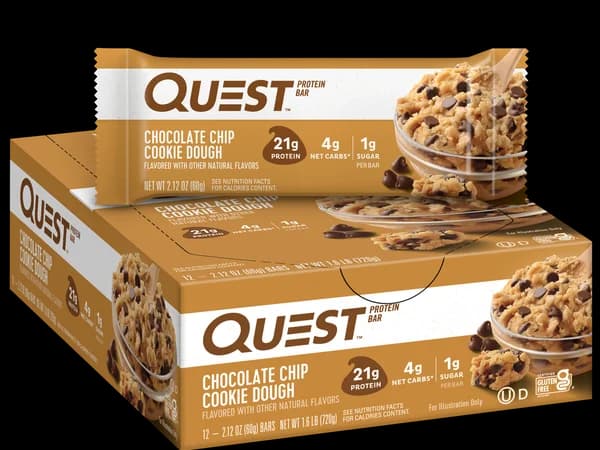

Quest Chocolate Chip Cookie Dough Protein Bar Review
Quest dominates on macros — 21g protein, <1g sugar, widely available everywhere. But it achieves this with sucralose AND erythritol, earning the lowest ingredient purity and sugar profile scores in our comparison. If you only count macros, Quest is king. If ingredient quality matters, look elsewhere.

Quest Chocolate Chip Cookie Dough Protein Bar Review
Quest dominates on macros — 21g protein, <1g sugar, widely available everywhere. But it achieves this with sucralose AND erythritol, earning the lowest ingredient purity and sugar profile scores in our comparison. If you only count macros, Quest is king. If ingredient quality matters, look elsewhere.
Quest Chocolate Chip Cookie Dough Protein Bar Review
Quest dominates on macros — 21g protein, <1g sugar, widely available everywhere. But it achieves this with sucralose AND erythritol, earning the lowest ingredient purity and sugar profile scores in our comparison. If you only count macros, Quest is king. If ingredient quality matters, look elsewhere.

Quest Chocolate Chip Cookie Dough Protein Bar Pros & Cons
Pros
- Industry-leading macros with 21g protein and less than 1g sugar per bar
- Milk protein isolate and whey isolate provide high bioavailability and complete amino acids
- Widely available in virtually every grocery store, gas station, and gym in the country
Cons
- Contains BOTH sucralose and erythritol — double artificial sweetener and sugar alcohol penalty
- Heavily processed ingredient list with numerous additives beyond the protein
- Sucralose is one of the most controversial artificial sweeteners in health-conscious circles
Overview
Quest Chocolate Chip Cookie Dough is the protein bar equivalent of a muscle car: raw performance numbers that dominate the spec sheet, with trade-offs you either accept or walk away from. At 21g protein and less than 1g sugar per bar, no other product in this comparison touches its macro efficiency. The protein blend of milk protein isolate and whey protein isolate delivers genuinely high bioavailability, and you can find these bars in virtually every grocery store, gas station, and gym vending machine in the country.
But those headline numbers come at a cost. Quest achieves its near-zero sugar profile by deploying both sucralose and erythritol, earning it our lowest ingredient purity and sugar-sweetener scores. The full ingredient list reads like a food science textbook, with soluble corn fiber, palm oil, and various additives rounding out the formulation. For the macro-counting gym-goer who views food primarily as fuel, Quest delivers exactly what they want. For anyone who reads ingredient labels with a critical eye, the picture gets considerably murkier.
This product is best for macro-focused gym-goers who prioritize protein-to-calorie ratio above ingredient purity.
Features Deep-Dive
Protein Profile and Bioavailability
Quest's protein blend is legitimately impressive from a sports nutrition standpoint. Milk protein isolate provides both casein and whey in their natural ratio, offering sustained amino acid release, while the added whey protein isolate delivers a fast-absorbing leucine spike that supports muscle protein synthesis. The combined 21g per bar hits the threshold most exercise science research identifies as effective for post-workout recovery. Unlike competitors that rely on soy protein isolate or plant blends with lower bioavailability scores, Quest invests in protein sources that actually deliver on their gram count. The PDCAAS (Protein Digestibility Corrected Amino Acid Score) of this blend approaches 1.0 -- the maximum possible -- which means your body can utilize nearly all of the stated protein.
Sugar and Sweetener Engineering
Here is where Quest makes its Faustian bargain. Achieving less than 1g sugar in a bar that tastes like cookie dough requires aggressive sweetener technology, and Quest pulls out all the stops. Erythritol provides bulk sweetness without calories, while sucralose delivers intensely concentrated sweetness at trace amounts. The result genuinely tastes sweet and satisfying -- our taste-texture score of 8.5 reflects that. However, sucralose remains one of the most debated artificial sweeteners in nutrition science, with some research suggesting impacts on gut microbiome composition and insulin signaling. The presence of both sweeteners simultaneously is unusual in the protein bar space and earns Quest the joint-lowest sugar-sweetener score (3.0) in our comparison. If artificial sweeteners are a hard no for you, Quest is off the table entirely.
Availability and Convenience Factor
One advantage Quest holds over premium and niche competitors is sheer ubiquity. While bars like Barebells or RXBAR require seeking out specific retailers or ordering online, Quest Chocolate Chip Cookie Dough is genuinely everywhere. Airport kiosks, hotel gift shops, Walmart, Target, CVS, gas station checkout counters -- Quest has distribution that rivals legacy candy bars. For travelers, busy professionals, or anyone who needs a reliable high-protein option without planning ahead, this availability is a real practical advantage that the spec sheet does not capture.
Pricing Analysis
At roughly $25 for a box of 12 ($2.08 per bar), Quest sits in the mid-range of this comparison. You are paying more than Pure Protein ($1.33/bar) or KIND ($1.50/bar), but substantially less than premium options like Barebells ($3.00/bar) or RXBAR (~$2.50/bar). The value proposition depends entirely on how you define value. In terms of protein per dollar, Quest delivers 21g for $2.08 -- roughly 10.1g of protein per dollar spent. That is competitive with Pure Protein's 15g per dollar (which wins on raw cost) but significantly ahead of premium bars that charge $3+ for comparable or lower protein counts. Where Quest loses the value argument is ingredient quality: at the same price point, think! delivers 20g protein without sucralose specifically, making it a meaningful alternative for budget-conscious buyers who draw the line at certain sweeteners.
Who Is This For?
Quest Chocolate Chip Cookie Dough works best for:
- Macro-tracking gym-goers who evaluate food by protein, carbs, and calories first and ingredient lists second. If you log every meal in MyFitnessPal and want a bar that fits cleanly into a high-protein, low-sugar plan, Quest is purpose-built for you.
- Travelers and busy professionals who need a high-protein option available at any convenience store or airport shop without advance planning. Quest's distribution network is unmatched in this comparison.
- Bodybuilding and physique competitors in prep phases where every gram of protein and sugar matters and ingredient sourcing takes a back seat to macro precision.
Who Should NOT Use This
Quest Chocolate Chip Cookie Dough might not be the right choice if:
- You avoid artificial sweeteners on principle. Quest contains both sucralose and erythritol, making it categorically unsuitable for anyone who has drawn a hard line on artificial or synthetic sweeteners. The think! bar achieves similar macros without sucralose specifically, and Orgain avoids all artificial sweeteners entirely.
- You prioritize ingredient transparency and clean labels. The ingredient list is long and includes items like soluble corn fiber, palm oil, and natural flavors (a notoriously vague category). If you want to recognize every ingredient, RXBAR or Orgain align far better with that philosophy.
- You experience digestive sensitivity to sugar alcohols. Erythritol is generally better tolerated than other sugar alcohols, but combining it with sucralose in a single bar does cause GI discomfort for some people, particularly when consuming multiple bars per day.
Bottom Line
Quest dominates on macros -- 21g protein, less than 1g sugar, available everywhere you look. It achieves this with sucralose and erythritol, earning our lowest ingredient purity and sugar profile scores. If you count macros and nothing else, Quest is king. If ingredient quality matters to you, the rest of this comparison exists for a reason.
FAQ
Is Quest Chocolate Chip Cookie Dough worth the price?
At ~$2.08/bar, Quest occupies reasonable middle ground. You get the highest protein count in the budget tier (21g) with near-zero sugar, which is genuinely hard to beat on paper. The question is whether you are comfortable with how those numbers are achieved. If sucralose and erythritol do not bother you, the macro-per-dollar ratio is strong. If they do, think! offers a very similar profile at ~$2.00/bar without sucralose, making Quest's value proposition less clear-cut.
How does Quest compare to think! and Pure Protein?
All three occupy the budget tier but make different trade-offs. Quest has the highest protein (21g vs 20g) and lowest sugar, but the most aggressive sweetener approach. think! matches Quest closely on macros while avoiding sucralose specifically, using sugar alcohols instead. Pure Protein undercuts both on price ($1.33/bar) with equivalent 20g protein but also uses sucralose. The choice ultimately comes down to which compromise you find most acceptable: sweetener type (Quest vs think!) or overall ingredient quality (both vs Pure Protein).
Does Quest contain any common allergens?
Yes. Quest Chocolate Chip Cookie Dough contains milk (from milk protein isolate and whey protein isolate) and is manufactured in facilities that may process tree nuts, peanuts, wheat, soy, and eggs. It is gluten-free by formulation but does not carry a certified gluten-free seal. Anyone with serious dairy allergies should look at plant-based alternatives like No Cow or Orgain instead.
Can I eat multiple Quest bars per day as a protein source?
You can, and many gym-goers do, but there are considerations. Each bar contains roughly 5g of fiber from soluble corn fiber, so two or three bars daily significantly increases your fiber intake, which may cause bloating. The cumulative sucralose and erythritol exposure also increases with multiple servings. Most sports nutritionists recommend whole food protein sources as your primary intake and bars as supplemental -- one per day as a convenient option, not three as a meal replacement strategy.
Who Is Quest Chocolate Chip Cookie Dough Protein Bar Best For?
Macro-focused gym-goers who prioritize protein-to-calorie ratio above ingredient purity
The Bottom Line
Quest dominates on macros — 21g protein, <1g sugar, widely available everywhere. But it achieves this with sucralose AND erythritol, earning the lowest ingredient purity and sugar profile scores in our comparison. If you only count macros, Quest is king. If ingredient quality matters, look elsewhere.
Try Quest Chocolate Chip Cookie Dough Protein Bar TodayKey Specs
Scoring Breakdown
Evaluates overall cleanliness of the ingredient list. Penalizes artificial sweeteners (sucralose, acesulfame K), sugar alcohols (erythritol, maltitol, sorbitol), artificial preservatives, artificial colors/flavors, and seed oils. Rewards whole food ingredients, organic certification, and minimal processing.
Assesses the quality and bioavailability of protein sources. Ranks: grass-fed whey isolate > whey concentrate > egg white > collagen > multi-source plant blend > single-source plant protein. Considers amino acid completeness and digestibility (PDCAAS score).
Analyzes total sugar content and sweetener types. Penalizes high sugar (>8g), sugar alcohols, and artificial sweeteners. Rewards natural sweeteners (dates, honey, monk fruit) and low total sugar while maintaining palatability.
Evaluates protein-to-calorie ratio, fiber content (3g+ preferred), and overall macronutrient distribution. Higher protein per calorie scores better. Balanced fat content and adequate fiber are preferred.
Third-party certifications including USDA Organic, Non-GMO Project Verified, NSF Certified for Sport, Informed Sport, Kosher, B Corp status, and independent lab testing verification.
Based on aggregated consumer reviews, expert taste tests, and texture assessments across major review sources. Considers flavor variety, chewiness vs. chalkiness, and overall enjoyment.
Full ingredient disclosure, clear allergen labeling, sourcing information (e.g., grass-fed, organic origin), nutritional claim accuracy, and company transparency practices.