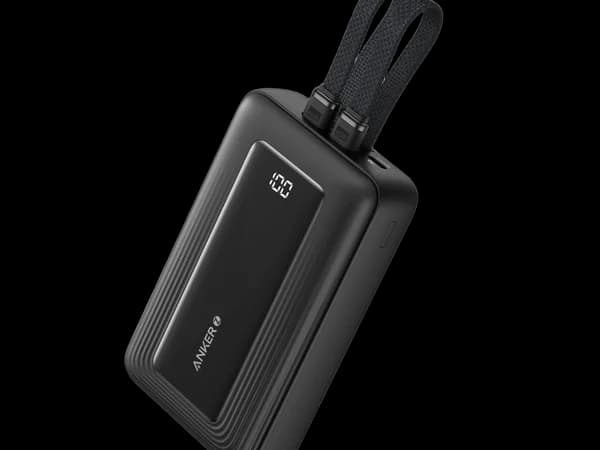
The Anker Zolo wins for users who value cable convenience, multi-device charging, and brand reliability. The INIU wins for budget-conscious buyers who want the same core specs at half the price.
Anker Zolo Power Bank (20K, 45W, 2025)
Users who want cable-free convenience with dual built-in cables and 4-device charging

INIU 45W Portable Charger 20000mAh
Budget-conscious buyers wanting high capacity and fast charging at the lowest price

Score Comparison
Quick Verdict
The Anker Zolo and INIU 45W share nearly identical core specs: 20,000mAh capacity, 45W USB-C output, and airline-safe 74Wh ratings. The difference is in execution and price. The Anker Zolo ($35-40) includes two built-in USB-C cables and charges four devices simultaneously with better build quality and Samsung Super Fast Charging 2.0 support. The INIU ($20-37) undercuts it by 40-50% at sale prices while delivering the same capacity and charging speed in a slightly heavier package with a single built-in cable. If you have $40 and want the most convenient power bank, buy the Zolo. If you have $20 and want the most power for the money, buy the INIU.
Head-to-Head Comparison
Charging Speed and Protocol Support
Winner: Anker Zolo Power Bank
Both power banks output 45W via USB-C and support USB Power Delivery, so single-device charging speeds are effectively identical. An iPhone 16 charges from empty to 50% in roughly 25 minutes on either unit, and most Android flagships hit similar marks.
The Zolo pulls ahead with Samsung Super Fast Charging 2.0 protocol support, which optimizes charging for Samsung Galaxy devices beyond what standard PD provides. Samsung users will see faster and more efficient charging curves on the Zolo compared to the INIU, which relies on PD and QC alone. The Zolo also handles multi-device scenarios better: its dual built-in cables plus two ports mean four devices can charge simultaneously with better power distribution. The INIU's single built-in cable plus two ports limits you to three devices, and power sharing between them is more aggressive at reducing individual device speeds.
For a single phone or tablet, the difference is negligible. For charging multiple devices at once, the Zolo's architecture wins.
Cable Convenience
Winner: Anker Zolo Power Bank
This is the Zolo's signature advantage. Two built-in USB-C cables mean you can charge two devices without carrying any extra cables at all. One cable extends from each end of the unit, and both retract flush when not in use. For travelers who forget cables in hotel rooms, commuters who want to grab-and-go, or anyone who finds loose cables annoying, the dual-cable design eliminates the most common friction point in portable charging.
The INIU includes a single built-in USB-C cable that tucks along the body of the unit. It solves the same forgetting-a-cable problem for one device, but if you need to charge a second device, you still need to bring your own cable and use the USB-C or USB-A port. In practice, this means the INIU works great for a solo phone charger but requires additional accessories for multi-device use.
The trade-off: built-in cables cannot be replaced if they wear out. The Zolo has two potential failure points versus the INIU's one. Both products use braided cables rated for thousands of bend cycles, but it is worth noting that a damaged built-in cable cannot be swapped like a detachable one.
Build Quality and Design
Winner: Anker Zolo Power Bank
Anker's build quality advantage is immediately apparent when you hold both products. The Zolo features tighter panel gaps, smoother surface finishes, and a more substantial feel in hand despite being 17 grams lighter than the INIU at 353g versus 370g. The Zolo also comes in multiple colorways, adding a personalization element that the INIU's black-only offering lacks.
The INIU's construction is functional but plainly budget-tier. The plastic housing has visible seam lines, the surface picks up fingerprints quickly, and the overall fit-and-finish communicates "affordable" rather than "premium." None of this affects charging performance, and many users will never notice or care about these cosmetic differences inside a bag pocket. But if you set both products on a desk, the quality gap is visible.
The INIU's digital display shows battery percentage and charging wattage, which is useful. The Zolo uses basic LED indicators instead, which is one of the few areas where the budget option actually provides more information than the mid-range one.
Value and Pricing
Winner: INIU 45W Portable Charger
This is where the INIU dominates. At a frequent sale price near $20 and a list price of $36.99, the INIU delivers 20,000mAh and 45W output for roughly half the cost of the Anker Zolo's $35-40 price point. The core specs are identical: same capacity, same maximum output wattage, same airline-safe 74Wh energy content.
On a cost-per-watt-hour basis, the INIU at sale price delivers approximately $0.27/Wh versus the Zolo's $0.47-0.54/Wh. That is a meaningful difference, especially for buyers who need multiple units for different bags, family members, or as backups. Three INIU units at sale price cost roughly the same as two Anker Zolos, giving you 50% more total capacity for the same money.
The Zolo's premium buys better build quality, dual cables, Samsung charging support, and Anker's established warranty and support network. Whether those extras justify a 75-100% price increase depends entirely on how much you value convenience and brand assurance over raw value.
Portability
Winner: Anker Zolo Power Bank
The Zolo weighs 353g versus the INIU's 370g, a 17-gram difference that is barely perceptible in hand. Both products have similar overall dimensions suited for bag pockets rather than jeans pockets. Neither is truly pocketable in the way a 5,000mAh slim bank is, but both fit comfortably in jacket pockets, backpack accessory pockets, and purse compartments.
The Zolo's lighter weight and slightly more compact form factor, combined with its self-contained cable design, give it a marginal edge in portability. You can grab the Zolo alone and walk out the door with a complete charging solution. The INIU may require you to also grab a cable for second-device charging, which adds to the carry.
When to Choose Anker Zolo Power Bank
The Anker Zolo is the right choice when:
- You hate carrying cables: The dual built-in USB-C cables make the Zolo a grab-and-go charging solution for two devices without any accessories
- You charge multiple devices daily: Four-device simultaneous charging handles a phone, tablet, earbuds, and smartwatch from a single battery
- You own Samsung Galaxy devices: Samsung Super Fast Charging 2.0 support provides optimized charging that generic PD-only banks miss
- Build quality and brand support matter: Anker's construction quality, warranty, and customer service justify the premium for users who keep products for years
When to Choose INIU 45W Portable Charger
The INIU is the right choice when:
- Budget is the priority: At $20 on sale, the INIU delivers the same 20,000mAh and 45W as products costing twice as much
- You need multiple units: For families, multiple bags, or keeping spares in different locations, the INIU's pricing makes it feasible to stock up
- You want a display: The INIU's digital percentage display provides more information than the Zolo's LED indicators, a genuine functional advantage despite the lower price
- You only charge one device at a time: If you primarily top up a single phone, the INIU's single built-in cable is sufficient and the Zolo's dual cables are an unused luxury
Final Recommendation
Choose the Anker Zolo if you can afford $35-40 and value cable convenience, multi-device charging, and Anker's build quality. The dual-cable design is genuinely useful, and the overall experience feels polished in a way that budget alternatives do not match.
Choose the INIU 45W if you want maximum battery capacity per dollar and are comfortable with a product that prioritizes function over finish. At its frequent sale price, the INIU is the best value in the entire power bank market, delivering flagship-tier specs at budget-tier pricing. The build quality is adequate, the charging performance is identical to products costing twice as much, and the digital display is actually better than the Zolo's LED indicators.
Both products charge your phone at the same speed and hold the same amount of energy. The Zolo is the better product. The INIU is the better deal.
Pricing & Features
Making Your Decision

When to Choose Anker Zolo Power Bank (20K, 45W, 2025)
Users who want cable-free convenience with dual built-in cables and 4-device charging
The Anker Zolo stands out with its dual built-in USB-C cables and 4-device simultaneous charging. It's the best budget power bank for users who hate carrying extra cables.
Strengths
- Dual built-in USB-C cables — charge two devices without any extra cables
- Samsung Super Fast Charging 2.0 support
- 4-device simultaneous charging via cables + ports
- Multiple colorway options for personalization
Limitations
- Built-in cables can't be replaced if damaged
- Slightly heavier than single-cable competitors
- No smart display — basic LED indicators only

When to Choose INIU 45W Portable Charger 20000mAh
Budget-conscious buyers wanting high capacity and fast charging at the lowest price
The INIU 45W 20000mAh delivers exceptional value with its TinyCell battery technology and built-in cable. It's the best power bank for users who prioritize capacity and price over premium build quality.
Strengths
- TinyCell high-density battery is 30% smaller than standard cells
- Built-in USB-C cable eliminates need for a separate cable
- 45W USB-C fast charging for phones and tablets
- Outstanding value — frequently on sale for ~$20
Limitations
- Build quality feels budget compared to Anker
- Display is basic compared to smart displays on premium models
- Lesser-known brand with smaller support network