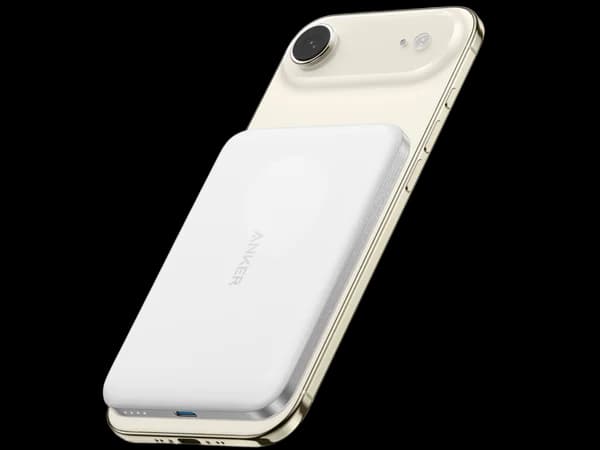

Anker Nano Power Bank (5K, MagGo, Slim) Review
The Anker Nano 5K MagGo Slim is the thinnest MagSafe power bank available. At just 0.34" thick, it's perfect for a quick top-up without adding bulk to your iPhone.

Anker Nano Power Bank (5K, MagGo, Slim) Review
The Anker Nano 5K MagGo Slim is the thinnest MagSafe power bank available. At just 0.34" thick, it's perfect for a quick top-up without adding bulk to your iPhone.
Anker Nano Power Bank (5K, MagGo, Slim) Review
The Anker Nano 5K MagGo Slim is the thinnest MagSafe power bank available. At just 0.34" thick, it's perfect for a quick top-up without adding bulk to your iPhone.

Anker Nano Power Bank (5K, MagGo, Slim) Pros & Cons
Pros
- Ultra-slim 0.34" profile — credit-card size, half the weight of iPhone 16 Pro Max
- Qi2 magnetic wireless charging snaps onto iPhone
- Graphene cooling with dual NTC chips prevents overheating
- Recharges fully in under 2 hours
Cons
- 5,000mAh provides only ~1 full phone charge
- 15W wireless output is slower than wired alternatives
- Premium price for small capacity
Overview
The Anker Nano Power Bank 5K MagGo Slim exists to answer a specific question: how thin can a MagSafe power bank get before it stops being useful? At 0.34 inches thick and 122g, roughly half the weight of an iPhone 16 Pro Max, it is the thinnest Qi2 magnetic power bank on the market. It snaps onto the back of any MagSafe-compatible iPhone and adds a full charge worth of battery without making the phone feel like a brick.
This is not a power bank for long trips or heavy users. At 5,000mAh, it delivers one full charge to most iPhones and perhaps a partial second charge to smaller models. What it does offer is something no 20K slab can: the ability to live in your back pocket, clip to your phone while you walk around a conference, or slide into a shirt pocket without sagging the fabric. The credit-card footprint means it fits in wallets, card slots, and the tiny pockets in running shorts. For the iPhone user who needs a safety net rather than a survival kit, the MagGo Slim is the most elegant solution available. The graphene cooling system and dual NTC thermal chips keep temperatures safe during wireless charging, which historically has been the Achilles heel of magnetic power banks.
Features Deep-Dive
Ultra-Slim Profile and Qi2 Magnetic Alignment
At 0.34 inches thick, the MagGo Slim is thinner than most phone cases. When attached to an iPhone via Qi2 magnetic alignment, the combined stack feels more like a phone with a thick case than a phone with a power bank bolted to it. The magnet array is strong enough to hold firmly during walking, gesturing, and light activity, though vigorous shaking or dropping could dislodge it. Qi2 certification means perfect coil alignment every time, eliminating the efficiency losses that plagued early MagSafe battery packs where slight misalignment could drop charging speeds by 30-40%. The wireless charging tops out at 15W, which is the Qi2 maximum and matches Apple's own MagSafe charging speed. This slim profile does require trade-offs in capacity, but Anker has optimized every millimeter: the battery cells, circuit board, and cooling system are all custom-designed for this form factor rather than adapted from a thicker product.
Graphene Cooling with Dual NTC Chips
Wireless charging generates significantly more heat than wired charging due to the air gap between coils and inherent efficiency losses. Previous magnetic power banks often throttled to lower wattages or became uncomfortably warm against the phone. The MagGo Slim addresses this with a graphene heat-spreading layer and two NTC (Negative Temperature Coefficient) thermal monitoring chips that continuously measure temperatures at different points in the device. When temperatures rise, the system can modulate charging speed to prevent overheating rather than simply cutting power entirely. In practice, this means the MagGo Slim stays noticeably cooler than competitors during sustained wireless charging, which also benefits your iPhone's battery longevity. Heat is the primary enemy of lithium-ion batteries, so better thermal management translates directly to longer-lasting batteries in both the power bank and your phone. The graphene layer also distributes heat across a wider surface area, preventing hot spots that users might feel through their phone case.
20W Wired USB-C and Sub-2-Hour Recharge
While wireless charging is the headline feature, the MagGo Slim also includes a USB-C port rated at 20W bidirectional. This serves two purposes: faster wired charging when you have a cable available, and rapid recharging of the power bank itself. At 20W input, the 5,000mAh battery refills in under two hours, which means a quick lunch stop can bring the bank from empty to full. The USB-C port also enables charging non-MagSafe devices like earbuds, Android phones, or a friend's phone in a pinch. Bidirectional functionality means you can charge the MagGo Slim wirelessly from a Qi2 pad if you prefer, though USB-C is significantly faster. For users who magnetically charge their phone during the day and then plug in the power bank overnight, the quick recharge time ensures the MagGo Slim is always ready for the next day. At 20W wired output, it also charges phones noticeably faster than the 15W wireless maximum when speed matters more than convenience.
Pricing Analysis
At $54.99, the Anker Nano 5K MagGo Slim sits at the premium end of pocket power banks on a cost-per-watt-hour basis ($2.97/Wh compared to $0.50/Wh for the INIU 20K). But comparing it to traditional wired power banks misses the category entirely. The real competition is other Qi2 magnetic power banks: the Anker MagGo 10K Slim at $45.99 (bigger but thicker), the UGREEN MagFlow 10K at a similar price, and the EcoFlow Rapid 10K at $59.99. Against those peers, the MagGo 5K Slim trades capacity for an unmatched slim profile. The question is whether you value pocketability over runtime. For a device that you carry every single day as an insurance policy, the daily cost over a two-year lifespan works out to about 7.5 cents per day. Given that it eliminates the low-battery anxiety that affects how freely you use your phone throughout the day (maps, camera, streaming), the value proposition is less about raw specs and more about peace of mind.
Who Is This For?
The Anker Nano Power Bank 5K MagGo Slim works best for:
- iPhone users who want invisible backup power: The credit-card profile means you can carry it in a pocket or slim bag every single day without noticing it, ensuring you always have emergency power
- Conference and event attendees who need their phone alive for networking, photos, maps, and ride-sharing throughout a long day but do not want a bulky power bank weighing down a blazer or crossbody bag
- Runners and fitness enthusiasts who want a lightweight top-up option that fits in running shorts or an armband pocket for long outdoor sessions where the phone's battery might not last
- Minimalist travelers who carry a small crossbody or wallet and want a power bank that does not force a bag upgrade
Who Should NOT Use This
The Anker Nano Power Bank 5K MagGo Slim might not be the right choice if:
- You need more than one full charge: At 5,000mAh, this provides roughly one complete iPhone charge with a small margin. Multi-day trips, heavy usage days, or users who charge multiple devices need the 10K or 20K options
- You use an Android phone: Without MagSafe compatibility, you lose the magnetic wireless feature entirely, and the 20W wired output is below what most Android flagships can accept. The INIU or Anker Zolo makes far more sense for Android users
- Maximum charging speed is the priority: 15W wireless is functional but noticeably slower than the 45W wired charging available from similar-priced power banks. If you always want the fastest possible charge, a wired power bank with a cable wins every time
Bottom Line
The Anker Nano 5K MagGo Slim is the best MagSafe power bank for people who will actually carry it every day. Its impossibly thin profile, reliable Qi2 wireless charging, and graphene cooling system make it the most refined magnetic charging solution available. The limited 5K capacity is the obvious trade-off, but for daily insurance rather than extended trips, no other power bank disappears into your life this seamlessly.
FAQ
Will it work through a phone case?
Yes, it works through MagSafe-compatible cases, which includes all Apple cases and most third-party cases with MagSafe magnet rings. Non-MagSafe cases will block the magnetic attachment and significantly reduce wireless charging efficiency. Cases thicker than about 3mm may also weaken the magnetic hold.
How much charge does it actually add to an iPhone?
Expect roughly 85-90% of a full charge on an iPhone 16 or about 95% on an iPhone 16 Pro. Wireless charging has inherent efficiency losses of 15-25% compared to wired charging, so the 5,000mAh capacity translates to roughly 3,800-4,200mAh of delivered energy. Using the USB-C cable directly will deliver more of the stored energy to your phone.
Can I use it while attached to my phone?
Yes, it is designed for use while attached. You can take photos, text, browse, and make calls with the MagGo Slim magnetically attached to the back of your phone. The 122g weight is noticeable but not burdensome, similar to adding a thick case. The magnetic hold is strong enough for normal handling but may shift during vigorous activity.
How does it compare to Apple's MagSafe Battery Pack?
Apple discontinued its MagSafe Battery Pack, which had a smaller 1,460mAh capacity and 5W wireless charging. The Anker MagGo Slim offers 3.4 times the capacity, triple the wireless charging speed (15W vs 5W), and a thinner profile, all for a lower price than Apple charged. It is objectively superior in every measurable spec.
Who Is Anker Nano Power Bank (5K, MagGo, Slim) Best For?
iPhone users who want the slimmest MagSafe power bank for pockets and purses
The Bottom Line
The Anker Nano 5K MagGo Slim is the thinnest MagSafe power bank available. At just 0.34" thick, it's perfect for a quick top-up without adding bulk to your iPhone.
Buy on AmazonKey Specs
Scoring Breakdown
Maximum output wattage, fast-charging protocol support (PD, QC), and real-world charging times for common devices.
Total capacity (mAh/Wh), number of full charges for typical devices, and energy density relative to size.
Weight, dimensions, form factor, and pocket-friendliness for everyday carry.
Materials, durability, display quality, aesthetic design, and ergonomics.
Number and types of ports, built-in cables, wireless charging, passthrough charging, and smart features.
Price relative to capacity and features, warranty, and overall cost-effectiveness.