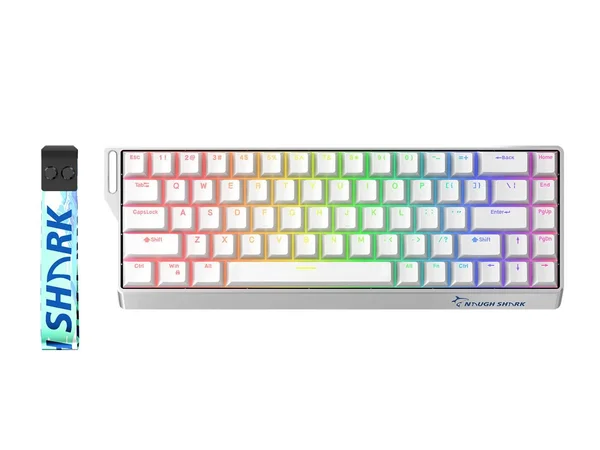

Gamakay x NaughShark NS68 Review
The NS68 delivers flagship-level 8KHz polling and Rapid Trigger at a fraction of the price. Build quality compromises are expected at $45, but the gaming performance punches well above its weight.

Gamakay x NaughShark NS68 Review
The NS68 delivers flagship-level 8KHz polling and Rapid Trigger at a fraction of the price. Build quality compromises are expected at $45, but the gaming performance punches well above its weight.
Gamakay x NaughShark NS68 Review
The NS68 delivers flagship-level 8KHz polling and Rapid Trigger at a fraction of the price. Build quality compromises are expected at $45, but the gaming performance punches well above its weight.

Gamakay x NaughShark NS68 Pros & Cons
Pros
- 8KHz polling rate and 0.01mm Rapid Trigger accuracy at just $45
- Hot-swappable Hall Effect switches with adjustable actuation
- Per-key RGB lighting with multiple effects
- Unbeatable price-to-performance for competitive gaming
Cons
- Plastic case feels budget compared to aluminum alternatives
- Wired only — no wireless connectivity
- ABS keycaps wear faster than PBT
Overview
The Gamakay x NaughShark NS68 does something that would have seemed impossible two years ago: it puts genuine 8KHz polling and 0.01mm Rapid Trigger accuracy into a $45 keyboard. Hall Effect technology used to be a $200+ proposition. The NS68 obliterates that price floor.
There are real compromises at this price point. The plastic case flexes under aggressive typing, the ABS keycaps will develop shine within months of heavy use, and you are locked to wired-only connectivity. But none of those shortcomings affect the core gaming proposition. When your opponent peeks a corner in Valorant, the NS68 registers your counter-strafe just as fast as keyboards costing four times as much. For budget-conscious competitive gamers who understand that switches matter more than chassis materials, this is the most disruptive product in the mechanical keyboard space right now.
Features Deep-Dive
8KHz Polling and 0.01mm Rapid Trigger
The headline spec is real and it performs. At 8KHz, the NS68 reports key states to your PC every 0.125 milliseconds, matching flagship boards from Wooting and Razer. The 0.01mm Rapid Trigger resolution means the keyboard can detect the tiniest upward movement of a key and immediately register its release, which translates directly into faster counter-strafing and more responsive stop-and-shoot mechanics in tactical shooters. In practice, the difference between 0.01mm and 0.1mm Rapid Trigger is subtle, but the gap between having Rapid Trigger and not having it is enormous. The NS68 puts you firmly on the right side of that divide. The software lets you configure actuation and reset points per key, so you can set your movement keys to hair-trigger sensitivity while keeping less critical keys at a more conventional depth to avoid accidental presses.
Hot-Swappable Hall Effect Switches
Every switch on the NS68 is hot-swappable, meaning you can pull them out and replace them without soldering. Since these are Hall Effect magnetic switches rather than traditional mechanical ones, there is no metal-on-metal contact and no debounce delay. Actuation is detected by measuring changes in magnetic field strength, which is why the adjustable actuation points are possible in the first place. The stock switches feel reasonably smooth with a linear profile that most gamers prefer. They lack the buttery refinement of premium Gateron or Geon switches, but the slightly scratchy travel has no impact on gaming response times. If the stock feel bothers you for typing, compatible HE switches from other manufacturers can be swapped in.
65% Layout and RGB
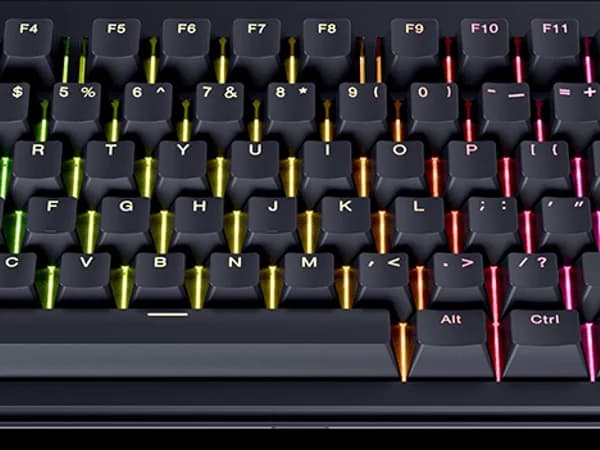
The 65% form factor strips away the function row and numpad while retaining dedicated arrow keys and a small navigation cluster. This is the sweet spot for gamers who need arrow keys for menu navigation but want maximum desk space for low-sensitivity mouse movements. Per-key RGB lighting supports a reasonable selection of preset effects and can be customized through the companion software. The lighting is bright enough to be visible in a lit room, though the ABS keycaps do not feature shine-through legends on all models, so the backlight bleeds around the edges of keycaps rather than illuminating the characters cleanly. It looks fine in a dim setup but will not win any aesthetic awards.
Pricing Analysis
At $45, the NS68 is not just affordable; it fundamentally redefines what budget means in the Hall Effect keyboard market. The closest competitors with 8KHz polling and Rapid Trigger start at roughly $55-60 and typically sacrifice either polling rate or actuation precision to hit that price. Spending $150+ more on a Wooting 60HE or Razer Huntsman V3 Pro gets you better build materials, more refined switches, and polished software, but the actual gaming-relevant performance is nearly identical. If you are a student or simply refuse to overpay for features that live in the switches rather than the chassis, the NS68 represents extraordinary value. The main financial risk is wanting to upgrade keycaps immediately; a decent PBT set runs $25-40, which narrows the value gap somewhat.
Who Is This For?
Gamakay x NaughShark NS68 works best for:
- Competitive FPS players on a budget who need Rapid Trigger and high polling rates but cannot justify $170+ for a Wooting or Razer board
- First-time Hall Effect buyers who want to experience adjustable actuation without a major financial commitment
- Desk-space-conscious gamers who prefer the compact 65% layout with arrow keys for everyday usability alongside low-sens mouse play
Who Should NOT Use This
Gamakay x NaughShark NS68 might not be the right choice if:
- Build quality matters to you as much as performance -- the plastic case and ABS keycaps feel like exactly what they cost, and the overall typing experience lacks the satisfying heft of aluminum-framed boards
- You need wireless connectivity -- there is no Bluetooth or 2.4GHz option, so laptop users and clean-desk enthusiasts will find the permanent cable limiting
Bottom Line
The NS68 proves that Hall Effect gaming performance has been democratized. The switches do not care what the case is made of, and neither will your reaction times. If you can accept budget materials in exchange for flagship responsiveness, this keyboard delivers a competitive advantage that used to cost four times as much.
FAQ
Does the 8KHz polling rate actually work, or is it just marketing?
It works. You can verify it using tools like Mouse Rate Checker adapted for keyboard input, and the difference from 1KHz is measurable in input latency tests. Whether you can feel the difference depends on your sensitivity and the game, but in fast-paced titles like Valorant and Counter-Strike, many players report noticeably snappier counter-strafing at 8KHz. The NS68 does not fake this spec.
Can I replace the keycaps with better ones?
Yes. The NS68 uses a standard MX-compatible stem, so any Cherry MX keycap set will fit. A PBT keycap set in the $25-40 range will dramatically improve the typing feel and resist the shine that develops quickly on the stock ABS caps. Just confirm the keycap set supports a 65% layout, since some sets lack the smaller right-side modifier keys this form factor requires.
How does this compare to the Epomaker HE80 at $59?
The Epomaker HE80 adds wireless connectivity, a rotary knob, and a 75% layout with function row for $14 more. If you need wireless or prefer having dedicated function keys, the HE80 is worth the premium. If you strictly want the most gaming performance per dollar in a compact wired package, the NS68 edges ahead on raw value. Both deliver the same core Hall Effect and Rapid Trigger experience.
Who Is Gamakay x NaughShark NS68 Best For?
Budget gamers who want Hall Effect Rapid Trigger performance without spending $200+
The Bottom Line
The NS68 delivers flagship-level 8KHz polling and Rapid Trigger at a fraction of the price. Build quality compromises are expected at $45, but the gaming performance punches well above its weight.
Buy on AmazonKey Specs
Scoring Breakdown
Switch quality, actuation feel, key travel, and overall typing/gaming experience. Includes switch type characteristics (linear, tactile, clicky, magnetic).
Frame materials (aluminum, plastic, steel), keycap quality (PBT vs ABS), stabilizer quality, weight, and overall construction durability.
Hot-swap support, RGB lighting, media controls, display/OLED, programmable keys, onboard memory, and extra functionality.
Wired/wireless options, Bluetooth, 2.4GHz wireless, USB-C, polling rate, latency, and multi-device pairing.
Software quality, macro programming, per-key RGB control, key remapping, profile management, and modding potential.
Price-to-performance ratio considering build quality, features, and overall package relative to competing options.