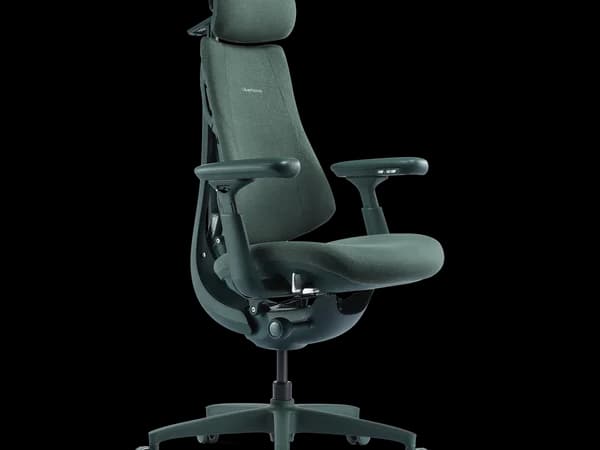

LiberNovo Omni Review
The LiberNovo Omni is the most innovative gaming chair of 2026, featuring a motorized 16-joint backrest that actively tracks and supports your spine. A bold choice for those who want the absolute best in adaptive ergonomics.

LiberNovo Omni Review
The LiberNovo Omni is the most innovative gaming chair of 2026, featuring a motorized 16-joint backrest that actively tracks and supports your spine. A bold choice for those who want the absolute best in adaptive ergonomics.
LiberNovo Omni Review
The LiberNovo Omni is the most innovative gaming chair of 2026, featuring a motorized 16-joint backrest that actively tracks and supports your spine. A bold choice for those who want the absolute best in adaptive ergonomics.

LiberNovo Omni Pros & Cons
Pros
- Motorized lumbar support with 16-joint adaptive backrest
- Tracks your spine movement in real-time
- Premium build with aerospace-grade materials
- Highly adjustable with motorized controls
Cons
- Premium price at $1,099
- Startup brand — long-term support uncertain
- Heavy and large footprint
Overview
The LiberNovo Omni is the most ambitious gaming chair anyone has attempted to build. A motorized 16-joint backrest that tracks your spine in real time and adjusts support automatically -- this is not an incremental improvement over existing designs. It is a fundamentally different approach to what a chair should do. Every other chair in this roundup asks you to find the right position and lock it in. The Omni finds the right position for you and follows you as you move.
At $1,099 from a startup brand, the Omni demands a leap of faith that the technology justifies the price and that LiberNovo will be around to support it. Tom's Hardware gave it a favorable review while raising exactly that concern. The aerospace-grade aluminum frame and motorized everything feel genuinely premium, but premium hardware from a company without a decade-long track record carries inherent risk.
For buyers willing to accept that risk, the Omni delivers ergonomic performance that established brands have not yet matched. The real-time spine tracking does work, the motorized adjustments are precise and quiet, and the overall sitting experience is unlike anything else available. Whether that makes it the right purchase depends on how much you value being on the cutting edge versus the safety of established options.
Features Deep-Dive
16-Joint Motorized Adaptive Backrest
The Omni's defining feature is its backrest: 16 independently motorized joints that form a flexible spine along the chair's back. Embedded sensors detect your posture in real time, and the joints adjust automatically to maintain optimal support as you shift positions. Lean forward during an intense gaming moment, and the lower joints follow your lumbar curve. Recline to watch a stream, and the entire backrest redistributes its profile.
This is not a gimmick with a good marketing pitch. The mechanism produces a tangible difference in how the chair feels across posture changes. Traditional chairs, even excellent ones like the Titan Evo, provide static support -- great in the position you set them for, less great when you deviate. The Omni's adaptive response means you stop thinking about your chair position entirely. You move; it follows. After a week of use, returning to a static chair feels noticeably crude.
The motors are quiet enough to be inaudible during normal use, and the response time is fast enough that the adjustment feels continuous rather than reactive. The system requires a power adapter, which means a cable running to your chair -- an aesthetic and practical consideration worth noting.
Real-Time Spine Tracking Sensors
The sensor array embedded in the backrest uses pressure mapping to detect your spinal alignment continuously. This data feeds the motor controllers, but it also serves a secondary purpose: posture awareness. The Omni can notify you (via its companion app) when you have been sitting in a position that stresses your spine for extended periods.
The accuracy of the tracking is impressive for a consumer product. It distinguishes between deliberate posture changes (leaning forward to concentrate) and drift (slowly slouching over 30 minutes). The adaptive response handles the first smoothly; the notification system addresses the second. For users with chronic back issues, the combination of active support and passive awareness creates a feedback loop that no static chair can offer. The companion app also logs sitting patterns over time, which can be useful data for physical therapists or chiropractors if you are working through back problems.
Aerospace-Grade Build and Motorized Controls
The aluminum frame is noticeably more rigid than the steel frames found in most gaming chairs, while being lighter per unit of strength. The "aerospace-grade" label is marketing-heavy, but the material quality is genuinely above standard. Every adjustment that would typically be a manual lever or dial -- lumbar depth, seat depth, recline tension, armrest position -- is motorized and controlled through physical buttons on the armrest or the companion app.
The motorized controls feel luxurious when they work and frustrating if they malfunction. Without manual overrides, a motor failure means losing access to that adjustment entirely until it is repaired. The chair weighs approximately 65 lbs due to the motor and sensor hardware, making assembly a two-person job and relocation nontrivial. The power adapter is required for all motorized features; without power, the chair functions as a static (and heavy) standard chair. The build quality of the motors and frame is high, but the complexity introduces more potential failure points than any mechanical chair.
Pricing Analysis
At $1,099, the Omni is the second most expensive chair in our roundup and the most expensive if you exclude the Herman Miller Vantum (which competes on warranty length rather than technology). The price reflects genuine engineering novelty -- motorized adaptive backrests do not exist at any other price point. You cannot get this technology for less because no one else makes it.
The value question depends entirely on how much the adaptive backrest matters to you. If you sit for 8+ hours daily and change postures frequently, the real-time tracking provides ergonomic benefits that static chairs cannot replicate regardless of their price. If you tend to find one position and stay there, you are paying a premium for technology you will not fully utilize. Compared to the Secretlab Titan Evo at $549, you are paying double for the motorized system. Compared to the Vantum at $960, you trade a 12-year warranty from an established company for cutting-edge adaptive technology from a startup. Available on Amazon and direct from LiberNovo.
Who Is This For?
LiberNovo Omni works best for:
- Tech enthusiasts and early adopters who derive genuine satisfaction from owning the most technologically advanced option available, and who accept the inherent risks of buying from a newer company
- Users with chronic back pain or spinal issues who have tried multiple static chairs without finding lasting comfort -- the active tracking and adaptive support offer a fundamentally different approach to back support
- All-day sitters (8+ hours) who shift postures frequently throughout the day and want a chair that automatically accommodates every position change rather than forcing them to readjust manually
Who Should NOT Use This
LiberNovo Omni might not be the right choice if:
- Long-term brand reliability matters more than features: LiberNovo is a startup without a proven 5- or 10-year track record for support, parts availability, or warranty fulfillment. If you need confidence that your chair will be serviced in 2032, Herman Miller's 12-year warranty from a company founded in 1905 is a safer bet.
- You prefer simplicity and minimal complexity: The Omni requires a power adapter, has a companion app, uses motors that could fail, and weighs 65 lbs. If a manual reclining lever and a foam lumbar pillow meet your needs, the added complexity brings more risk than reward. The Secretlab Titan Evo does the fundamentals excellently with zero electronics to maintain.
Bottom Line
The LiberNovo Omni is the most innovative chair in this roundup by a wide margin. Its motorized adaptive backrest genuinely works and delivers ergonomic benefits that static chairs cannot match. The open questions -- startup longevity, motor reliability over years, repair infrastructure -- are real but unanswered rather than negative. For buyers willing to bet on new technology, the Omni delivers an experience that nothing else in the market currently replicates.
FAQ
What happens if a motor fails?
Without that motor functioning, the corresponding joint locks in its last position. The chair remains usable but loses adaptive capability in that zone. LiberNovo offers a 3-year warranty on motors and has stated they will ship replacement motor units for self-installation. Whether parts remain available in 5+ years is the unanswered question.
Does it work without being plugged in?
The chair functions as a standard (non-adaptive) chair without power. Recline, tilt, and basic seating work mechanically. All motorized adjustments and spine tracking require the power adapter. If your outlet situation is inconvenient, plan for a cord running to your chair location.
How loud are the motors?
Nearly silent during normal operation. The adaptive adjustments produce a faint hum comparable to a laptop fan on low -- noticeable in a dead-quiet room if you listen for it, but inaudible during gaming, music, or conversation. Larger adjustments like motorized seat depth are slightly louder but still unobtrusive.
Is the companion app required?
No. The chair's automatic adaptive features work without the app. The app adds manual override controls, posture tracking history, and sitting habit notifications. It enhances the experience but is not required for core functionality.
Who Is LiberNovo Omni Best For?
Tech enthusiasts wanting cutting-edge motorized ergonomics
The Bottom Line
The LiberNovo Omni is the most innovative gaming chair of 2026, featuring a motorized 16-joint backrest that actively tracks and supports your spine. A bold choice for those who want the absolute best in adaptive ergonomics.
Buy on AmazonKey Specs
Scoring Breakdown
Lumbar support quality (adjustable, adaptive, or fixed), spinal alignment, and overall posture support during extended sessions.
Padding quality/density, seat shape, breathability of materials, and comfort during long gaming or work sessions.
Range of adjustments: armrests (2D/3D/4D/5D), recline angle, seat height/depth/tilt, headrest adjustability.
Frame materials, weight capacity, caster quality, upholstery durability, and expected lifespan.
Aesthetic appeal, color options, profile (racing vs office vs hybrid), and how well it fits various room setups.
Price-to-feature ratio, warranty length, included accessories, and overall bang for the buck.