
PetSafe Automatic Ball Launcher Review
The PetSafe Automatic Ball Launcher is the most ambitious toy in this comparison — it genuinely enables independent fetch play, and the built-in safety sensor shows thoughtful engineering. Nine distance settings make it adaptable from apartment hallways to backyards. The $170 price and reliance on electronics are real drawbacks, but for fetch-obsessed dogs, it provides unmatched autonomous play value.

PetSafe Automatic Ball Launcher Review
The PetSafe Automatic Ball Launcher is the most ambitious toy in this comparison — it genuinely enables independent fetch play, and the built-in safety sensor shows thoughtful engineering. Nine distance settings make it adaptable from apartment hallways to backyards. The $170 price and reliance on electronics are real drawbacks, but for fetch-obsessed dogs, it provides unmatched autonomous play value.
PetSafe Automatic Ball Launcher Review
The PetSafe Automatic Ball Launcher is the most ambitious toy in this comparison — it genuinely enables independent fetch play, and the built-in safety sensor shows thoughtful engineering. Nine distance settings make it adaptable from apartment hallways to backyards. The $170 price and reliance on electronics are real drawbacks, but for fetch-obsessed dogs, it provides unmatched autonomous play value.

PetSafe Automatic Ball Launcher Pros & Cons
Pros
- Automatic fetch enables independent play — dogs can load and launch balls on their own
- Nine distance settings from 8 to 30 feet adapt to indoor and outdoor spaces
- Built-in motion sensor pauses launch when dogs are too close for safety
Cons
- Most expensive toy in this comparison at $170 — significant investment for a single toy
- Requires standard-size tennis balls — not compatible with smaller or oversized balls
- Electronic components can fail and are not field-serviceable
Overview
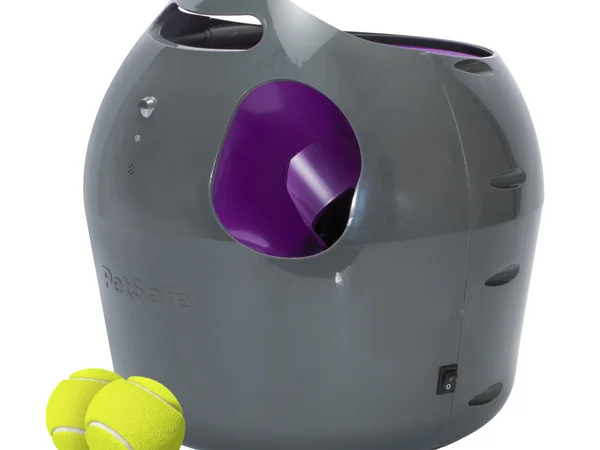
The PetSafe Automatic Ball Launcher attempts something no other toy in this comparison even tries: fully autonomous fetch. Your dog drops a tennis ball into the bucket, the machine launches it, and the dog retrieves it and does it again — no human arm required. And the remarkable thing is that it actually works. Dogs figure out the load-and-launch cycle surprisingly quickly, and the built-in motion sensor that pauses launching when a dog gets too close shows that PetSafe took safety seriously rather than treating it as an afterthought.
Nine distance settings spanning 8 to 30 feet let you scale the game from apartment hallway to full backyard, and dual power options (AC adapter or six D batteries) cover both permanent setups and portable use. At $169.95, this is by far the most expensive toy in this comparison — the price of roughly nine KONG Classics or seventeen Chuckit! Ultra Balls. Whether that premium is justified depends on one question: does your dog want to play fetch more than you want to throw? If the answer is yes, and you have said "no more" to a pair of pleading eyes while your arm ached, the PetSafe launcher is the only product that solves that problem.
Features Deep-Dive
Self-Serve Fetch Mechanism
The core innovation is a bucket-shaped hopper that accepts standard tennis balls and launches them at adjustable intervals. Dogs drop the ball into the top of the hopper, a tone plays to signal an upcoming launch (giving the dog time to back away), and then a spinning wheel mechanism fires the ball forward. Most dogs learn the complete cycle — retrieve, return, drop, back up, chase — within five to ten sessions. Some dogs figure it out in one. The learning curve is steeper for dogs that have never played structured fetch, but the audible launch warning helps them make the connection between dropping the ball and getting rewarded with another throw. Once the cycle clicks, many dogs will play for 20 to 30 minutes straight without any human involvement whatsoever.
Motion-Activated Safety Sensor
A proximity sensor on the front of the launcher detects movement within a few feet of the launch zone and pauses the firing mechanism until the area is clear. This prevents point-blank launches into a dog's face — a genuine injury risk with any ball-launching device. The sensor is not infallible; it works on movement detection rather than true presence sensing, so a motionless dog sitting directly in front of the launcher may not trigger the pause. In practice, though, the audible launch warning combines with the motion sensor to create a safety system that works well enough for supervised play. PetSafe explicitly recommends supervision during use, and that recommendation is worth following.
Nine-Setting Distance Control
The distance dial adjusts launch power from roughly 8 feet (the minimum indoor setting) to approximately 30 feet (the maximum outdoor setting). The lower settings are surprisingly useful: they turn the launcher into an apartment-compatible toy that bounces the ball down a hallway rather than across a field. Mid-range settings work well in average backyards, and the maximum setting provides enough distance for a genuine sprint in larger outdoor spaces. The ball trajectory changes with distance — short settings produce a more lobbed arc, while maximum distance creates a flatter, faster launch. You will want to test the settings in your specific space before letting your dog play independently to make sure the ball is not ricocheting off walls or sailing over fences.
Dual Power Options
The launcher runs on either a standard AC adapter or six D-cell batteries. The AC option is ideal for permanent indoor or covered patio setups — plug it in and forget about power entirely. The battery option makes the launcher portable for parks, beaches, and yards without outdoor outlets. Battery life varies significantly with launch distance: shorter throws consume less power, and a fresh set of D batteries typically lasts through 100 to 200 launches on medium settings. That is enough for several play sessions, but heavy daily use on batteries gets expensive fast. If you plan to use this regularly, running an extension cord to an AC setup is the more practical long-term approach.
Pricing Analysis
At $169.95, the PetSafe launcher costs more than every other toy in this comparison combined. That is not a typo — you could buy a KONG Classic, a Chuckit! Ultra Ball, a Benebone, a Nylabone, a rope toy, a plush toy, and a Nina Ottosson puzzle and still have change left over. The price makes sense only if you evaluate it as a different category of product: not a toy, but a play system. The ongoing cost is also worth calculating. Standard tennis balls wear out or get lost, and the launcher requires them specifically — smaller or oversized balls will not fit. A three-pack of tennis balls costs $3 to $5, and you will go through them regularly. Budget-conscious owners should also factor in D batteries if using the portable option, though AC power eliminates that cost. Over a year of daily use, the total cost of ownership approaches $200 to $220 depending on your ball and battery consumption.
Who Is This For?
- Owners of fetch-obsessed breeds with unlimited energy (Labradors, Golden Retrievers, Border Collies): These dogs want to play fetch long after your arm gives out. The launcher turns a 15-minute human-limited session into a 30-minute dog-limited one, which is often the difference between a calm evening and a restless, destructive one.
- People with mobility limitations or arm injuries: If throwing a ball repeatedly causes pain — shoulder issues, tennis elbow, arthritis — the launcher removes the physical demand while preserving the activity that your dog loves most.
- Work-from-home professionals who need their dog occupied: Setting the launcher up in a hallway or covered patio gives your dog an independent activity during video calls, focused work sessions, or lunch breaks. The 8-foot minimum setting is specifically designed for indoor spaces.
- Multi-dog households where one dog is fetch-obsessed and others are not: Rather than forcing all dogs into a fetch routine, the launcher lets the ball-driven dog self-serve while you attend to the others.
Who Should NOT Use This
- Budget-conscious dog owners: At $170, this is a significant purchase that only serves one play style. If your dog enjoys fetch but is not obsessed with it, a $5 Chuckit! Ultra Ball and your own arm provide 90% of the same experience. The launcher's value only materializes for dogs who want to play fetch far more often than their owners can accommodate.
- Owners of small breeds or toy breeds: The launcher requires standard tennis balls, which are too large for many small dogs to carry comfortably. There is no small-ball option, and the minimum launch distance of 8 feet may still be excessive for a Chihuahua-sized space.
- Anyone who needs field-serviceable equipment: The launcher contains electronic components — motors, sensors, circuit boards — that are not user-repairable. If the launch mechanism or motion sensor fails outside the warranty period, you are looking at a full replacement rather than a part swap. For a $170 device, the inability to repair it is a meaningful drawback.
- Owners who leave dogs truly unsupervised for extended periods: Despite the safety sensor, PetSafe recommends supervision during use. Dogs can jam the hopper with debris, the motion sensor has blind spots, and a malfunctioning launcher could injure an unsupervised dog. This is a tool for semi-independent play, not a substitute for an owner's presence.
Bottom Line
The PetSafe Automatic Ball Launcher is the most specialized and most expensive toy in this comparison, and it delivers on its core promise: genuine hands-free fetch for dogs who never want the game to end. The safety sensor, adjustable distance, and dual power options show thoughtful engineering. The price and electronic fragility are real drawbacks, but for the specific owner who needs this — the one whose dog brings the ball back for the fortieth time while their arm hangs limp — nothing else in this comparison comes close to solving that problem.
FAQ
How long does it take for a dog to learn to use it independently?
Most dogs learn the complete load-and-launch cycle within five to ten sessions. Start by loading the ball yourself while your dog watches, then gradually encourage your dog to drop the ball into the hopper. Treats for successful drops accelerate the training. Some retrievers figure it out in a single session. Dogs with no fetch background may take longer or may never reliably self-load.
Can I use any tennis balls, or do I need special ones?
Standard-size tennis balls work — the Penn, Wilson, and Kong varieties all fit. Do not use pressureless practice balls (they are slightly oversized), mini tennis balls, or the oversized jumbo balls marketed for large dogs. The launcher mechanism is calibrated for the standard 2.5-inch tennis ball diameter, and anything outside that range will jam the hopper or launch unpredictably.
Is it loud enough to bother neighbors?
The launch mechanism produces a brief whirring sound followed by the ball impact, roughly comparable to a blender running for one second. Indoor use on hard floors amplifies the sound; outdoor use on grass is considerably quieter. The pre-launch warning tone is audible but not loud. If you share walls with neighbors, the repetitive launch-and-impact cycle could become annoying during extended sessions. Testing during reasonable hours first is wise.
What happens if my dog does not bring the ball back?
The launcher does nothing — it waits indefinitely for a ball to be loaded into the hopper. If your dog is not a natural retriever, the launcher will not teach them to fetch. You need a dog that already brings the ball back reliably. The launcher automates the throwing, not the training.
Who Is PetSafe Automatic Ball Launcher Best For?
Fetch-obsessed dogs whose owners want hands-free play and adjustable distance settings
The Bottom Line
The PetSafe Automatic Ball Launcher is the most ambitious toy in this comparison — it genuinely enables independent fetch play, and the built-in safety sensor shows thoughtful engineering. Nine distance settings make it adaptable from apartment hallways to backyards. The $170 price and reliance on electronics are real drawbacks, but for fetch-obsessed dogs, it provides unmatched autonomous play value.
Try PetSafe Automatic Ball Launcher TodayKey Specs
Scoring Breakdown
Material strength, chew resistance indexed by dog size/chew strength (light, moderate, power chewer), tear resistance, and expected lifespan under intended use
Non-toxic certifications (BPA-free, phthalate-free), manufacturing standards, choking hazard risk assessment, material origin transparency
Mental stimulation level, engagement time, play variety, ability to sustain interest over repeated sessions, puzzle complexity where applicable
Build quality, stitching/seam strength, hardware durability, design thoughtfulness, squeaker placement and resilience
Availability across dog sizes, weight-appropriateness, multi-dog household suitability, breed-type compatibility
Washability (machine/hand/dishwasher-safe), resistance to odor and bacteria buildup, drying time
Price-to-durability ratio, cost per play hour estimate, replacement frequency, included accessories or multi-packs