Dog Brick is the right starting point for most dogs new to puzzle toys. Challenge Slider is the upgrade for dogs who have mastered Level 2 puzzles and need more complexity to stay engaged.

Nina Ottosson Challenge Slider Interactive Treat Puzzle
Experienced puzzle dogs and owners who want the most challenging treat puzzle available
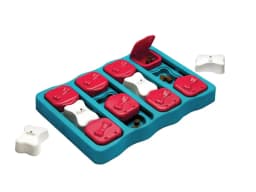
Nina Ottosson Dog Brick Interactive Treat Puzzle
Dogs who need mental stimulation and owners who want to slow down treat time

Score Comparison
Quick Verdict
These are not competing products — they are sequential difficulty levels from the same manufacturer, and the right choice depends entirely on where your dog falls on the puzzle-solving spectrum. The Dog Brick (Level 2, $19.99) is the better buy for dogs new to puzzle toys or those who solve simple puzzles in under five minutes. The Challenge Slider (Level 3, $32.99) is for dogs who have already conquered Level 2 puzzles and blow through simpler toys in minutes. Buying the wrong difficulty level wastes your money either way: too easy and your dog finishes in 30 seconds, too hard and your dog gives up or resorts to flipping the entire toy.
Head-to-Head Comparison
Puzzle Complexity
Winner: Challenge Slider (by design)
The Dog Brick uses two mechanics: sliding compartments that move side to side and removable bone-shaped covers that sit over treat wells. A dog needs to learn that nudging a slider reveals food and that lifting a bone cover reveals more food. These are sequential but independent actions — solving one compartment does not require solving another first.
The Challenge Slider introduces multi-step dependencies. Sliding panels lock other panels in place, meaning your dog must move pieces in a specific sequence to access all the treats. It is closer to a sliding tile puzzle than a simple hide-and-seek game. Some compartments require two or three preparatory moves before the treat is accessible.
This difference sounds incremental on paper but is dramatic in practice. The Dog Brick teaches dogs that interacting with objects yields rewards. The Challenge Slider teaches dogs to plan sequences of actions where the immediate next step does not produce a reward but enables a future reward. That is a fundamentally different cognitive demand.
Engagement Duration
Winner: Challenge Slider
The Dog Brick typically occupies a food-motivated dog for 15 to 30 minutes on early attempts. Once a dog learns the two mechanics (usually after three to five sessions), solve times drop to 5 to 10 minutes. After two weeks of regular use, most dogs complete it in under 5 minutes. At that point, the toy has served its educational purpose but is no longer providing meaningful mental stimulation.
The Challenge Slider's locking mechanisms and sequential dependencies keep solve times higher for longer. Initial sessions run 20 to 45 minutes. Even after dogs learn the general mechanics, the multi-step sequences maintain engagement at 10 to 20 minutes per session for weeks. The ceiling is higher because the puzzle has more possible configurations — you can change which compartments you load with treats, altering the required solving sequence each time.
For sustained long-term engagement, the Challenge Slider provides more mileage. But this only matters if your dog can actually solve it. A frustrated dog staring at a puzzle it cannot crack is not being enriched — it is being stressed.
Build Quality
Winner: Tie
Both are made from BPA-free, phthalate-free composite plastic by the same manufacturer to the same standards. Both are dishwasher-safe on the top rack. Both use the same type of sliding mechanisms and the same general construction approach.
The Challenge Slider has more moving parts, which theoretically means more points of potential failure. In practice, Nina Ottosson's plastic composites hold up well under normal use. Neither toy is designed for chewing — these are puzzle toys, not chew toys — and both will crack if a frustrated dog decides to bite through the plastic rather than solve the puzzle. This is worth noting: if your dog's frustration response is to destroy rather than disengage, puzzle toys at any level need supervision.
The Dog Brick's removable bone covers are the most vulnerable component in either toy. Dogs sometimes chew on them or carry them away. They are small enough to be a concern for very large dogs who might swallow them, though this is uncommon. The Challenge Slider's fully integrated sliding mechanism has no removable pieces, which is a minor safety advantage.
Both clean easily. Both resist staining from most treat residue. Build quality is not a differentiator here.
Value
Winner: Dog Brick
At $19.99, the Dog Brick costs 40% less than the Challenge Slider's $32.99. For a first puzzle toy, this price difference matters because you are testing whether your dog engages with puzzle feeding at all. Some dogs take to it immediately. Others show zero interest regardless of difficulty level. Spending $20 to find out is more sensible than spending $33.
If your dog does engage with the Dog Brick, you will likely want the Challenge Slider eventually anyway — but you will buy it knowing your dog enjoys puzzle feeding and is ready for the next level. That is $53 total spent wisely versus $33 potentially wasted on a toy that is too advanced for a dog who has never seen a puzzle before.
The Challenge Slider provides more engagement per session and retains its challenge longer, which improves its per-use value over time. But the Dog Brick's lower entry price and role as a diagnostic tool (does my dog even like this?) make it the better value for most first-time buyers.
Dog Skill Level Matching
Winner: Depends on your dog
This is the entire decision, and getting it wrong makes the other comparison points irrelevant.
Your dog needs the Dog Brick (Level 2) if:
- This is their first puzzle toy
- They have only used basic treat-dispensing toys (like KONGs or snuffle mats)
- They tend to give up quickly when something is difficult
- They are a puppy still developing problem-solving confidence
- They have solved Level 1 puzzles (simple flip-and-find toys) and need more challenge
Your dog needs the Challenge Slider (Level 3) if:
- They solve the Dog Brick or similar Level 2 puzzles in under 5 minutes consistently
- They understand that manipulating objects yields treats and actively experiment with different actions
- They persist through initial failure rather than walking away or destroying the toy
- They are a breed with high cognitive drive (Border Collies, Poodles, Australian Shepherds, Belgian Malinois) that has already been introduced to puzzle concepts
- You have tried making Level 2 puzzles harder (loading fewer compartments, using less aromatic treats) and your dog still finishes too quickly
The single most common mistake with puzzle toys is overestimating your dog's readiness. Owners of smart breeds assume their dog can skip levels. Sometimes they can. More often, the dog spends 30 seconds trying, fails to get any reward, and either destroys the toy or loses interest permanently. That $33 Challenge Slider becomes an expensive piece of plastic in the corner.
When to Choose the Dog Brick
The Nina Ottosson Dog Brick is the right choice when:
- Your dog is new to puzzle toys — the two-mechanic design teaches foundational problem-solving without overwhelming
- Budget matters — at $20, it is a low-risk way to discover whether your dog enjoys puzzle feeding
- You have a puppy — the simpler mechanics build confidence and positive associations with problem-solving
- Your dog frustrates easily — the shorter solve path means more frequent reward moments, keeping motivation high
- You want a diagnostic tool — how your dog handles the Dog Brick tells you exactly whether and when to upgrade to Level 3
When to Choose the Challenge Slider
The Nina Ottosson Challenge Slider is the right choice when:
- Your dog has outgrown Level 2 puzzles — consistent sub-5-minute solve times on the Dog Brick mean it is no longer providing mental stimulation
- You need longer engagement — the 20-45 minute sessions are valuable for high-energy dogs who need mental tire-out
- Your dog demonstrates sequential reasoning — if they already experiment with multi-step interactions on simpler toys, they are ready
- You have an experienced puzzle dog — breeds or individuals with established puzzle-solving skills will be bored by Level 2
- You are building a progression — if you already own the Dog Brick and your dog has mastered it, the Challenge Slider is the natural next step
Final Recommendation
Start with the Dog Brick unless your dog has demonstrably mastered Level 2 puzzle toys. The $13 you save is secondary to the real benefit: building your dog's confidence and confirming they enjoy puzzle feeding before investing in a harder puzzle. A dog that learns to love problem-solving on the Dog Brick will get far more value from the Challenge Slider when they graduate to it.
Go directly to the Challenge Slider only if your dog already completes Level 2 puzzles in under five minutes and actively seeks more complex interactions. For these dogs, the Dog Brick will be solved in a single session and will never be touched again.
The ideal path for most dogs is Dog Brick first, Challenge Slider second. Nina Ottosson designed these as a progression, and the progression works. Fighting it by skipping levels usually results in a frustrated dog and an unused toy.
Pricing & Features
Making Your Decision

When to Choose Nina Ottosson Challenge Slider Interactive Treat Puzzle
Experienced puzzle dogs and owners who want the most challenging treat puzzle available
The Nina Ottosson Challenge Slider is the most mentally demanding toy in this comparison — the multi-step sliding and locking mechanisms require genuine problem-solving that Level 2 puzzles simply do not offer. For dogs who blow through simpler puzzles in minutes, this provides 20-45 minutes of focused engagement. The premium price is justified by the enrichment quality for dogs who need the challenge.
Strengths
- Level 3 advanced puzzle with multi-step sliding and locking mechanisms — the hardest in this comparison
- BPA, PVC, and phthalate-free composite material is food-safe and dishwasher-safe
- Multiple hidden compartments keep even experienced puzzle dogs challenged for 20-45 minutes
Limitations
- Expensive at $33 for a single puzzle toy
- One size only — too large for toy breeds and not durable enough for giant breed chewing
- Dogs who have mastered Level 2 puzzles may solve this faster than expected
When to Choose Nina Ottosson Dog Brick Interactive Treat Puzzle
Dogs who need mental stimulation and owners who want to slow down treat time
The Nina Ottosson Dog Brick is the best intermediate puzzle toy in this comparison — the combination of sliding compartments and removable bone covers creates genuine cognitive challenge for most dogs. The food-safe, dishwasher-friendly construction makes cleanup effortless. Smart dogs may outgrow it quickly, but for most dogs it provides 15-30 minutes of focused enrichment per session.
Strengths
- Level 2 puzzle difficulty with sliding compartments and removable bones challenges dogs mentally
- BPA, PVC, and phthalate-free composite material is food-safe
- Dishwasher-safe top rack for easy cleaning after treat use
Limitations
- Smart dogs may solve the puzzle too quickly — limited replay difficulty
- One size only — may be too large for very small breeds or too small for giant breeds
- Plastic construction can be chewed and damaged if used as a chew toy

